
Last updated: October 2026
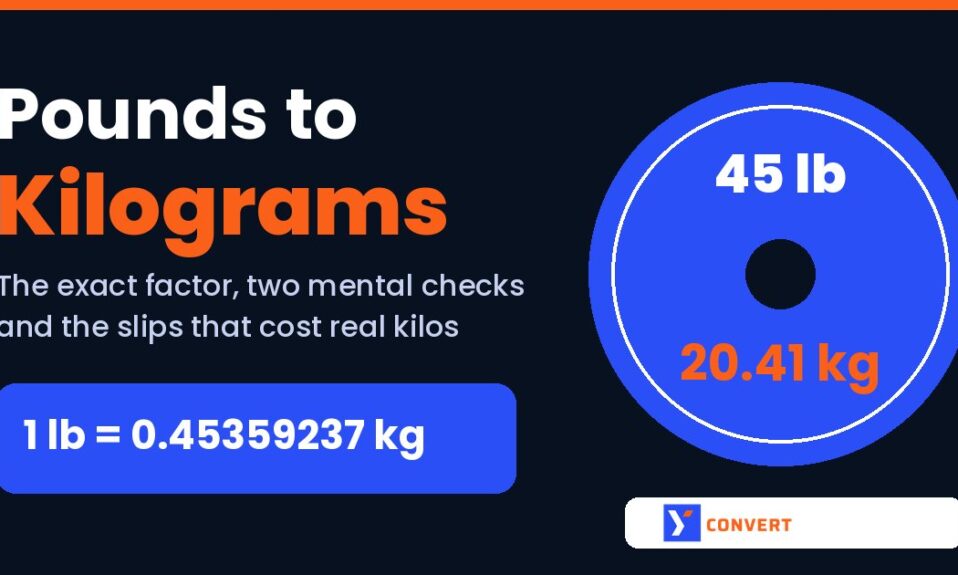
Short answer: to convert pounds to kilograms, multiply the pounds by 0.45359237. That number is exact, by definition, so 1 lb = 0.45359237 kg. In practice I use 0.4536, which means 50 lb × 0.4536 = 22.68 kg.
Dividing by 2.2 gets you close too. Slightly high, but close.
Most of the pounds to kilograms questions I deal with start with something written in American units: a recipe, a gym program, a luggage tag, a supplier’s spec sheet, a hospital bracelet with a birth weight on it. The person has the pounds. They need kilograms. And they want to know which shortcut they can trust and which one will quietly bite them later.
So this guide is built around that. The formula first, then the two mental shortcuts (and why they disagree), then the real situations where people get it wrong.
The pounds to kilograms formula
Since 1959, the international pound has been defined as exactly 0.45359237 kilograms. Not roughly. Exactly. Everything else is just rounding that number.
- kilograms = pounds × 0.45359237
- good enough for daily use: kilograms = pounds × 0.4536
- division version: kilograms = pounds ÷ 2.20462
All three give the same answer to two decimals for normal weights. I prefer multiplying. Division by 2.20462 is awkward on paper, and people who divide by 2.2 often forget they’ve rounded.
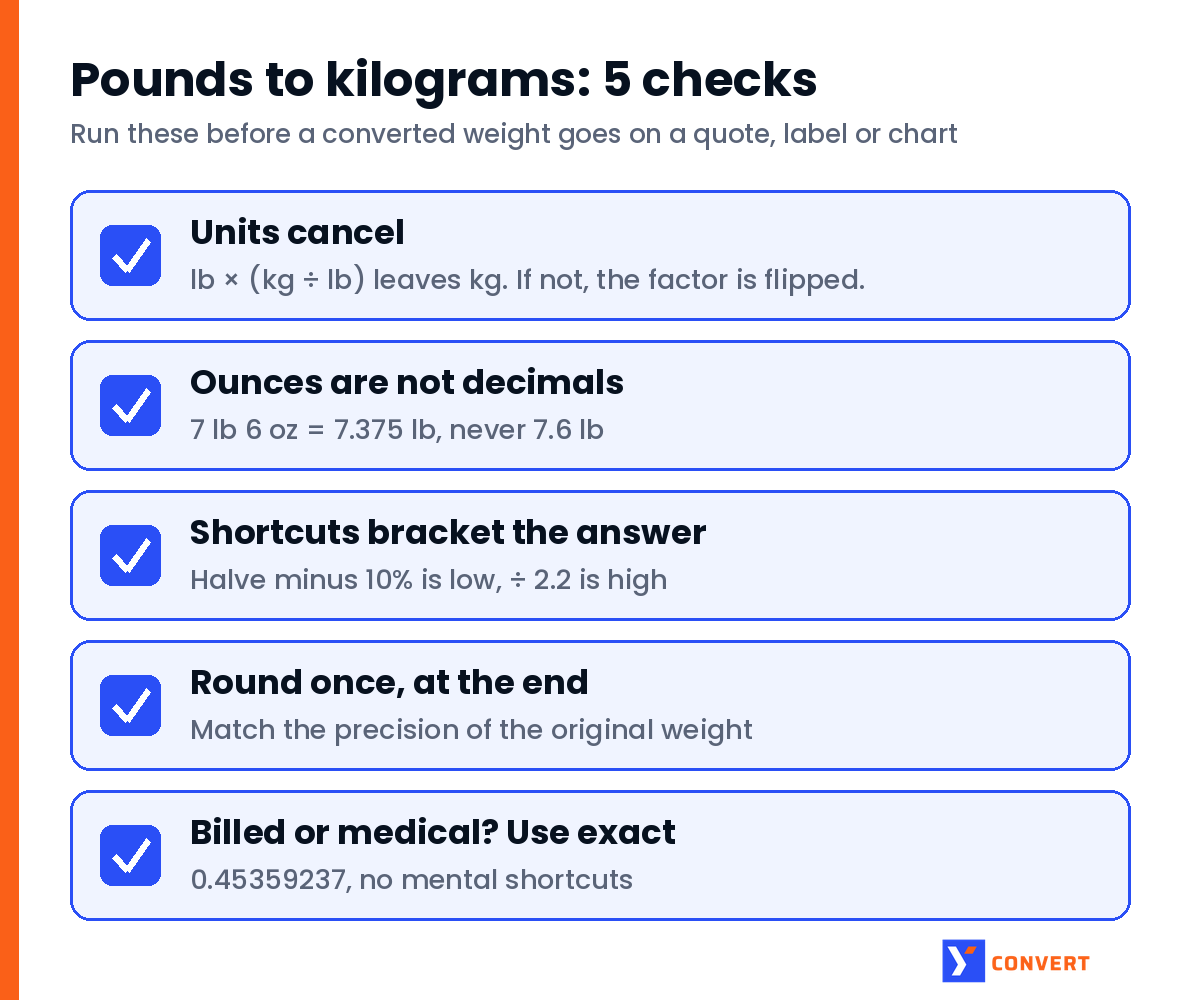
A trick that helps when you’re unsure which way to go: write the units out. 50 lb × (0.4536 kg / 1 lb). The “lb” on top and bottom cancel, and you’re left with kg. If the units don’t cancel, you’ve flipped the factor. Takes five seconds. Saves the classic mistake of multiplying when you should divide, which turns 50 lb into 110 “kg”.
Converting pounds to kilograms, step by step
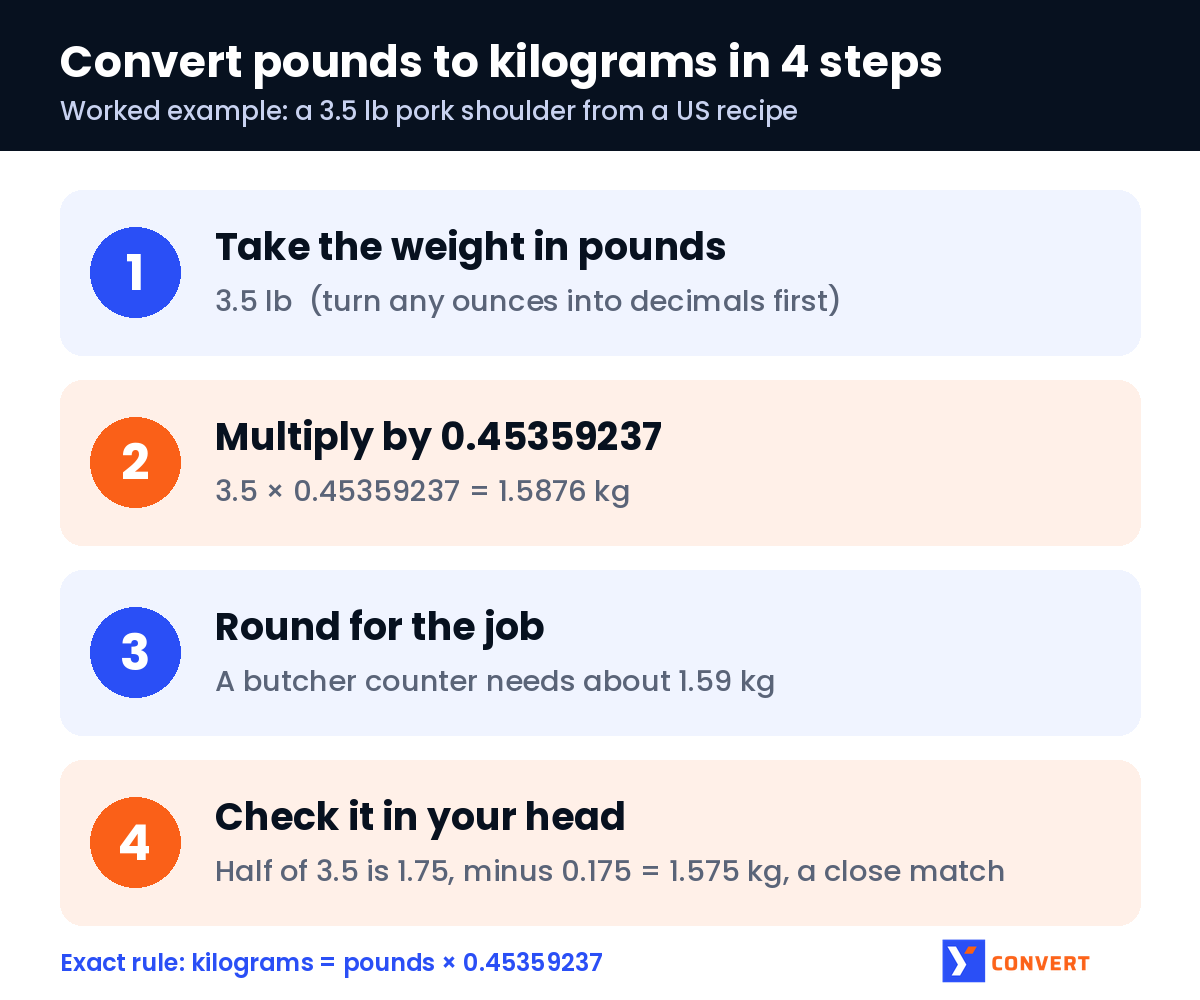
Here’s one from a kitchen. Say a restaurant is testing an American recipe that calls for a 3.5 lb pork shoulder, and the butcher sells by the kilo.
Step 1: Take the weight in pounds
3.5 lb. If the recipe gives pounds and ounces, turn the ounces into a decimal first (more on that below).
Step 2: Multiply by 0.45359237
3.5 × 0.45359237 = 1.5876 kg.
Step 3: Round for the job
For a butcher’s counter, 1.59 kg is plenty. Nobody is weighing meat to a tenth of a gram. Ask for 1.6 kg and trim if you must.
Step 4: Check it in your head
Halve 3.5 to get 1.75. Take off a tenth of that (0.175). You get 1.575, which sits right next to 1.588. No slipped decimal, no flipped factor.
Two mental shortcuts that miss in opposite directions
This is the bit I find most useful, and it’s rarely explained.
Shortcut A: divide by 2.2. Because 2.2 is a bit smaller than the real 2.20462, the answer comes out a touch high. About 0.2% high.
Shortcut B: halve it, then subtract 10%. This is the same as multiplying by 0.45, which is a bit smaller than 0.4536. So the answer comes out low. Roughly 0.8% low.
The real value sits between them. Every time.
| Pounds | Halve minus 10% (low) | Exact (× 0.45359237) | Divide by 2.2 (high) |
|---|---|---|---|
| 10 lb | 4.50 kg | 4.54 kg | 4.55 kg |
| 50 lb | 22.50 kg | 22.68 kg | 22.73 kg |
| 160 lb | 72.00 kg | 72.57 kg | 72.73 kg |
| 1,350 lb | 607.50 kg | 612.35 kg | 613.64 kg |
For a body weight or a bag of rice, either shortcut is fine. Look at the last row, though. A furniture importer reading a 1,350 lb pallet off a US supplier’s sheet would be almost 5 kg out with the mental trick. If the freight quote has a weight cap near that number, 5 kg matters. On anything that gets billed, use the exact factor and stop there.
Gym plates in pounds and kilograms
Gyms are where I see this conversion argued about most. Many gyms stock plates in pounds, many training plans are written in kilos, and the two systems don’t line up neatly.
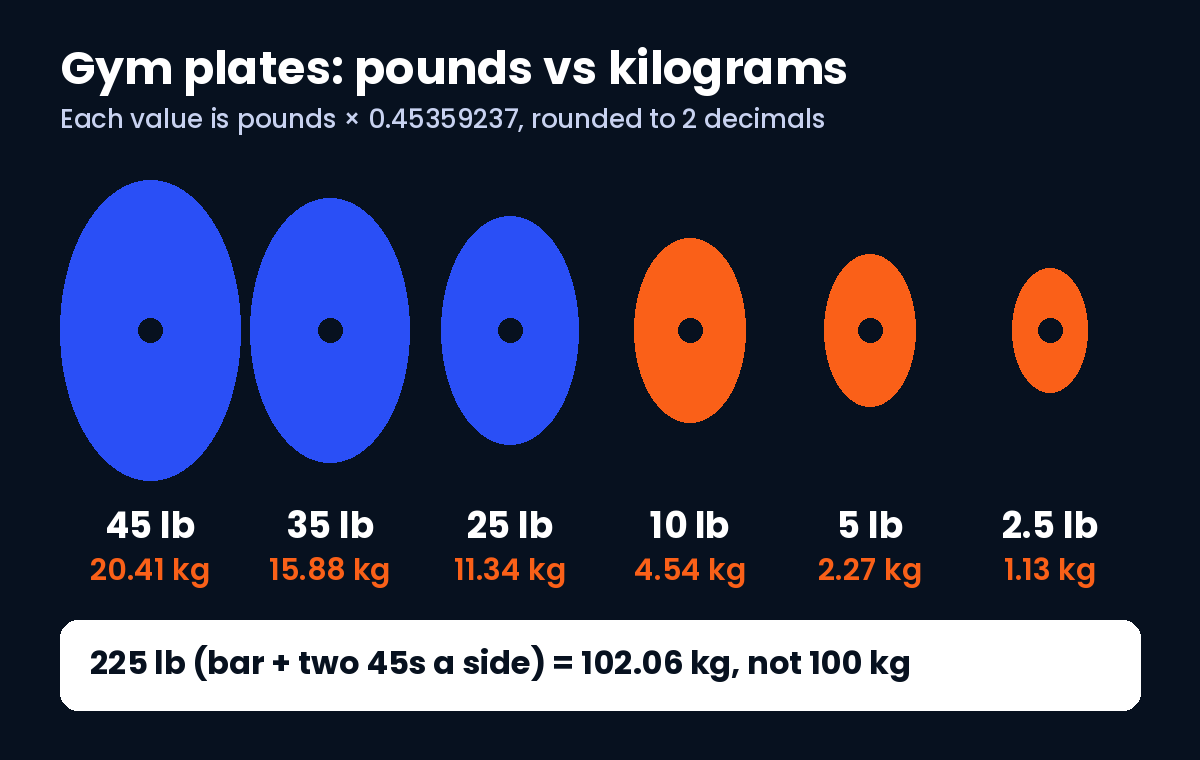
- A 45 lb plate is 20.41 kg. Close to a 20 kg plate, but not the same.
- A standard 45 lb barbell is also 20.41 kg, a little heavier than the 20 kg bar used in kilo gyms.
- The classic “two plates a side” squat, 225 lb, is 102.06 kg.
That gap adds up. Load four 45 lb plates and a 45 lb bar and you have 225 lb on the bar, which is about 2 kg more than the “100 kg” a lot of people assume it equals. Not a big deal for training. A real deal if you’re comparing a logbook against a competition total in kilos.
Pounds and ounces to kilograms
Birth weights are the example most people hit first. A maternity ward in the US will say a baby weighed 7 lb 6 oz. Relatives abroad want it in kilos.
- Turn the ounces into part of a pound: 6 ÷ 16 = 0.375. So 7 lb 6 oz is 7.375 lb.
- Multiply by 0.45359237: 7.375 × 0.45359237 = 3.345 kg.
- Round to what makes sense. 3.35 kg, or 3,345 g if the family likes grams.
The slip I keep seeing: someone types “7.6” into a calculator because the label says 7 lb 6 oz. Ounces aren’t tenths. 7.6 lb would be 3.447 kg, about 100 g too heavy. For a newborn, that’s a noticeable difference on a growth chart.
Checked bags flying out of the US
Bathroom scales in American homes read in pounds. Airline allowances on many international routes are quoted in kilograms. So you get questions like “my bag is 52 lb, am I over 23 kg?”
52 × 0.45359237 = 23.59 kg. Yes, over.
The usual 50 lb limit works out to 22.68 kg, and a 70 lb heavy-bag limit is 31.75 kg. My own rule when I’m packing: aim for a pound or two under the line on a home scale. Home scales and airport scales rarely agree to the ounce, and the airport one wins.
Pounds to kilograms chart
Every value below is pounds × 0.45359237, rounded to two decimals. I’ve checked each one rather than rounding the factor first.
| Pounds | Kilograms | Where it tends to show up |
|---|---|---|
| 1 lb | 0.45 kg | Pack of butter in a US recipe, block of cheese |
| 2 lb | 0.91 kg | Bag of coffee beans, small chicken |
| 5 lb | 2.27 kg | Bag of flour, small plate in a gym |
| 10 lb | 4.54 kg | Bag of potatoes, light dumbbell |
| 15 lb | 6.80 kg | Holiday turkey, toddler’s car seat |
| 20 lb | 9.07 kg | Bag of dog food, mid-weight kettlebell |
| 25 lb | 11.34 kg | Rice sack, bumper plate |
| 35 lb | 15.88 kg | Gym plate, large dog |
| 45 lb | 20.41 kg | Standard plate and barbell |
| 50 lb | 22.68 kg | Checked bag limit |
| 70 lb | 31.75 kg | Heavy bag allowance |
| 100 lb | 45.36 kg | Sack of feed, small adult |
| 150 lb | 68.04 kg | Adult body weight |
| 200 lb | 90.72 kg | Adult body weight |
| 225 lb | 102.06 kg | Two plates a side on a barbell |
How I round, and when I don’t
Round once, at the end. Never round the factor and then round the answer again.
How many decimals you keep depends on what you started with. If a scale says “about 25 lb”, reporting 11.33980925 kg is false precision. 11.3 kg says what you actually know. If the starting number is precise, say a lab balance or a certified freight scale, keep more digits and round only on the final document.
Anything involving medicine is different. Doses are often set per kilogram, and the conversion should come from a clinician’s own system using the exact factor, not a shortcut done in your head. I’d never use the halve-minus-10% trick there.
Pounds to kilograms in Excel or Google Sheets
- Pounds in A2:
=A2*0.45359237 - Built-in function:
=CONVERT(A2,"lbm","kg")(the unit code is “lbm”, pound mass) - Pounds in A2 and ounces in B2:
=(A2+B2/16)*0.45359237 - Rounded for display:
=ROUND(A2*0.45359237,2)
Keep the raw result in one column and the rounded one next to it. When a supplier questions a figure, you can show both.
Try the converter
For one-off numbers, the pounds to kilograms converter uses the exact factor and shows the working, so you can check it. It’s free and needs no sign-up. Going the other way? My kilograms to pounds guide covers that direction with its own examples. And if you’re converting a US product listing end to end, the inches to centimeters guide and the grams to ounces converter handle the rest.
FAQ
How many kilograms are in a pound?
Exactly 0.45359237 kg. For everyday use, 0.4536 kg or 0.45 kg is close enough.
What is the formula to convert pounds to kilograms?
Multiply the pounds by 0.45359237. For example, 150 lb × 0.45359237 = 68.04 kg. Dividing by 2.20462 gives the same result.
Is dividing pounds by 2.2 accurate?
It’s close but runs about 0.2% high. That’s fine for body weight or groceries. For freight, billing or anything medical, use the exact factor.
How do I convert pounds and ounces to kilograms?
Divide the ounces by 16, add that to the pounds, then multiply by 0.45359237. 7 lb 6 oz is 7.375 lb, which is 3.345 kg.
How much is a 45 lb plate in kilograms?
A 45 lb plate is 20.41 kg, slightly heavier than a 20 kg plate.
How many kilograms is 50 pounds?
50 pounds is 22.68 kg, which is why a 50 lb checked bag limit is a little under 23 kg.

1 Comment