Last updated: October 2026
Short answer: to convert inches to centimeters, multiply the inches by 2.54. So 10 in × 2.54 = 25.4 cm. If your measurement has a fraction, like 5 3/8 in, turn the fraction into a decimal first (5.375), then multiply: 5.375 × 2.54 = 13.6525 cm, or about 13.65 cm.
That’s it. One number to remember, and it’s exact. Where people trip up isn’t the formula. It’s fractions on a tape measure, screen sizes that are measured corner to corner, and spreadsheets that round halfway through a calculation.
Most of the inches to cm questions I deal with come from product pages and print jobs, not school homework. An online electronics store listing a TV, a print shop sizing a poster, a tailor reading an imported pattern. So that’s where the examples below come from. (If you’re going the other way, my centimeters to inches guide covers that.)
Why 2.54 exactly
Since 1959, one inch has been defined as exactly 2.54 centimeters. It isn’t a rounded figure someone measured once. It’s the definition. So there’s no long decimal tail you’re ignoring when you use it.
The rule:
- centimeters = inches × 2.54
- millimeters = inches × 25.4
I keep the millimeter version handy too, because hardware and engineering drawings almost always want mm.
How to convert inches to centimeters, step by step
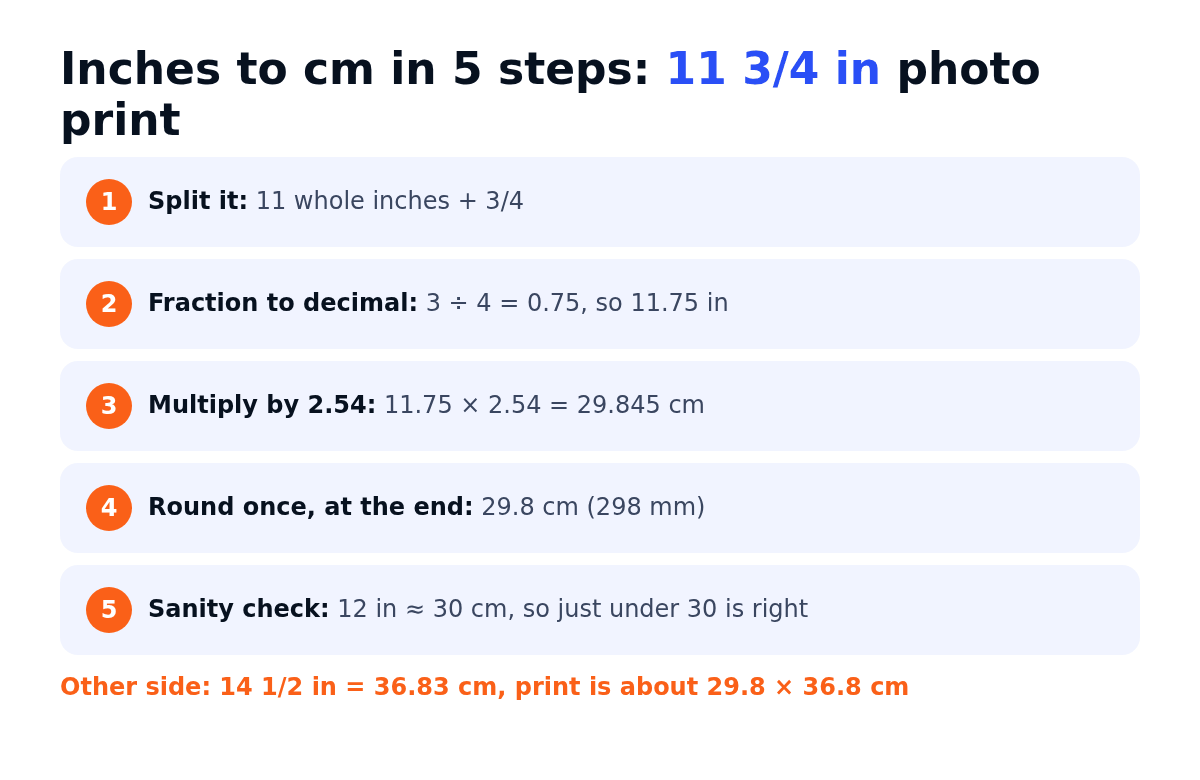
Say a print shop gets an order for a framed photo at 11 3/4 in by 14 1/2 in, and the frame supplier only quotes in centimeters. Here’s how I’d handle the first side.
Step 1: Read the whole number and the fraction separately
11 3/4. Whole part is 11, fraction is 3/4. Write both down.
Step 2: Turn the fraction into a decimal
3 ÷ 4 = 0.75. So the measurement is 11.75 in.
Step 3: Multiply by 2.54
11.75 × 2.54 = 29.845 cm.
Step 4: Round once, at the end
For a frame order I’d write 29.8 cm, or 298 mm if the supplier works in millimeters. Round the final number only. Rounding 2.54 to 2.5 “to make it easier” throws you off by more than a centimeter on a 30 cm side, which is enough for a photo to fall out of a mat.
Step 5: Sanity check
2.5 times 12 is 30. 11.75 is just under 12, so just under 30 cm makes sense. Good.
The other side, 14 1/2 in, is 14.5 × 2.54 = 36.83 cm. So the print is about 29.8 × 36.8 cm.
Tape measure fractions, converted
This is the part people actually get stuck on. A US tape measure is marked in halves, quarters, eighths and sixteenths, and the little lines don’t map neatly onto anything metric.
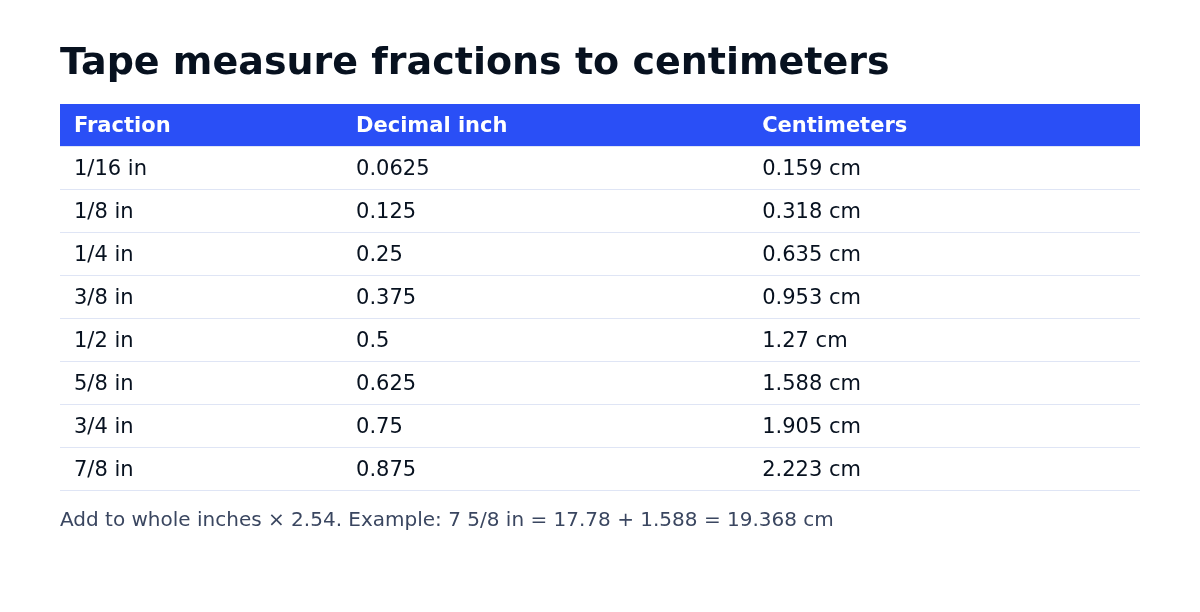
Here’s the cheat sheet I use for the fraction part only. Add it to the whole inches converted separately.
| Fraction | Decimal inch | Centimeters |
|---|---|---|
| 1/16 in | 0.0625 | 0.159 cm |
| 1/8 in | 0.125 | 0.318 cm |
| 1/4 in | 0.25 | 0.635 cm |
| 3/8 in | 0.375 | 0.953 cm |
| 1/2 in | 0.5 | 1.27 cm |
| 5/8 in | 0.625 | 1.588 cm |
| 3/4 in | 0.75 | 1.905 cm |
| 7/8 in | 0.875 | 2.223 cm |
So 7 5/8 in is 17.78 + 1.588 = 19.368 cm. Or just do 7.625 × 2.54 and get the same thing. Honestly the second way is faster once you’re used to it.
Screen sizes are diagonal, and that confuses everyone
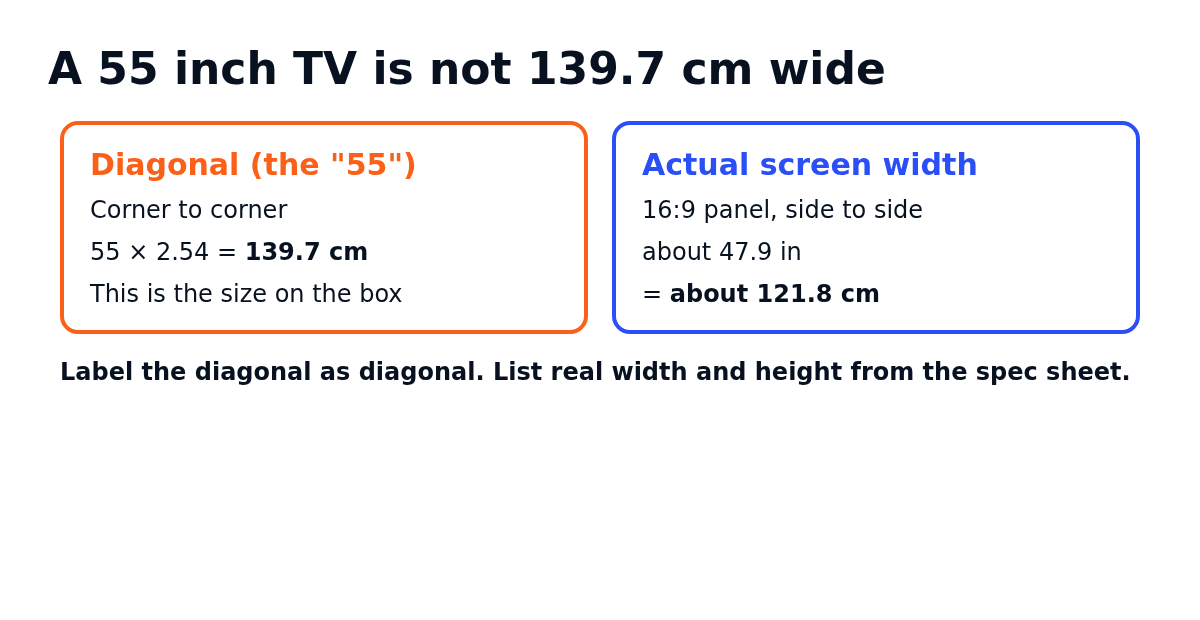
A “55 inch TV” is 55 inches measured corner to corner across the screen. Converted, that’s 55 × 2.54 = 139.7 cm. It is not the width.
I’ve seen an electronics store category page list a 55 in TV as “139.7 cm wide” in the specs table. A customer measured their wall unit, it was 130 cm across, and they assumed it wouldn’t fit. On a standard widescreen panel, the actual screen width is closer to 121.8 cm. The diagonal conversion was correct. The label was wrong.
If you sell screens, monitors or tablets, convert the diagonal and say it’s the diagonal. Then list the real width and height from the manufacturer’s sheet separately.
Inches to cm values I get asked about most
| Inches | Centimeters | Where I usually see it |
|---|---|---|
| 1 in | 2.54 cm | Button, pipe fitting |
| 4 in | 10.16 cm | Phone width, photo print |
| 6 in | 15.24 cm | Ruler, sub sandwich, shoe insole |
| 8 in | 20.32 cm | Cake tin, photo print |
| 10 in | 25.4 cm | Tablet screen, frying pan |
| 12 in | 30.48 cm | Ruler, pizza, vinyl record |
| 24 in | 60.96 cm | Monitor diagonal, suitcase |
| 27 in | 68.58 cm | Monitor diagonal |
| 32 in | 81.28 cm | Trouser inseam, TV |
| 36 in | 91.44 cm | Fabric yard, door width |
| 55 in | 139.7 cm | TV diagonal |
| 65 in | 165.1 cm | TV diagonal |
Where inches to cm goes wrong in real work
- Tailoring and clothing patterns. A 32 in waist is 81.28 cm. Fine. But seam allowances are often given as 5/8 in, and that’s 1.59 cm, not “1.5 cm”. Across four seams, the shortcut takes away more than a centimeter of ease.
- Baking tins. A recipe asks for a 9 in round tin. That’s 22.86 cm, and most metric tins are sold as 22 or 23 cm. The 23 cm one is the right swap. A 20 cm tin changes the bake time.
- Plumbing and hardware. Pipe sizes in inches are often nominal, not the actual outside diameter. A “1/2 inch” pipe doesn’t measure 1.27 cm across. Convert the number on the spec sheet, not the name of the part.
- Document settings. Word processors and design apps default to inches in some regions. If a print shop asks for margins in centimeters, change the measurement unit in the app’s settings instead of converting every field by hand.
Inches to cm in Excel or Google Sheets
For a column of product dimensions:
- Decimal inches in A2:
=A2*2.54 - Built-in function:
=CONVERT(A2,"in","cm") - Feet in A2, inches in B2:
=(A2*12+B2)*2.54
Keep the raw result in one column and round in the next with =ROUND(B2,1). When a supplier asks why your total is 3 mm off, you’ll want the unrounded figure.
Use the converter for single numbers
For a quick one, the inches to centimeters converter does the multiplication and shows the formula with the answer. Free, no sign-up.
If your measurement is in feet and inches, my feet to centimeters guide walks through that, and the centimeters to feet guide handles the reverse for heights and room sizes.
FAQ
How many centimeters are in an inch?
Exactly 2.54. The inch has been defined as 2.54 cm since 1959, so the value doesn’t need rounding.
What is the formula to convert inches to cm?
Multiply the inches by 2.54. For example, 8 in × 2.54 = 20.32 cm.
How do I convert fractions of an inch to centimeters?
Divide the top of the fraction by the bottom to get a decimal, add it to the whole inches, then multiply by 2.54. 3 3/8 in is 3.375 in, which is 8.5725 cm.
Is a 55 inch TV 55 inches wide?
No. TV and monitor sizes are measured diagonally. 55 in is 139.7 cm corner to corner, while the screen width on a widescreen TV is about 121.8 cm.
How do I convert inches to millimeters?
Multiply by 25.4. So 2 in is 50.8 mm. It’s the same conversion as centimeters, with the decimal moved one place.