Last updated: October 2026
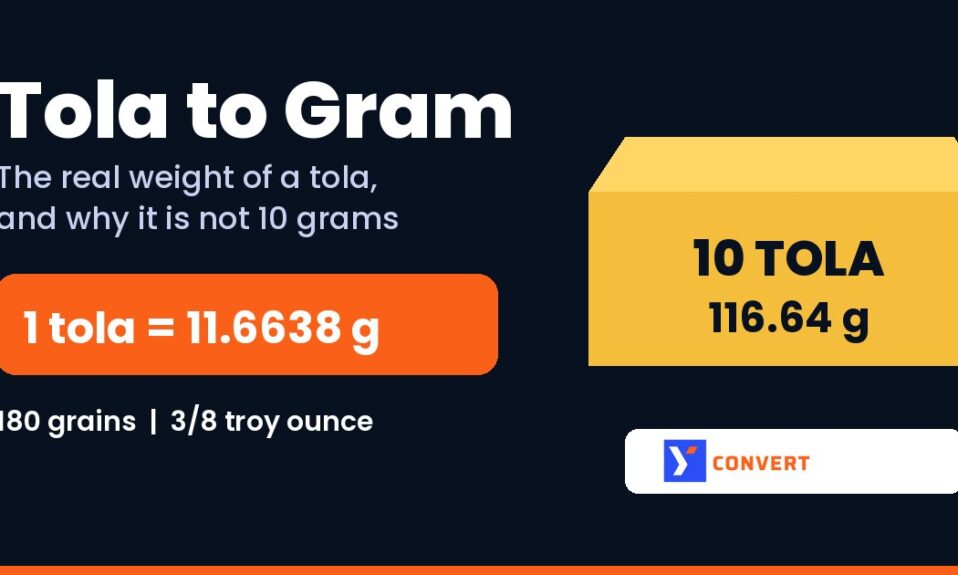
Short answer: 1 tola = 11.6638038 grams. To convert tola to gram, multiply the number of tolas by 11.6638. So 2 tolas is 23.33 g, 5 tolas is 58.32 g and 10 tolas is 116.64 g.
That’s the standard tola. Not 10 grams. Not 12.
I get asked about this one more than almost any other old unit, and the question is rarely academic. Somebody is standing in a jewellery shop, or reading a grandmother’s bill from decades ago, or following a recipe from an old book, and the number is in tolas. Everything else in their life is in grams. They need the conversion, and they need to know whether the person across the counter means the same tola they do.
So this guide covers the exact figure, a quick way to do it in your head, a tola to gram chart, and the places where the word “tola” gets used loosely.
Where 11.6638 grams comes from
The tola was standardised in British India as 180 grains troy. That was also the weight of the silver rupee coin of the time, which is why the tola and the rupee were tied together for so long.
A grain is defined as exactly 64.79891 milligrams. Multiply that by 180 and you get 11,663.8038 mg, or 11.6638038 g. Another way to see it: a tola is three eighths of a troy ounce. A troy ounce is 31.1034768 g, and 0.375 of that is the same 11.6638038 g. Two routes, one number. That’s how I know it’s right.
India moved to metric weights from the late 1950s, so officially the tola is history. Unofficially? Very much alive, especially around gold, silver and traditional medicine.
The tola to gram formula
- grams = tolas × 11.6638038
- good enough for a shop counter: grams = tolas × 11.664
- going the other way: tolas = grams ÷ 11.6638
For most jobs I use 11.664. It agrees with the full number to two decimal places up to about 20 tolas. Beyond that, if money is involved, I keep every digit and round only at the end.
A mental shortcut I actually use
Take the tolas, multiply by 12, then knock off a tiny bit. Twelve is easy. 3 tolas × 12 = 36, and the true answer is 34.99 g, so you’re about 1 g high for every 3 tolas. Roughly, subtract a third of a gram per tola. It gets you close enough to spot a bill that’s badly wrong, which is mostly what a mental check is for.
Converting tola to gram, step by step
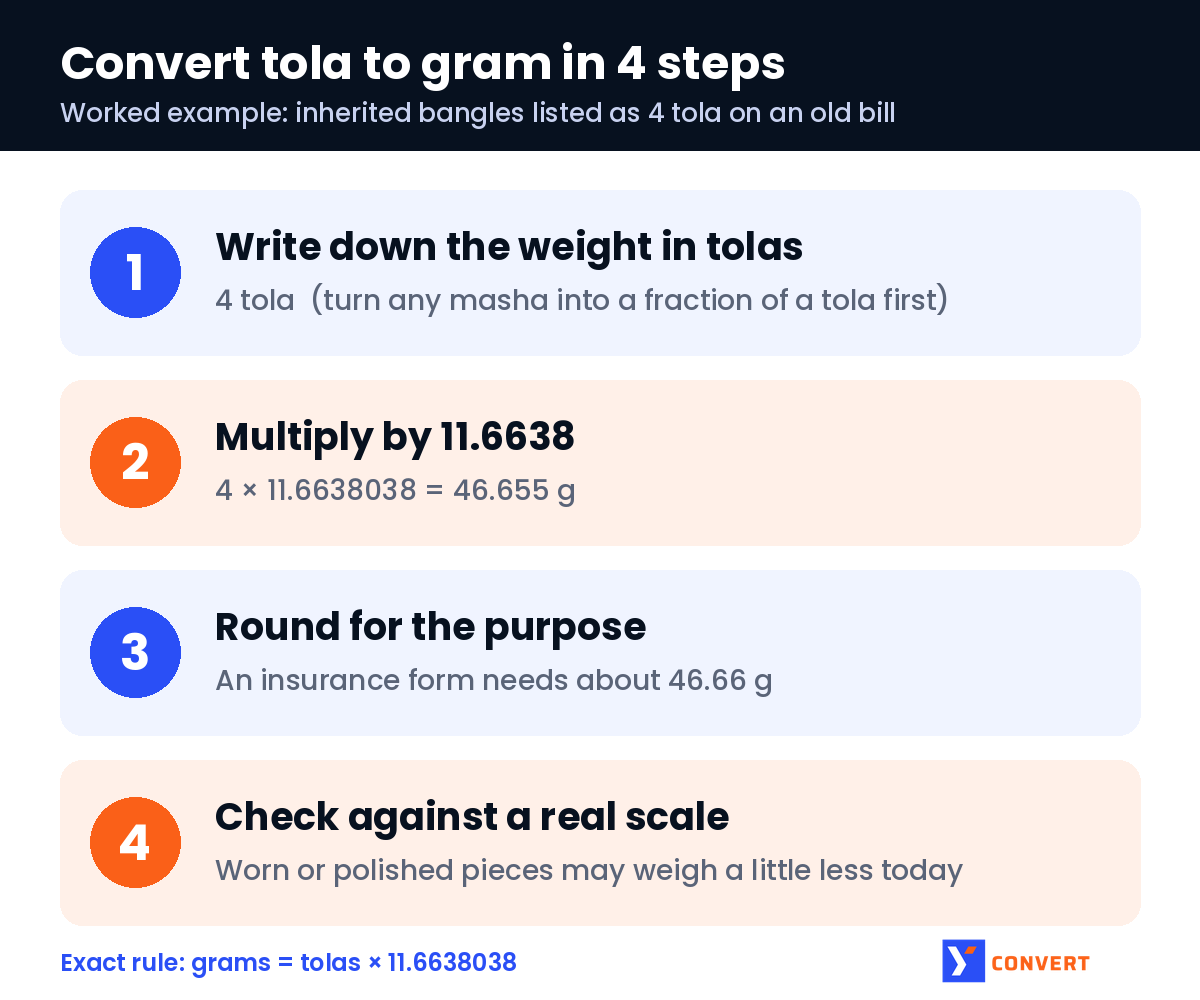
Here’s a situation I like because it has an old document in it. Say a home insurer asks a family to list an inherited set of gold bangles by weight in grams. The only paperwork is an old jeweller’s bill that says “4 tola”.
Step 1: Write down the weight in tolas
4 tola. If the bill also lists masha or ratti (smaller old units), convert those to a fraction of a tola first. I cover that further down.
Step 2: Multiply by 11.6638
4 × 11.6638038 = 46.655 g.
Step 3: Round for the purpose
An insurance form usually wants two decimals at most. 46.66 g.
Step 4: Check against a real scale
This is the step people skip. A bill is a record of what something weighed when it was sold, not what it weighs now. Bangles get worn, polished and repaired. If a jeweller’s scale today reads a little under 46.66 g, that’s normal. If it reads 40 g, something else is going on, and that’s worth knowing before the insurer finds out.
The “10 gram tola” and why people mix them up
You’ll hear people in parts of India say “one tola” and mean 10 grams. I want to be careful here, because this isn’t a rule anyone wrote down. It’s a habit.
Gold rates in India are very commonly displayed per 10 grams. Over time, “the rate for a tola” and “the rate for 10 grams” started to blur in casual speech. The actual billing, weighing and tax are done in grams, so on paper nothing changes. The confusion happens in conversation and in people’s heads.
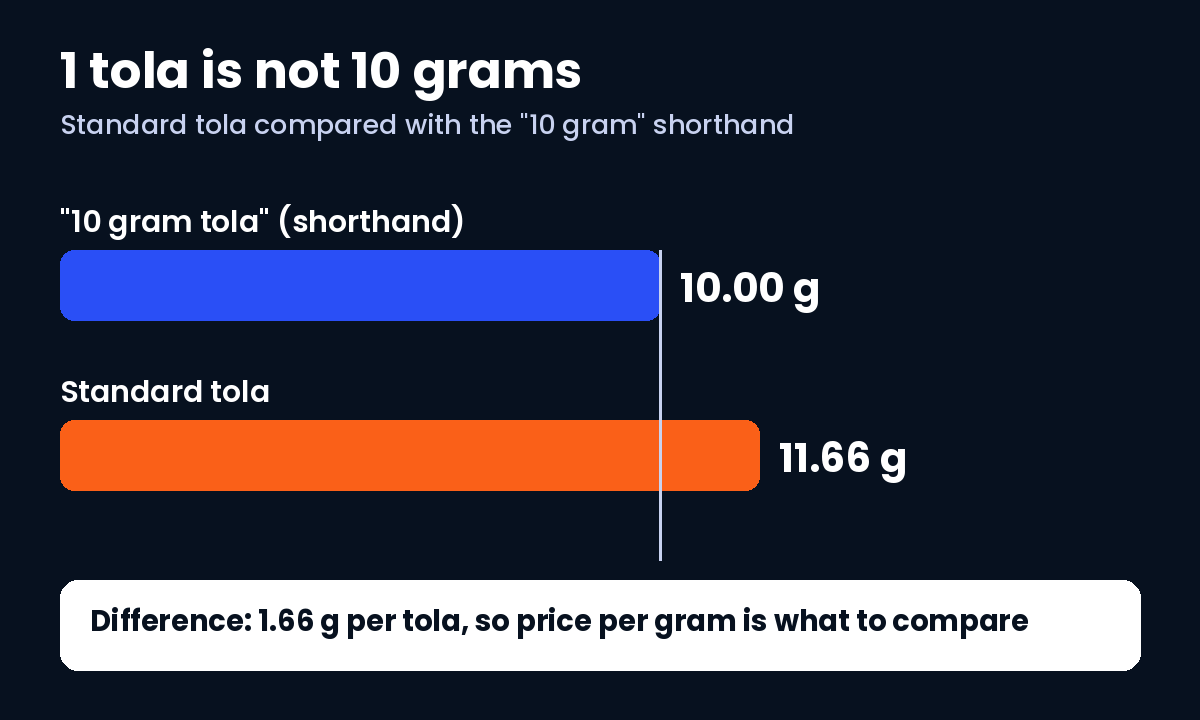
And it’s not a small gap. A standard tola is 1.66 g heavier than 10 g. Put differently, if you assume a tola is 10 g, you’re underestimating the real weight by roughly a seventh.
Some markets outside India use a local tola that doesn’t match the 11.66 g figure either. I’ve seen that come up with gold buyers in different cities. My advice doesn’t change: ask the shop what gram value they use for a tola, and do your own maths in grams. Grams are the one unit nobody argues about.
A gift budget, done properly
Say you want to give a 1 tola gold coin at a wedding, and the rate board shows a price per 10 g. To keep the maths easy I’ll use a round ₹1,00,000 per 10 g. That’s an illustration, not a live rate.
- Price per gram: ₹1,00,000 ÷ 10 = ₹10,000.
- Weight of the coin: 11.6638 g.
- Metal value: 11.6638 × ₹10,000 = ₹1,16,638.
Notice the coin costs about 16.6% more than “one 10 g rate”. That’s the whole tola difference showing up in a budget. Then add GST and any making charge on top, because the board rate never includes those.
One more thing, and it trips people up constantly. Tola measures weight. Karat measures purity. A 1 tola coin in 24 karat and a 1 tola piece of 22 karat jewellery weigh the same, but they don’t contain the same amount of gold, and they shouldn’t cost the same per gram. Keep the two questions separate: how heavy, and how pure.
Bullion: the 10 tola bar
In gold bullion trading across the Gulf and South Asia, the 10 tola bar is a well-known size. Ten tolas is 116.64 g. If you’re comparing it with a 100 g bar, the 10 tola bar holds about 16.64 g more metal, so a price that looks “high” may simply be for a heavier bar. Compare price per gram, every time.
Old units: masha and ratti
Traditional weights were built as a chain: 1 tola = 12 masha, and 1 masha = 8 ratti. That makes 96 ratti in a tola. Using the British India tola:
- 1 masha = 11.6638 ÷ 12 = 0.972 g
- 1 ratti = 11.6638 ÷ 96 = 0.1215 g
So a bill that says “2 tola 6 masha” is 2.5 tola, which is 29.16 g.
A caution. The ratti started out as a seed weight, and seeds aren’t identical. In gemstone selling, especially for astrology stones, the “ratti” quoted by a shop is often a market convention with its own gram value. Don’t apply the figure above to a gemstone price without asking.
Spices and old ledgers
Saffron is the classic example on the trade side. It’s expensive enough that small weights matter, and some older wholesale ledgers and family shops kept it in tolas. Say a spice wholesaler is digitising a ledger that lists 5 tola of saffron. That’s 58.32 g. If the new system stores stock in grams, convert each line once using the full factor, then round. Rounding 11.66 to 12 across hundreds of ledger lines would inflate stock by a few percent. Small per line. Not small in total.
Ayurvedic and traditional recipes
This is where I’d slow down the most. Many classical recipes are written in tola, masha and ratti, and modern references don’t always convert them the same way. A lot of present-day Ayurvedic references round the tola to about 12 g and the masha to about 1 g, because round numbers are easier to measure in a pharmacy.
That means “2 tola” could be read as 23.33 g using the British India standard, or 24 g using the rounded convention. For cooking, that difference rarely matters. For anything taken as medicine, follow the gram quantity your practitioner or the specific formulary gives you, and don’t convert it yourself.
Tola to gram chart
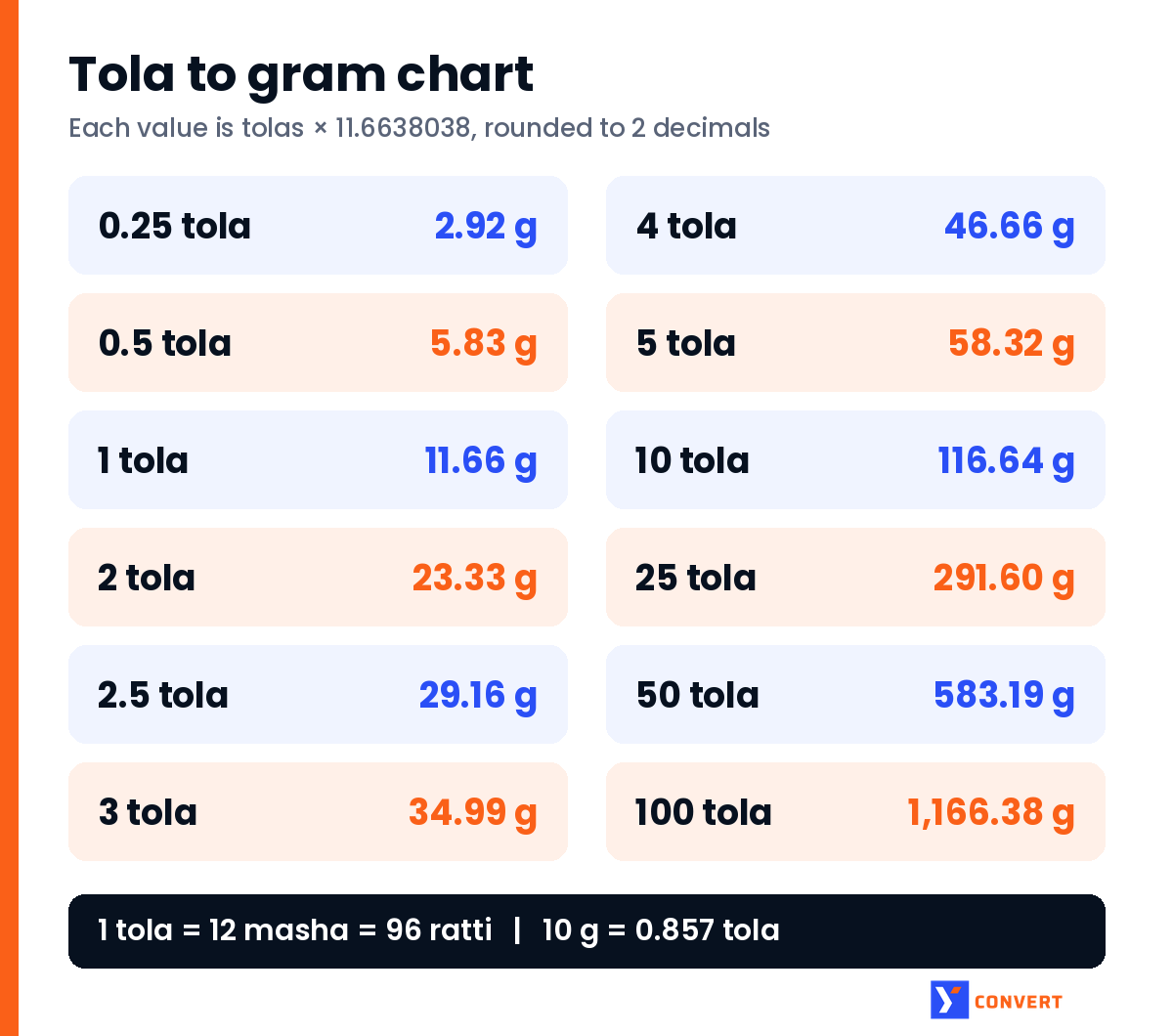
Every value below is tolas × 11.6638038, rounded to two decimals.
| Tola | Grams | Where you might see it |
|---|---|---|
| 0.25 tola | 2.92 g | Small earrings, nose pin |
| 0.5 tola | 5.83 g | Light chain, small pendant |
| 0.75 tola | 8.75 g | Ring set |
| 1 tola | 11.66 g | Gift coin |
| 1.5 tola | 17.50 g | Pair of light bangles |
| 2 tola | 23.33 g | Old recipe quantity |
| 2.5 tola | 29.16 g | Necklace on an old bill |
| 3 tola | 34.99 g | Bangle set |
| 4 tola | 46.66 g | Inherited bangles |
| 5 tola | 58.32 g | Saffron in an old ledger |
| 10 tola | 116.64 g | Bullion bar |
| 20 tola | 233.28 g | Two bullion bars |
| 25 tola | 291.60 g | Silver puja plate |
| 50 tola | 583.19 g | Silver serving set |
| 100 tola | 1,166.38 g | Large silver item |
And the reverse, for when you’re holding grams: 10 g is 0.857 tola, 50 g is 4.287 tola, and 100 g is 8.574 tola.
Tola to gram in Excel or Google Sheets
- Tolas in A2:
=A2*11.6638038 - Rounded:
=ROUND(A2*11.6638038,2) - Tola and masha in A2 and B2:
=(A2+B2/12)*11.6638038 - Grams back to tolas:
=A2/11.6638038
I keep the factor in its own cell and point every formula at it. If a client works with a different local tola, I change one cell, not two hundred rows.
Try the converter
For quick checks, the tola to gram converter uses the standard 11.6638 g tola and shows the result instantly. It’s free and needs no sign-up. If you also deal in imported goods, the grams to ounces converter helps, and my guides to pounds to kilograms and kilograms to pounds cover the other weight questions I see most.
FAQ
How many grams are in 1 tola?
1 tola is 11.6638038 grams, usually rounded to 11.66 g. This is the standard tola of 180 grains defined in British India.
Is 1 tola equal to 10 grams?
No. A standard tola is about 11.66 g. Some people say “tola” when they mean 10 grams because gold rates are often shown per 10 g, but that’s casual usage, not the actual weight.
How do I convert tola to gram?
Multiply the number of tolas by 11.6638. For example, 3 tolas × 11.6638 = 34.99 g.
How many tolas are in 10 grams?
10 grams is 0.857 tola. Divide the grams by 11.6638 to get tolas.
How many grams is 10 tola gold?
10 tola is 116.64 grams. That’s the weight of the well-known 10 tola gold bar.
How many masha are in a tola?
There are 12 masha in a tola, and 8 ratti in a masha. Using the standard tola, one masha is about 0.972 g.