Last updated: November 2026
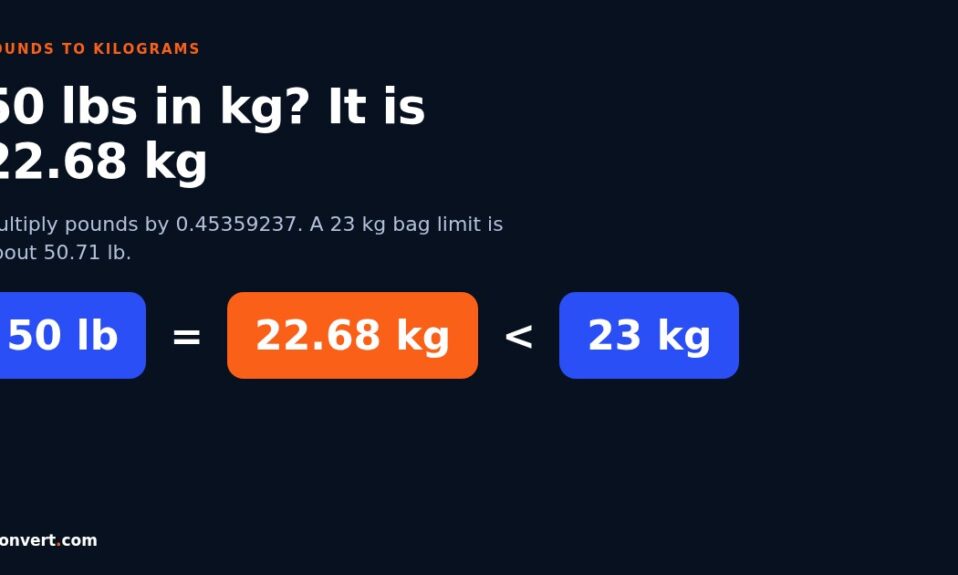
50 lbs is 22.68 kg. To turn any pound figure into kilograms, multiply it by 0.45359237. That number isn’t a rounded estimate. Since 1959 the international pound has been defined as exactly 0.45359237 kg, so the answer you get from it is as precise as your scale.
Most people searching for 50 lbs in kg aren’t doing homework. They’re standing next to a suitcase, a sack of flour, a box they need to ship or a dumbbell rack, and they need to know if a number printed in one system fits a rule written in the other. That’s what this page is about.
If you want the full method with spreadsheet formulas and both mental shortcuts explained, my main guide on how to convert pounds to kilograms covers it step by step. Here I’m sticking to the everyday questions.
What is 50 lbs in kg, worked out
Here’s the sum, so you can check it on your phone.
50 × 0.45359237 = 22.6796 kg.
Round that to 22.68 kg for anything official, or 22.7 kg for everyday use. If you only have a basic calculator and can’t remember the long factor, dividing by 2.2 gets you close: 50 ÷ 2.2 = 22.73 kg. A little high, but only by about 50 grams.
Or skip the math. The pound to kg converter uses the exact factor and shows the decimals, which matters more than you’d think when you’re right on a limit.
Is a 50 lb suitcase under 23 kg?
Yes, just. 23 kg works out to about 50.71 lb, so a bag that weighs exactly 50 lb sits roughly 320 grams under a 23 kg line.
That’s why you’ll often see the two numbers treated as the same thing. Many airlines publish a checked-bag limit of around 23 kg, and carriers that work in pounds tend to round it to 50 lb. They aren’t identical, though, and the rules belong to each airline, so check yours on the booking page before you pack rather than trusting a number you remember from a past trip.
Two things trip people up here.
- Home luggage scales round. A cheap handheld scale may show 50.0 lb when the bag is a little over. If you’re within a pound of the limit, assume you’re over.
- Airport scales are the ones that count. Your bathroom scale and the check-in counter can disagree by a few hundred grams, which is exactly the margin you were relying on.
A family flying back from a wedding with gifts is the classic case. Pack to about 48 lb (21.8 kg) and you’ve got room for the scale disagreement and the one extra box of sweets someone hands you at the door.
Common pound values in kilograms
These are the weights I see asked about most, worked out with the exact factor.
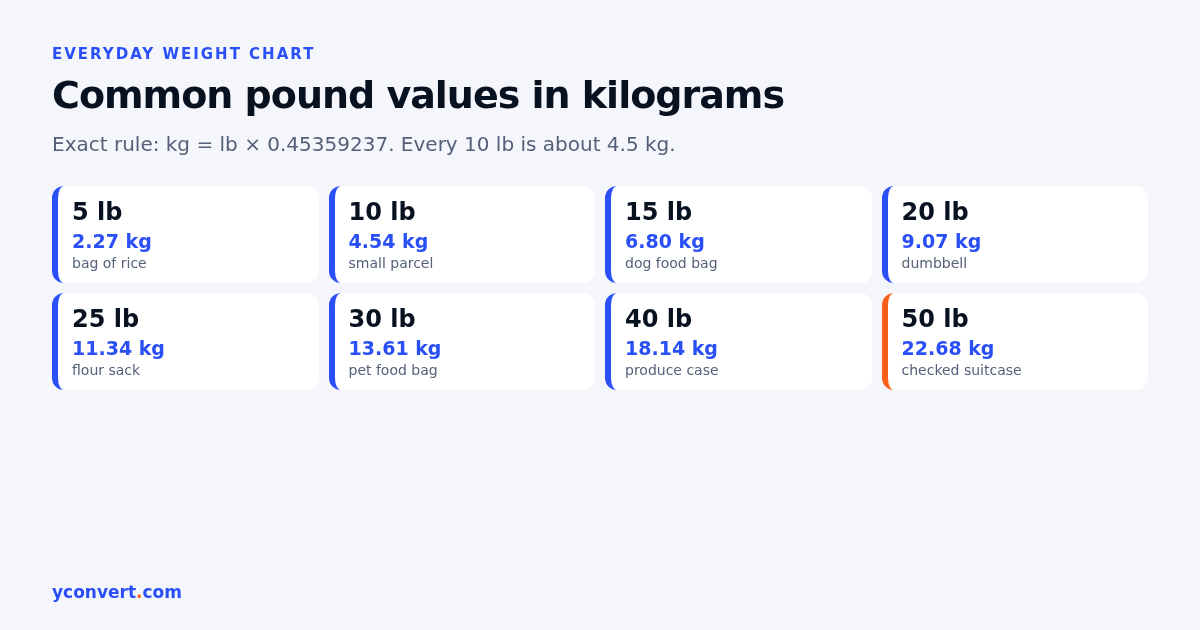
| Pounds | Kilograms (exact factor) | Where you’ll see it |
|---|---|---|
| 5 lb | 2.27 kg | bag of sugar or rice, small dumbbell |
| 10 lb | 4.54 kg | small parcel, cat litter |
| 15 lb | 6.80 kg | medium dog food bag |
| 20 lb | 9.07 kg | dumbbell, propane cylinder label |
| 25 lb | 11.34 kg | flour or rice sack, dumbbell |
| 30 lb | 13.61 kg | large pet food bag |
| 40 lb | 18.14 kg | produce case, carry bag of soil |
| 50 lb | 22.68 kg | checked suitcase, bulk sack |
| 70 lb | 31.75 kg | heavy shipped box |
| 100 lb | 45.36 kg | bulk feed or cement bags |
A quick pattern for checking your own sums: every 10 lb is about 4.5 kg. If 30 lb comes out as 15 kg, you divided by 2 and forgot the rest.
Are dumbbells marked in lbs the same as kg ones?
No, and the gap grows as the weights get heavier.
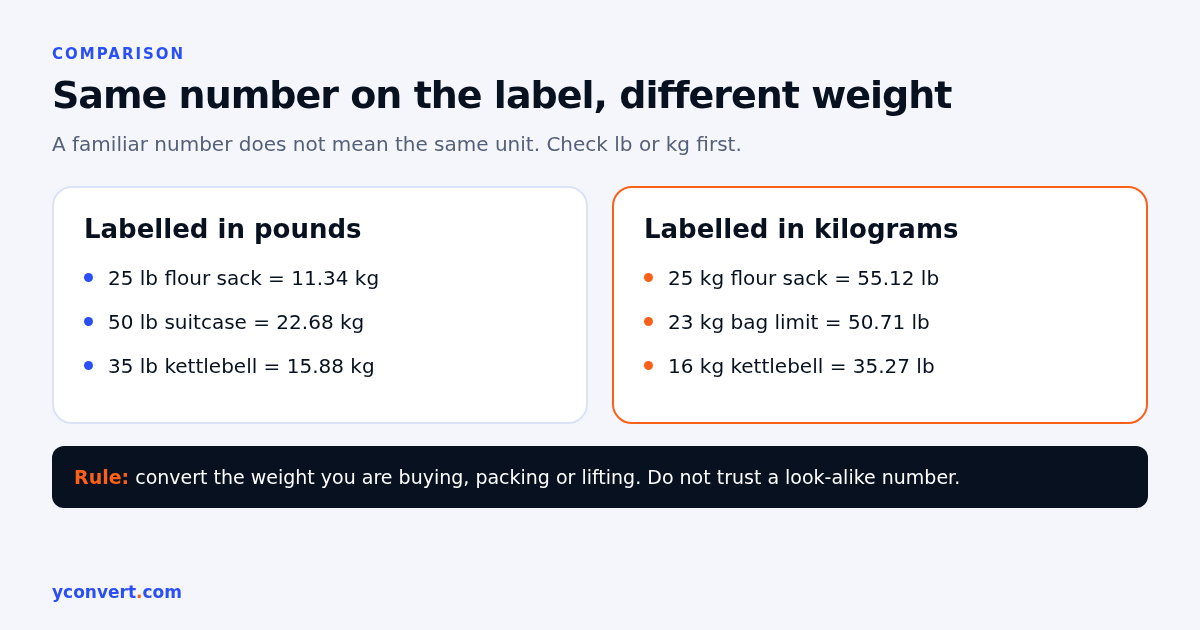
A 25 lb dumbbell is 11.34 kg. The nearest metric dumbbell on most racks is 12 kg (about 26.5 lb) or 10 kg (about 22 lb). So if a training plan written in pounds says “25s for bench” and your gym only has kilogram dumbbells, you’re choosing between a little lighter and a little heavier. Neither is wrong. Just pick one and stay with it for the whole block so your progress actually means something.
Kettlebells have the same quirk. A 35 lb bell is 15.88 kg, while a standard 16 kg bell is about 35.27 lb. Close enough to swap. Not close enough to call identical on a sales listing.
One thing I noticed while reading up on home gym gear: printed weights on plates and bells are nominal. Cheaper equipment can be off from the label by a noticeable amount, and two plates that look the same don’t always weigh the same. If exact numbers matter to you, weigh the item yourself and convert that reading, not the stamp.
If you’re going the other way, from a kilogram rack back to a pound plan, the kg to pound converter is quicker than doing it in your head between sets.
How do I convert a parcel weight for shipping?
Convert the weight from a scale reading, then think about rounding before you fill in the label.
Say a small online candle shop weighs a box at 3 lb 4 oz. First turn the ounces into pounds: 4 ÷ 16 = 0.25, so it’s 3.25 lb. Then multiply: 3.25 × 0.45359237 = 1.47 kg.
Here’s the part sellers miss. Couriers usually don’t charge for the exact figure. Many round any fraction up to the next step, and a lot of them also work out a size-based weight from the box dimensions and bill whichever is bigger. So a light but bulky parcel, like a pillow or a lampshade, can cost more than its weight suggests. Check your courier’s rules for both the rounding step and the size formula.
My advice for anyone shipping regularly:
- Weigh the packed box, not the product alone. Tape, filler and the carton itself add up.
- Convert once, using the exact factor.
- Round up to the courier’s step, never down.
- Compare with the size-based weight if your box is large for what’s inside.
Getting this wrong in your favour usually means a surcharge later. Getting it wrong the other way just means you overpaid a little.
What is a pound and ounces in kg?
Food labels, baby weights in some countries and small parcels often use pounds and ounces together. There are 16 ounces in a pound, and one ounce is 28.35 grams.
So:
- 8 oz is 226.8 g, half a pound
- 12 oz is 340.2 g, a common coffee or snack pack size
- 1 lb 8 oz is 1.5 lb, or 0.68 kg
A bakery switching a recipe from cups and pounds to a metric scale is where this shows up most. If a bulk recipe calls for 25 lb of flour, that’s 11.34 kg. But a mill that sells in metric will usually offer a 25 kg sack, which is about 55.1 lb. Same number on the bag, very different amount inside. I’ve seen people order the wrong size because the “25” looked familiar.
How much is a 30 lb bag of dog food in kg?
13.61 kg. A 15 lb bag is 6.80 kg, and a 40 lb bag is 18.14 kg.
This matters for two reasons. First, comparing prices. A pet store might stock one brand in pounds and an imported one in kilograms, and the only fair comparison is price per kilogram (or per pound) after converting. Second, feeding guides. If the bag tells you to feed by body weight in pounds but your vet weighed the dog in kilograms, convert the dog’s weight once and keep using that figure.
Can I just divide by 2?
You can, if you then take off another 10 percent.
Halving gives you a number that’s too high, because a kilogram is about 2.2 pounds, not 2. Knock off a tenth of the result and you land close:
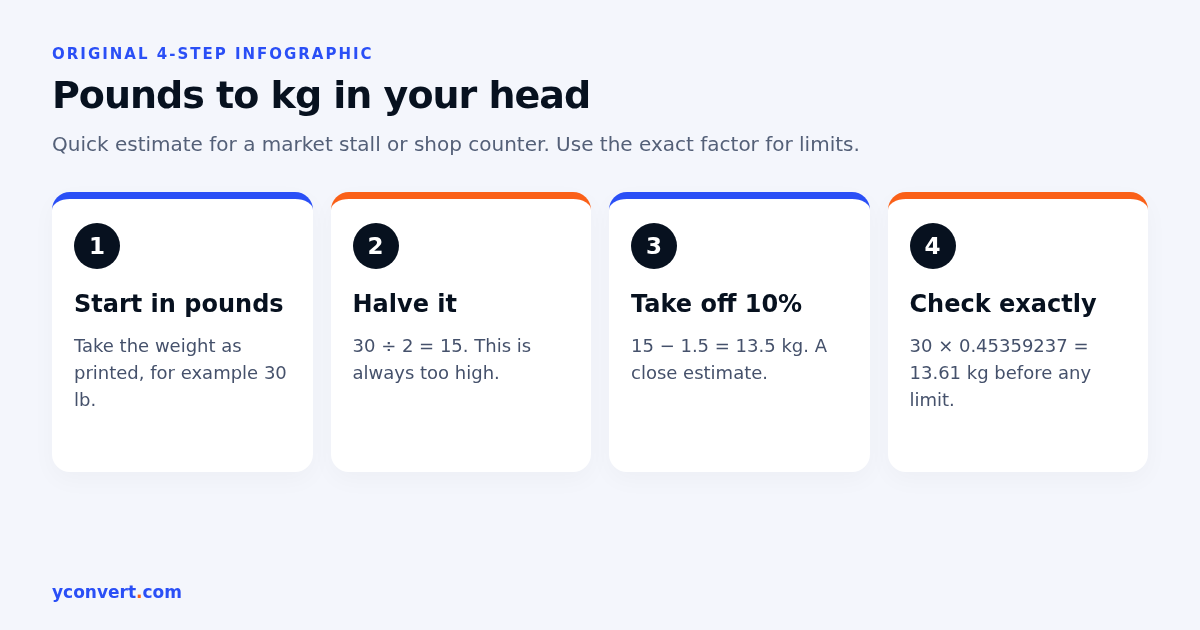
- 50 lb: half is 25, minus 2.5 is 22.5 kg. Real answer 22.68.
- 30 lb: half is 15, minus 1.5 is 13.5 kg. Real answer 13.61.
- 70 lb: half is 35, minus 3.5 is 31.5 kg. Real answer 31.75.
It always comes out slightly low. Good for a quick sense of scale at a market stall or a hardware counter. Not good enough for a baggage limit or a shipping label.
When does the exact factor really matter?
Honestly? Less often than people worry, but more often than they expect at the edges.
For cooking at home, rounding to the nearest 10 grams is fine. For a farm supplier selling produce by the case, small rounding errors multiply across hundreds of boxes and show up on the invoice. For anything with a legal or contractual limit (a checked bag, a freight booking, a lift rating on a piece of warehouse equipment), use the exact 0.45359237 and round only at the very end.
The habit that saves the most trouble is simple: convert one time, from the original reading. Converting a rounded number and then converting it back is how a 50 lb box turns into 22.5 kg and then 49.6 lb on someone else’s paperwork.
Related questions
If your question is about your own body weight rather than objects, I answered those separately in 70 kg in pounds and other body weight questions, including stone and why your scale disagrees with your app. And if you deal with jewellery or gold, where tiny units matter, the guide to converting tola to grams is the one to read.
FAQ
How many kg is 50 lbs?
50 lbs is 22.68 kg. Multiply 50 by 0.45359237, the exact number of kilograms in one pound, and round to two decimals.
Is 50 lb the same as 23 kg?
Not quite. 23 kg is about 50.71 lb, so 50 lb is roughly 320 grams lighter. Airlines often treat them as equivalent limits, but always check your own airline’s rule.
What is the fastest way to convert pounds to kg in my head?
Halve the pounds, then subtract 10 percent of that result. For 50 lb, half is 25, minus 2.5 gives 22.5 kg. The exact answer is 22.68 kg.
How do I convert pounds and ounces to kilograms?
Divide the ounces by 16 and add them to the pounds, then multiply by 0.45359237. For example, 3 lb 4 oz is 3.25 lb, which is 1.47 kg.
How many kg is a 25 lb dumbbell?
A 25 lb dumbbell is 11.34 kg. The closest common metric dumbbells are 10 kg and 12 kg.
Check it before you pack or post
When a number is close to a limit, run it through the pound to kg tool and look at the second decimal. It takes a few seconds, and it’s cheaper than a baggage fee or a courier adjustment.
And if you run a site with practical how-to pages like this one, our AEO and SEO audit starts with 1 free credit, then $2 per report, or 10 reports for $15 and 20 for $20, so you can see whether answer engines are picking up your pages.