Last updated: November 2026
To convert feet to meters, multiply the feet by 0.3048. So 10 ft is 3.048 m, 20 ft is 6.096 m and 100 ft is 30.48 m. That factor is exact, not rounded. One foot has been defined as precisely 0.3048 meters since 1959, so the only rounding you ever do is at the end.
That’s the whole method. The trouble starts when the number isn’t a plain length.
A room listed as 12 by 10. A ceiling height written as 10 ft 6 in. A price quoted per running foot. A plot measured in square feet. Each of these needs one small extra step, and skipping it is how a sensible measurement turns into a wrong order, a wrong quote or a wrong listing. I’ll go through them one at a time.
The feet to meters formula
Here it is, written out:
meters = feet × 0.3048
And going the other way:
feet = meters ÷ 0.3048 (or meters × 3.28084)
A few worked examples so you can check your own calculator:
- 6 ft × 0.3048 = 1.8288 m
- 15 ft × 0.3048 = 4.572 m
- 33 ft × 0.3048 = 10.0584 m
If you’d rather not type the factor each time, the feet to meters converter does it in one box and shows a conversion table from 1 to 20 ft underneath. For the reverse, there’s a matching meters to feet converter.
Common feet values in meters
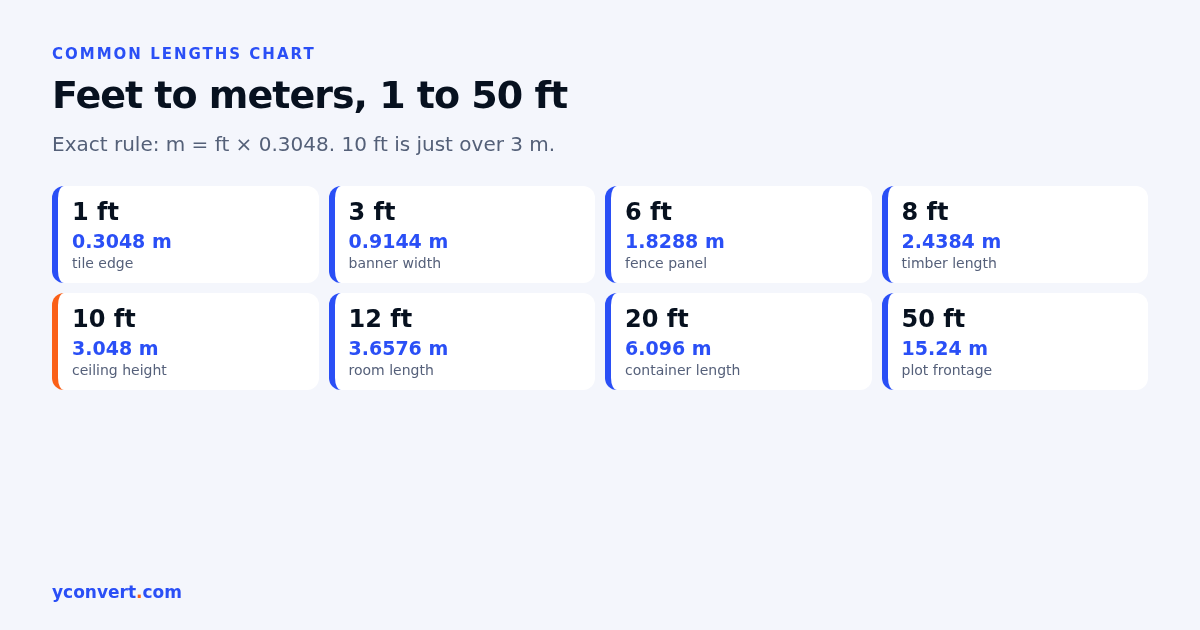
These are the lengths that come up again and again in buildings, sport and shopping. All of them use the exact factor.
| Feet | Meters | Where you’ll see it |
|---|---|---|
| 1 ft | 0.3048 m | ruler, tile edge |
| 3 ft | 0.9144 m | banner width, counter depth |
| 6 ft | 1.8288 m | fence panel, table length |
| 8 ft | 2.4384 m | timber length, standard sheet |
| 10 ft | 3.048 m | room width, ceiling height |
| 12 ft | 3.6576 m | room length |
| 20 ft | 6.096 m | shipping container length |
| 50 ft | 15.24 m | plot frontage |
| 100 ft | 30.48 m | long boundary, cable run |
| 400 ft | 121.92 m | altitude limits in some drone rules |
One sanity check I use: 10 ft is a touch over 3 m. If your answer for 10 ft is 30 m or 0.3 m, a decimal point has wandered.
How to convert feet and inches to meters
This is where most mistakes happen, and they’re sneaky because the answer still looks believable.
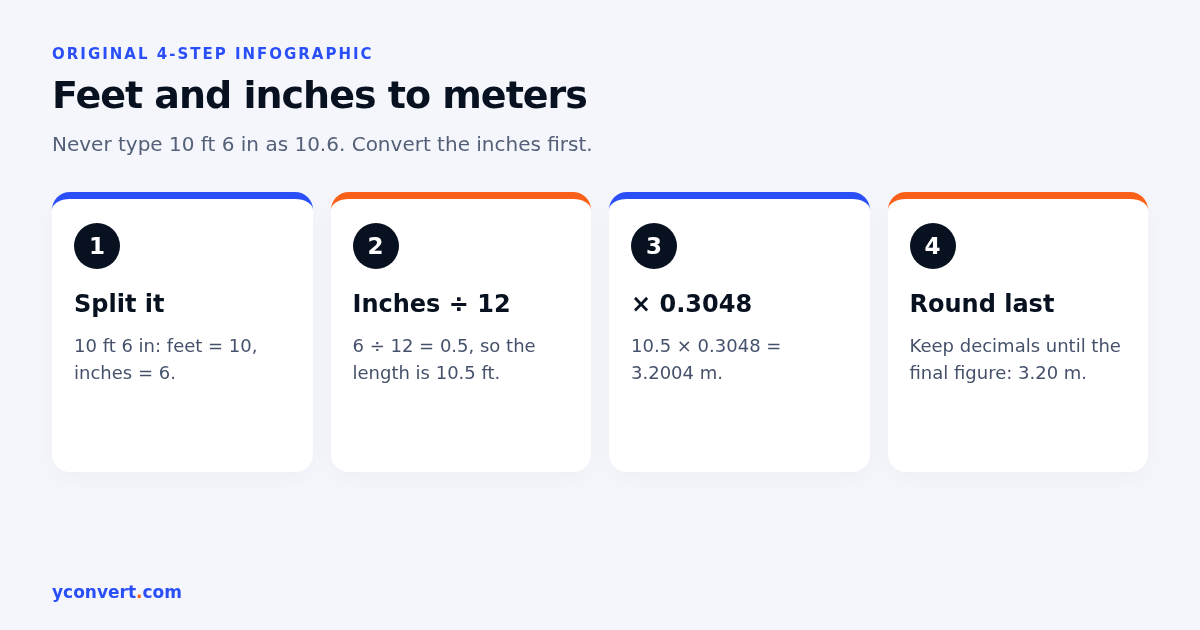
Take a ceiling height of 10 ft 6 in. The tempting move is to type 10.6 into a calculator. Don’t. Six inches is half a foot, so the decimal value is 10.5 ft, not 10.6.
There are two clean ways to do it:
- Turn everything into inches first. 10 ft 6 in is 126 inches. One inch is exactly 0.0254 m, so 126 × 0.0254 = 3.2004 m.
- Turn the inches into a fraction of a foot. 6 ÷ 12 = 0.5, so 10.5 ft × 0.3048 = 3.2004 m.
Same answer, either way. The 10.6 version gives 3.2309 m, which is about 3 cm too tall. Small? Maybe. Not if you’re ordering a door frame or a run of shelving to fit it.
A sign printer runs into this all the time. A client asks for a banner “4 foot 9 wide”, the order form wants meters, and someone keys in 4.9. That’s 1.4935 m. The real width, 4.75 ft, is 1.4478 m. Roughly 4.5 cm off, on a banner that’s meant to fit an exact frame.
Room sizes: length versus area
Real estate listings are the classic case. A bedroom is described as 12 ft × 10 ft, and someone abroad wants it in metric.
Convert each side first:
- 12 ft = 3.6576 m
- 10 ft = 3.048 m
Then multiply: 3.6576 × 3.048 = 11.15 m².
Or take the area in square feet (12 × 10 = 120 sq ft) and multiply by 0.09290304, the exact number of square meters in one square foot. You get 11.15 m² again.
What you must not do is multiply 120 sq ft by 0.3048. That gives 36.58, which looks like a perfectly reasonable room size and is completely wrong. It’s more than three times the real floor area. I’ve seen this exact slip in a property description, and nobody caught it because the number “felt” right for a decent room.
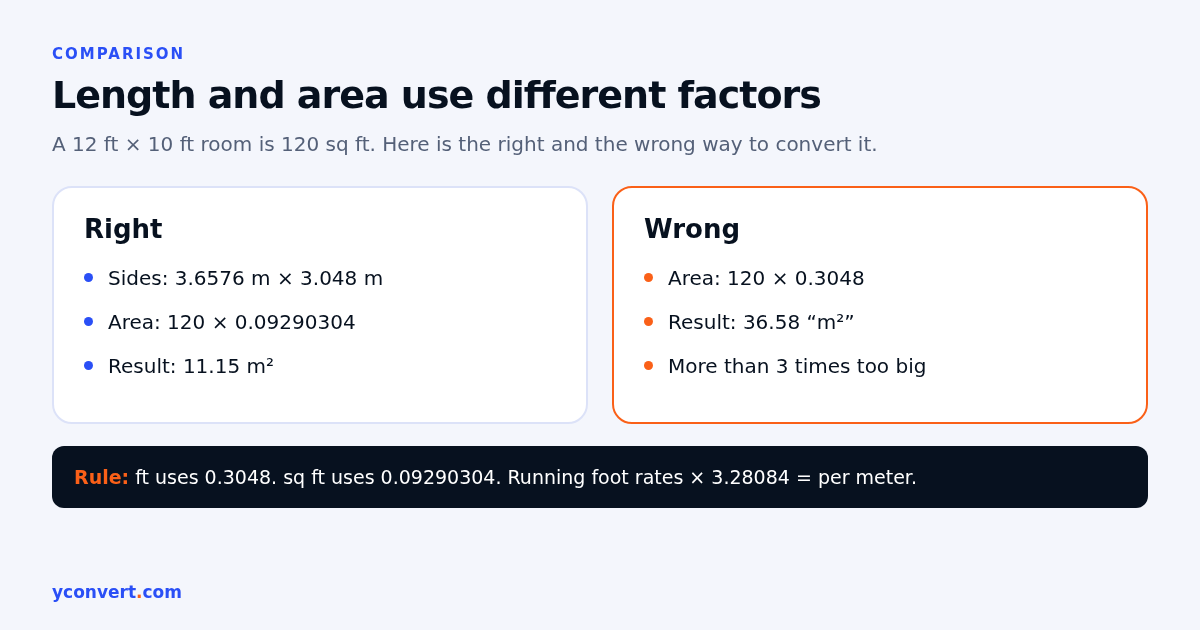
So the rule is simple. A length uses 0.3048. An area uses 0.09290304 (or roughly 0.0929). If you see “sq ft” or “ft²”, you’re in area territory.
Running foot vs square foot
In a lot of building quotes, especially for boundary walls, skirting, railings and fencing, prices are given per running foot. That’s a straight length, not an area. A running foot is just a foot measured along the line.
To turn a per-running-foot rate into a per-meter rate, multiply the rate by 3.28084, because there are about 3.28 feet in a meter. A fencing contractor charging 150 per running foot is charging about 492.13 per meter. Per square foot rates (for flooring or plastering) convert with 10.7639 instead, since there are about 10.76 square feet in a square meter.
Mix those two up and the quote is wrong by a factor of more than three. Worth a second look before anyone signs.
Where feet and meters meet in real work
I keep coming back to the same handful of situations where people need this conversion. They aren’t exotic.
Timber and sheet material. A carpenter working from a plan in feet might specify 8 ft lengths. That’s 2.4384 m. But a timber yard that sells in metric often stocks 2.4 m lengths, which is about 7.87 ft. The difference is just under 4 cm per piece. Fine for framing that gets trimmed anyway. Not fine if the plan assumed the board would span an 8 ft gap with no join.
Warehouse clear height. Racking suppliers and building specs don’t always use the same system. A warehouse with 32 ft of clear height has 9.7536 m to play with. Round that to 9.75 m on the plans, never up to 9.8, because a racking design that assumes the extra few centimetres can hit a sprinkler line.
Diving and water depth. Dive training material, gauges and site briefings may be in feet or meters depending on where you learned. 60 ft is 18.288 m, and 18 m is about 59.06 ft. Close enough that people treat them as the same depth. They’re near each other, but the conversion should be exact when a limit is involved.
Drones. Several countries set recreational drone altitude limits around 400 ft or 120 m. They’re close, not identical: 400 ft is 121.92 m. Always check the rule where you fly, and go by the unit your local regulator actually publishes.
Sports grounds. A school groundskeeper marking a pitch from an old plan in feet will need meters for new equipment. Here I convert every distance on the plan from the original feet figure. Converting the total and then dividing it up is how a line ends up 10 cm short.
Quick mental math: 30 percent, plus a bit
Sometimes you just need a rough figure. Standing in a shop. Reading a listing on your phone.
Take 30 percent of the feet, then add a little under 2 percent of that. Since 0.3048 is 0.3 plus a sliver, this lands very close:
- 10 ft: 30 percent is 3, plus a sliver is about 3.05 m (exact 3.048)
- 50 ft: 15, plus about 0.24, gives 15.24 m (exact 15.24)
- 25 ft: 7.5, plus about 0.12, gives 7.62 m (exact 7.62)
Even rougher: divide by 3.3. It’s quick and always lands a hair under, but it’s good enough to know if a room is “about 4 m” or “about 5 m”. For anything going on an order form, a contract or a listing, use the exact factor.
Converting a whole column of feet in a spreadsheet
If you have a list of measurements, say a site survey or a stock sheet, don’t convert them one by one. In any spreadsheet, put the feet in column A and use this in column B:
=A2*0.3048
Then fill it down. Keep the original feet column. If anyone questions a figure later, you’ll want the source measurement, not just the converted one.
One habit that saves a lot of grief: round only in the final column you share, and leave the full decimals in the working column. Rounded numbers that get converted again drift.
A note on the old US survey foot
You might come across this in older land records in the United States. For a long time, US surveying used a “survey foot” that was a tiny bit longer than the international foot, about two parts per million. Over a short wall that’s nothing. Over many kilometres of survey lines it adds up. The US formally retired the survey foot at the end of 2022, and the international foot (exactly 0.3048 m) is now the standard. For rooms, timber, signs and everyday lengths, 0.3048 is the only number you need.
Related conversions
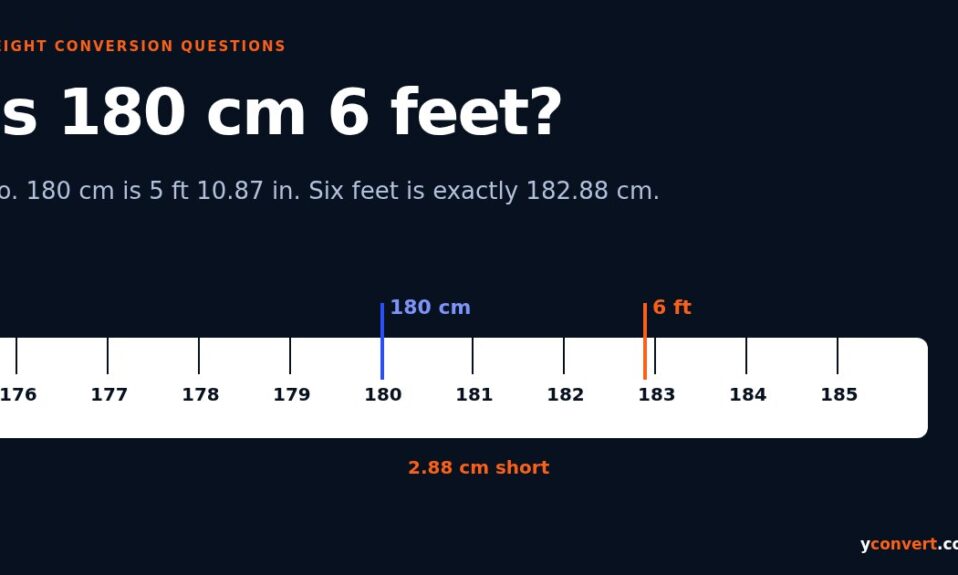
If your measurement needs more precision than meters give you, my guide on converting feet to centimeters covers feet-and-inches in centimetres in detail. Going back from metric, there’s also centimeters to feet, done correctly. And if your question is really about someone’s height, I answered those separately in is 180 cm 6 feet and other height questions.
FAQ
How do I convert feet to meters?
Multiply the number of feet by 0.3048. For example, 10 feet × 0.3048 = 3.048 meters. The factor is exact, so round only at the end.
How many meters is 10 feet?
10 feet is 3.048 meters. That’s a common ceiling height and room width, and it’s just over 3 m.
How do I convert feet and inches to meters?
Convert the inches to a fraction of a foot by dividing by 12, add that to the feet, then multiply by 0.3048. For example, 10 ft 6 in is 10.5 ft, which is 3.2004 meters.
How do I convert square feet to square meters?
Multiply square feet by 0.09290304. A 120 sq ft room is about 11.15 square meters. Don’t use 0.3048 for area, because that factor is only for lengths.
Is a meter longer than 3 feet?
Yes. One meter is about 3.28 feet, or 3 feet 3.37 inches. So a meter is roughly 3 feet plus a hand’s width.
How do I convert a price per running foot to a price per meter?
Multiply the price per running foot by 3.28084. A rate of 150 per running foot works out to about 492.13 per meter.
Check the number before it goes on paper
For a one-off length, the ft to m tool is the fastest route, and it keeps the decimals so you can round where it makes sense. If you’re converting feet and inches, do the inches step first. And if you see “sq ft”, stop and switch factors.
If you also run a site full of practical pages like this one, our AEO and SEO audit starts with 1 free credit, then $2 per report, or 10 reports for $15 and 20 for $20. It shows whether search and answer engines are actually picking up your pages.