Last updated: October 2026
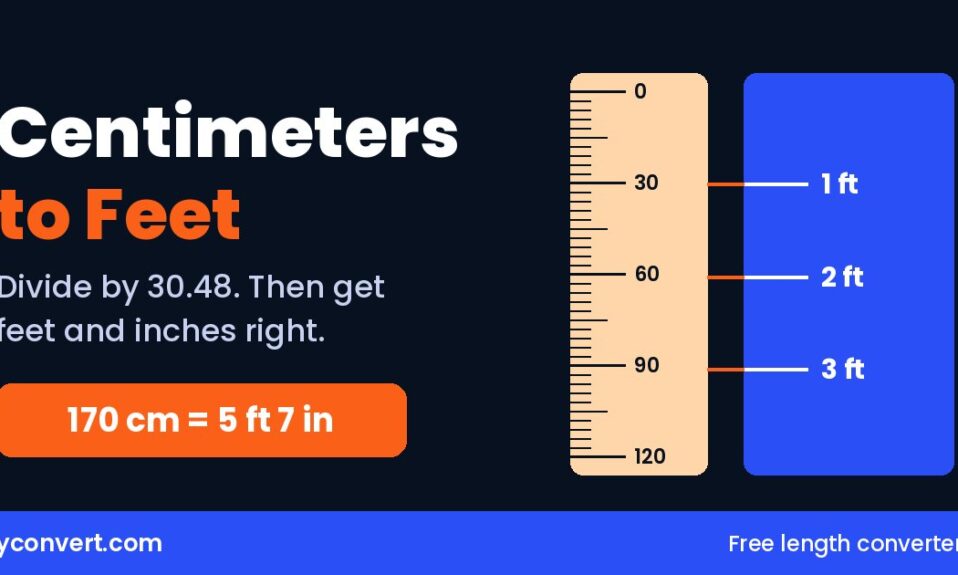
Short answer: to convert centimeters to feet, divide the number of centimeters by 30.48. So 170 cm ÷ 30.48 = 5.58 ft. If you want feet and inches (the way people actually say heights), divide the centimeters by 2.54 to get total inches, then split that into whole feet and leftover inches: 170 cm is 66.93 inches, which is 5 ft 6.93 in, or about 5 ft 7 in.
That’s the whole formula. It’s also where most of the mistakes start, because “5.58 feet” and “5 feet 5.8 inches” look almost the same and are not the same thing at all.
I convert centimeters to feet more often than I’d like to admit. Product listings, room sizes, the height field on a form that only accepts one unit. The arithmetic is never the hard part. Reading the answer correctly is. So here’s how I do it, step by step, plus the slips I see over and over.
The number you need: 30.48
One foot is exactly 30.48 centimeters. Not roughly. Exactly. The inch was fixed at 2.54 cm by international agreement in 1959, and a foot is 12 inches, so 12 × 2.54 = 30.48.
That gives you two ways to write the same rule:
- feet = centimeters ÷ 30.48
- feet = centimeters × 0.0328084
Dividing by 30.48 is cleaner because 30.48 is exact. The 0.0328084 figure is already rounded, so on big numbers you’ll drift by a hair. For a height or a shelf, nobody will notice. For a long run of cable or fencing, I’d still divide.
How to convert cm to feet, step by step
Step 1: Decide what kind of answer you need
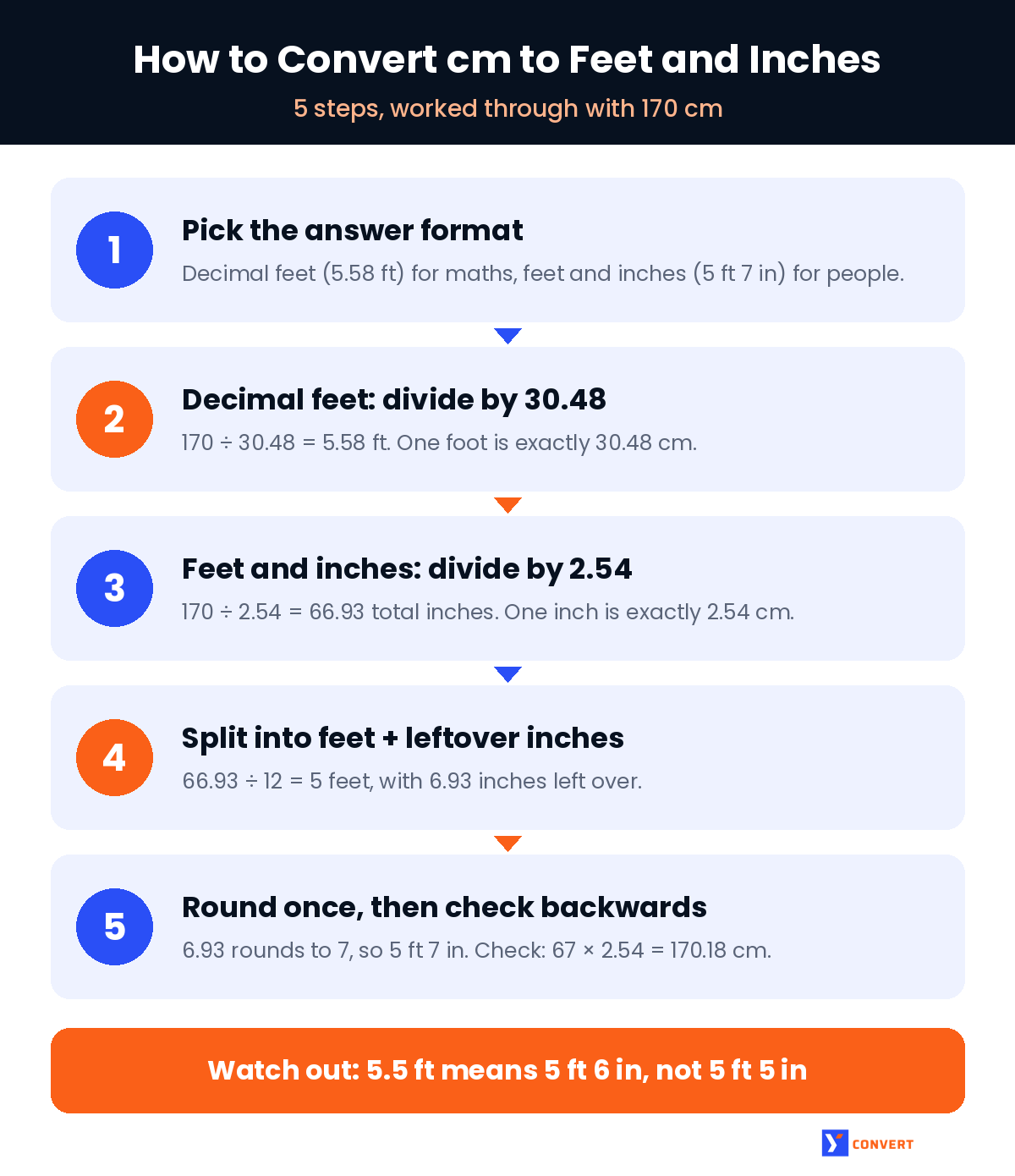
This sounds fussy. It isn’t. Before touching a calculator, ask whether the person on the other end wants decimal feet (5.58 ft) or feet and inches (5 ft 7 in).
Decimal feet show up in engineering drawings, some property documents and spreadsheets where you need to add or multiply. Feet and inches show up almost everywhere else: heights, furniture, clothing, door frames, anything a person will picture in their head.
Get this wrong and the maths can be perfect and the answer still useless.
Step 2: Divide by 30.48 for decimal feet
Take the centimeters and divide by 30.48.
- 150 cm ÷ 30.48 = 4.92 ft
- 183 cm ÷ 30.48 = 6.00 ft
- 240 cm ÷ 30.48 = 7.87 ft
If decimal feet is what you need, you’re done. Round to two decimal places for most uses.
Step 3: For feet and inches, go through inches first
This is the method I trust. Divide the centimeters by 2.54 to get total inches. Then:
- Divide the total inches by 12. The whole number is your feet.
- Whatever is left over is your inches.
Take 165 cm. 165 ÷ 2.54 = 64.96 inches. 64.96 ÷ 12 = 5 with 4.96 left over. So 165 cm is 5 ft 4.96 in, which most people would round to 5 ft 5 in.
You can also do it from decimal feet: take the part after the decimal point and multiply it by 12. 5.41 ft gives 0.41 × 12 = 4.92 in. Same answer, give or take rounding. I still prefer the inches route because there’s one less rounded number in the chain.
Step 4: Round at the very end, and watch the 12
Round only once, at the last step. If you round the decimal feet first and then convert the leftover, the error stacks up.
And keep an eye out for 12 inches. 152 cm is 59.84 inches, which is 4 ft 11.84 in. Round that to the nearest inch and you get 4 ft 12 in, which isn’t a thing. It’s 5 ft 0 in. Same with 213 cm: 6 ft 11.86 in rounds up to a flat 7 ft. Spreadsheets will happily print “4 ft 12 in” if you let them.
Step 5: Check it backwards
Multiply your feet back by 30.48 (or your total inches by 2.54) and check that you land near where you started. 5 ft 7 in is 67 inches, and 67 × 2.54 = 170.18 cm. Close to 170. Good.
It takes five seconds and catches the typo where you divided by 3.048 instead of 30.48. I’ve done that. Once was enough.
The mistake almost everyone makes: 5.5 ft is not 5’5”
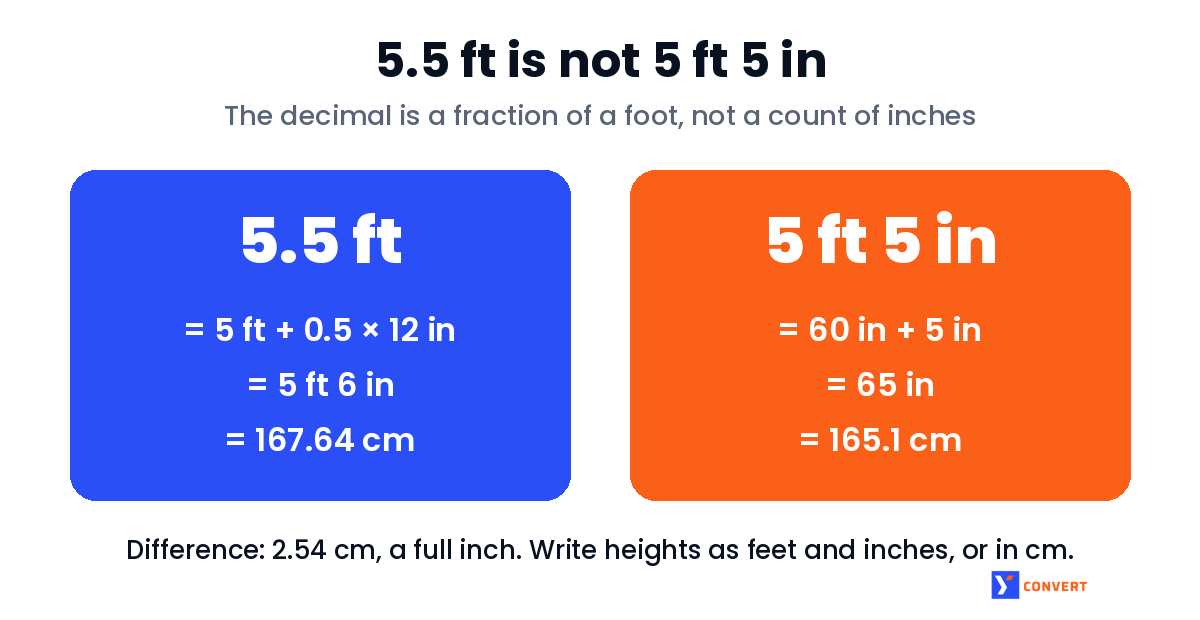
If I could fix one thing, it would be this. The decimal in “5.5 feet” means half a foot. Half a foot is 6 inches. So:
- 5.5 ft = 5 ft 6 in = 167.64 cm
- 5 ft 5 in = 65 inches = 165.1 cm
That’s a gap of more than 2.5 cm from a misread dot. On a person’s height it’s the difference between two clothing sizes. On a kitchen counter it’s a drawer that won’t close.
Here’s where I see it bite. A clinic records a patient’s height in centimeters, someone types it into another form as “5.6”, and the next person reads it as 5 ft 6 in. It’s actually 5 ft 7.2 in. Small, sure, until it feeds into a dosage chart or a BMI figure that someone acts on.
My rule: never write decimal feet anywhere a human will read it as a height. Write “5 ft 7 in” or write the centimeters. Pick one and don’t mix.
Quick mental shortcuts (and how far off they are)
Sometimes you just need a rough number in your head while someone’s talking.
Divide by 30. 30 cm is close to a foot, so cm ÷ 30 gives you a fast ballpark. It runs a little high, by about 1.6%, because a real foot is 30.48 cm. On 180 cm you’d get 6.0 ft when the true figure is 5.91 ft. Fine for “is this sofa going to fit through the door”, not fine for ordering glass.
100 cm is about 3 ft 3 in. A meter is 3.28 ft, or 3 ft 3.4 in. I keep that one in my head as an anchor and work out from there.
Every 2.5 cm is about an inch. Handy for small adjustments. If something is 5 cm taller than a known height, it’s roughly 2 inches taller.
When the number actually matters, skip the shortcuts and divide properly, or use a converter.
Common heights: cm to feet and inches
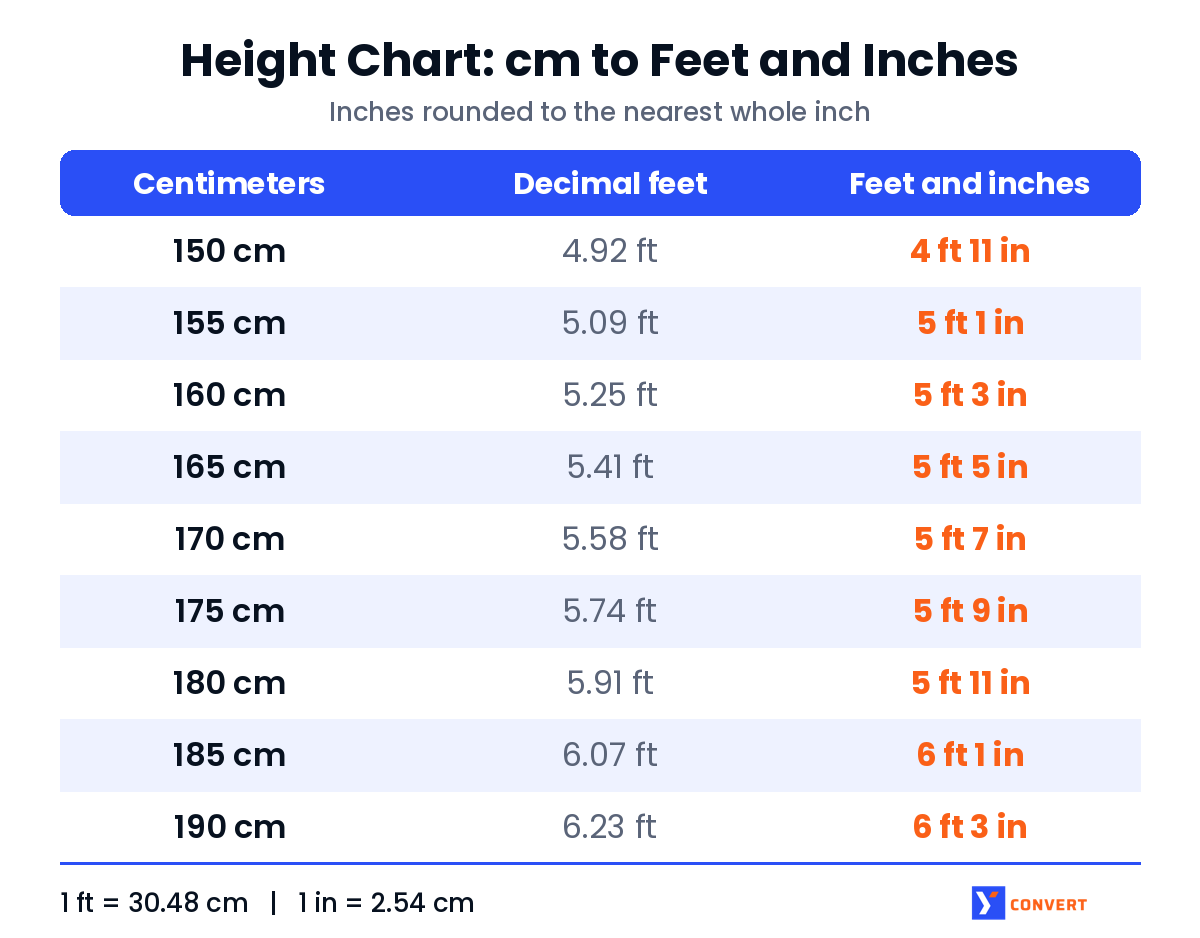
This is the table I end up rebuilding every few months, so here it is in one place. Inches are rounded to the nearest whole inch, with the 12-inch rollover already handled.
| Centimeters | Decimal feet | Feet and inches |
|---|---|---|
| 150 cm | 4.92 ft | 4 ft 11 in |
| 155 cm | 5.09 ft | 5 ft 1 in |
| 160 cm | 5.25 ft | 5 ft 3 in |
| 165 cm | 5.41 ft | 5 ft 5 in |
| 170 cm | 5.58 ft | 5 ft 7 in |
| 175 cm | 5.74 ft | 5 ft 9 in |
| 180 cm | 5.91 ft | 5 ft 11 in |
| 185 cm | 6.07 ft | 6 ft 1 in |
| 190 cm | 6.23 ft | 6 ft 3 in |
Where cm to feet conversions show up in real work
A few patterns I run into, from very different kinds of businesses.
Furniture and home goods listings. A furniture seller sources from a supplier who lists everything in centimeters, but a lot of buyers think in feet. A 213 cm sofa reads as “about 7 ft”, which is exactly what a shopper needs to picture it against their wall. Listing both units on the product page saves a stack of “will this fit?” messages.
Property and interiors. Ceiling heights and room dimensions get quoted both ways depending on who drew the plan. A 240 cm ceiling is 7 ft 10 in. If you’re a real estate agent writing a listing, that’s worth converting carefully, because buyers compare it against other homes they’ve seen in feet.
Shipping and export. Carton sizes from a factory come in centimeters. A courier or a buyer abroad may want inches or feet. Here I convert each side separately and don’t round until the final figure, since small errors on three sides multiply into a volume that’s noticeably off.
Sports and school sign-ups. Coaches and event organisers often collect heights on paper forms, and people fill them in however they like. Converting everything to one unit before sorting teams avoids the “5.6 vs 5’6” mess from earlier.
Tailoring and uniforms. Garment makers usually work in centimeters or inches, but customers describe their own height in feet. Translating cleanly between the two is part of getting the size right the first time.
Doing it in a spreadsheet
If you’ve got a column of centimeters and need feet and inches next to it, this formula (for a value in cell A2) rounds to the nearest inch first, so you never get a 12:
=INT(ROUND(A2/2.54,0)/12)&" ft "&MOD(ROUND(A2/2.54,0),12)&" in"
For decimal feet, keep it simple: =A2/30.48, then format to two decimals.
Use the converter when it matters
For a one-off number, our centimeters to feet converter does the division for you and shows the formula and a reference table on the same page. It’s free, there’s nothing to sign up for, and it’s quicker than finding the calculator app.
If you’re going the other way, the feet to centimeters converter handles that. For smaller measurements, I use the cm to inches converter and the inches to cm converter, which are handy when you only need the inches part.
FAQ
How many centimeters are in a foot?
Exactly 30.48. One inch is defined as 2.54 cm and a foot is 12 inches, so 12 × 2.54 = 30.48 cm.
What is the formula to convert centimeters to feet?
Divide the centimeters by 30.48. For example, 160 cm ÷ 30.48 = 5.25 ft. For feet and inches, divide the centimeters by 2.54 to get inches, then split into whole feet (divide by 12) and the leftover inches.
How do I convert cm to feet and inches?
Divide by 2.54 to get total inches. Divide that by 12: the whole number is feet and the remainder is inches. 175 cm is 68.9 inches, which is 5 ft 8.9 in, or about 5 ft 9 in.
Is 5.5 feet the same as 5 feet 5 inches?
No. 5.5 feet means five and a half feet, which is 5 ft 6 in (167.64 cm). 5 ft 5 in is 165.1 cm. The decimal part of feet is a fraction of 12 inches, not a count of inches.
What is 170 cm in feet?
170 cm is 5.58 ft in decimal feet, or 5 ft 6.93 in, which rounds to 5 ft 7 in.