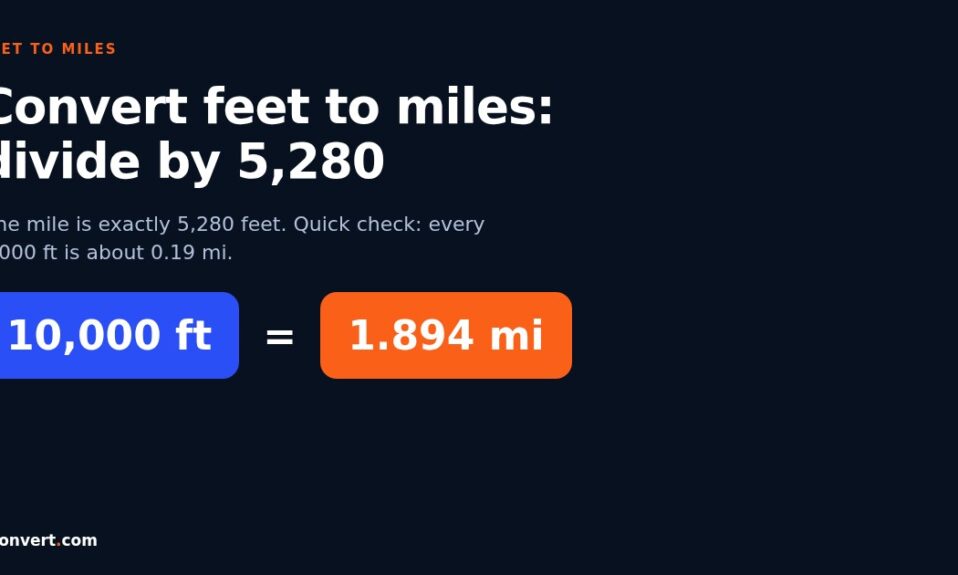
To convert feet to miles, divide the number of feet by 5,280. A mile is exactly 5,280 feet, so 10,000 feet is 1.894 miles, 2,640 feet is half a mile, and 26,400 feet is exactly 5 miles. If you’d rather multiply, one foot is 0.000189394 of a mile, rounded.
That’s the whole formula. The trouble is that feet show up in odd places: a cable drum, a trail sign, a pilot’s announcement, a road plan. And when the number has five digits, people tend to guess. This post gives you the division, a table of values worth knowing, a way to estimate in your head, and the few traps I see most often.
The feet to miles formula
Written out:
miles = feet ÷ 5,280
And back again:
feet = miles × 5,280
Three quick examples you can check on your own calculator:
- 1,320 feet ÷ 5,280 = 0.25 miles (a quarter mile)
- 7,920 feet ÷ 5,280 = 1.5 miles
- 35,000 feet ÷ 5,280 = 6.6288 miles
The feet to miles converter does this in one box. Type the feet, get the miles. It uses the multiplier 0.000189394, which is 1 ÷ 5,280 rounded to nine decimal places. On everyday numbers you won’t see any difference. If you want the cleanest possible figure for a contract or a report, divide by 5,280 directly and round once at the end.
Why 5,280 and not a round number? The mile was built from older units. It’s 8 furlongs, and a furlong is 660 feet. Eight times 660 gives 5,280. It’s also 1,760 yards. None of that is tidy, which is exactly why a converter earns its keep.
Feet to miles: a table of values worth knowing
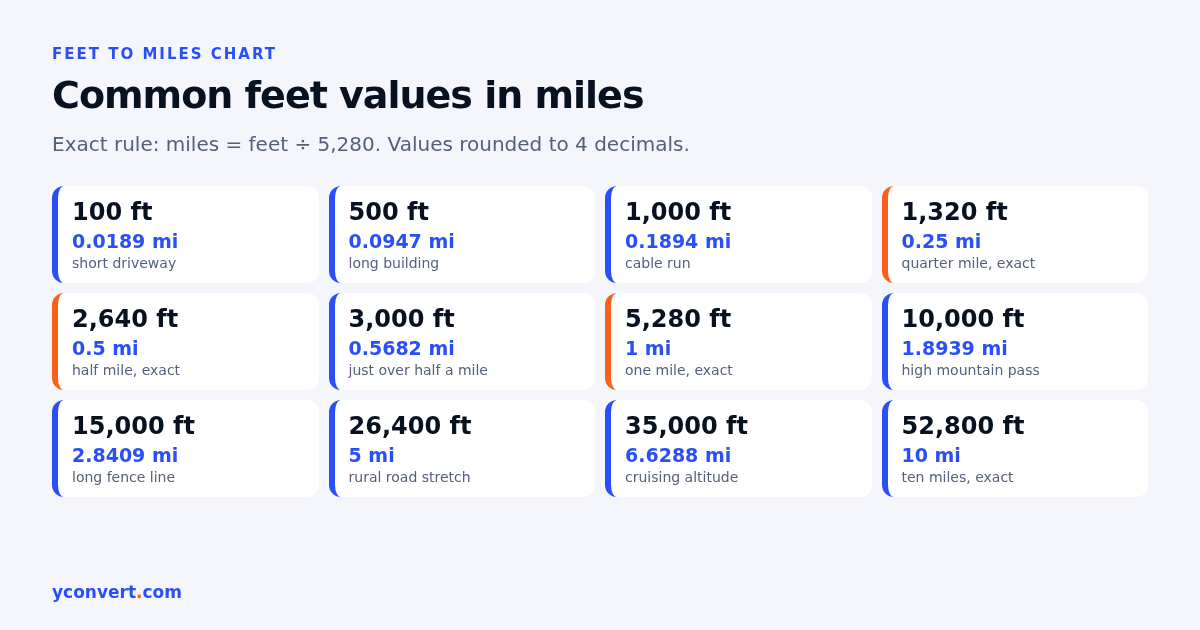
These are the figures I get asked about most. I’ve kept four decimals where the answer isn’t a clean fraction.
| Feet | Miles | Where it shows up |
|---|---|---|
| 100 ft | 0.0189 mi | a short driveway or a city lot frontage |
| 500 ft | 0.0947 mi | a long building or a pier |
| 1,000 ft | 0.1894 mi | a cable run between two poles a block apart |
| 1,320 ft | 0.25 mi | a quarter mile, exactly |
| 2,640 ft | 0.5 mi | a half mile, exactly |
| 5,280 ft | 1 mi | one mile, by definition |
| 10,000 ft | 1.8939 mi | a high mountain pass or a small plane’s altitude |
| 15,000 ft | 2.8409 mi | a long fence line around farmland |
| 26,400 ft | 5 mi | a stretch of rural road |
| 35,000 ft | 6.6288 mi | a typical airliner cruising altitude |
| 52,800 ft | 10 mi | ten miles, exactly |
Two of those rows are worth memorising: 1,320 for a quarter mile and 2,640 for a half. Once you know them, a lot of numbers stop being scary. Something like 3,000 feet? A bit more than a half mile. Done.
How to estimate feet to miles in your head
Nobody divides by 5,280 mentally. I don’t either. Here’s what I do instead.
Think in thousands. Every 1,000 feet is a little under a fifth of a mile (0.1894, to be exact). So take the thousands and multiply by 0.19. For 18,000 feet, that’s 18 × 0.19 = 3.42 miles. The exact answer is 3.4091. Close enough to plan with.
Or divide by 5,000 and shave a bit. Dividing by 5,000 is easy: halve the number, then move the decimal four places. For 10,000 feet you get 2. That’s too high, because 5,000 is smaller than 5,280, so take off about 5 percent. Two minus a tenth is 1.9. The exact figure is 1.894.
Use the anchors. Quarter mile, 1,320. Half mile, 2,640. One mile, 5,280. A lot of real numbers sit near one of these, and comparing is faster than calculating.
Whichever you pick, the estimate is a check, not the answer. Use it to catch a slipped digit before it goes on a quote.
Where feet to miles actually comes up
I like seeing a formula in context, because that’s where mistakes hide. Here are a few situations, each from a different line of work.
A fibre installer quoting a cable run
Say a broadband installer measures a new line along a road and the survey comes back as 18,500 feet. The client’s budget sheet is priced per mile. 18,500 ÷ 5,280 = 3.5038 miles. Keep those decimals while you multiply by the per-mile rate. Rounding to 3.5 first sounds harmless, but on a costly job that small gap can turn into real money.
A paving crew working out lane-miles
Road work is often costed in lane-miles, which means the length of road times the number of lanes. A 7,920-foot stretch is 1.5 miles. If that stretch has two lanes being resurfaced, it’s 3 lane-miles. People sometimes convert the road length and forget the lanes, or multiply the feet by the lanes and then forget to divide. Do the conversion first, then the lanes.
A trekking operator describing a route
Trail descriptions mix units all the time: distance in miles, climb in feet. Say a tour company lists a day hike as 4 miles with 1,000 feet of elevation gain. Those two numbers measure different things. You don’t convert the 1,000 feet and add it to the distance. The climb is vertical; the 4 miles is along the path.
There’s a useful trick here, though. Divide the feet of climb by the miles to get feet per mile, then divide by 52.8 for the average grade as a percentage. 1,000 ÷ 4 = 250 feet per mile, and 250 ÷ 52.8 is about 4.7 percent. Works because 52.8 feet per mile is a 1 percent slope.
An airline announcement at altitude
When a captain says you’re cruising at 35,000 feet, plenty of passengers wonder how high that really is. It’s 6.6288 miles. Put that way, it’s easy to picture: a little over six and a half miles straight up, which is longer than many people’s daily commute.
A farm laying irrigation lines
A grower laying drip tape might run 24 rows, each 1,320 feet long. That’s 31,680 feet of tape, which is exactly 6 miles. Suppliers often sell by the roll in feet, so it’s handy to flip between the two when you’re comparing prices or checking an order.
Convert feet to miles in 4 steps
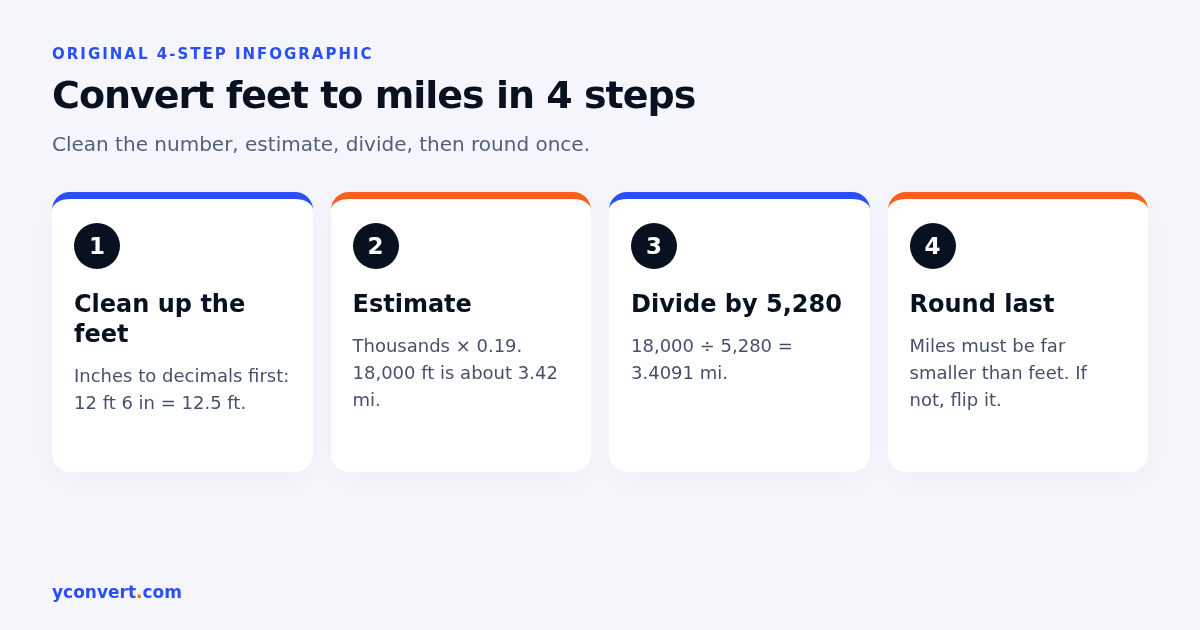
My routine, so a big number doesn’t catch me out:
- Clean up the feet. If the measurement has inches, turn them into a decimal first. 12 feet 6 inches is 12.5 feet, not 12.6.
- Estimate. Thousands × 0.19, or compare with 1,320, 2,640 and 5,280.
- Divide by 5,280. Or use the converter and paste the result.
- Round last and sanity check. The miles figure should always be much smaller than the feet figure. If it isn’t, something went backwards.
Going the other way, multiply miles by 5,280. The miles to feet converter handles that direction if you’d rather not do it by hand.
The mistakes I see most often
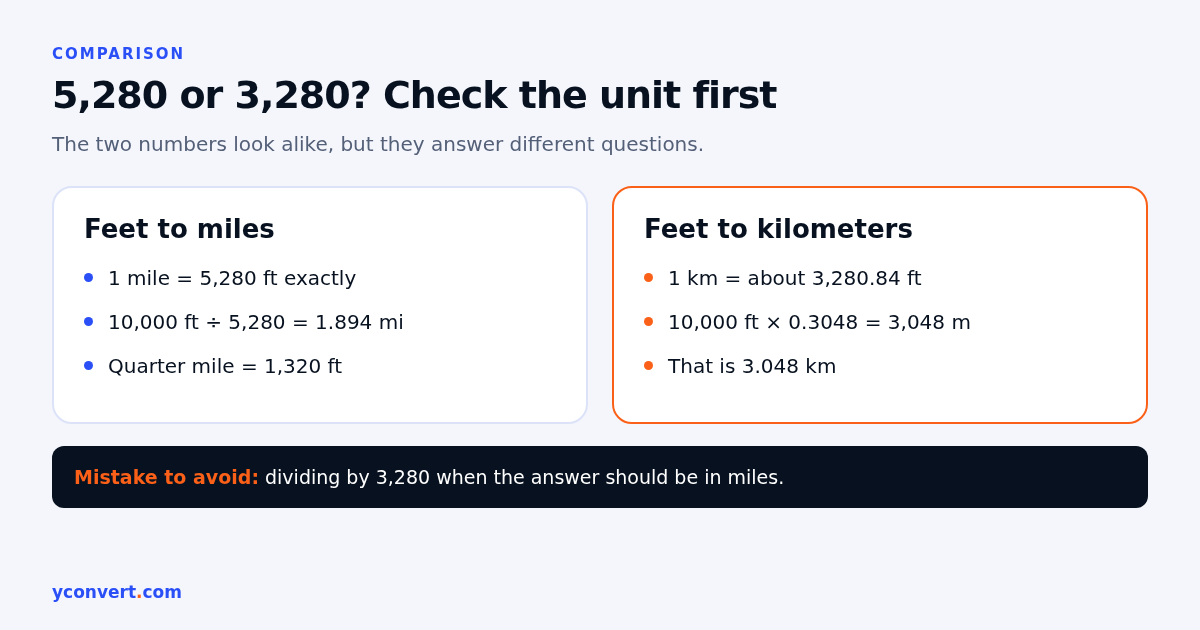
Mixing up 5,280 and 3,280
This is the sneaky one. A mile is 5,280 feet. A kilometer is about 3,280.84 feet. The two numbers look almost the same and I’ve seen them swapped more than once. Divide 10,000 feet by 5,280 and you get 1.894 miles. Divide by 3,280.84 and you get 3.048 kilometers. Both are correct answers to different questions. Check which unit the person actually wants.
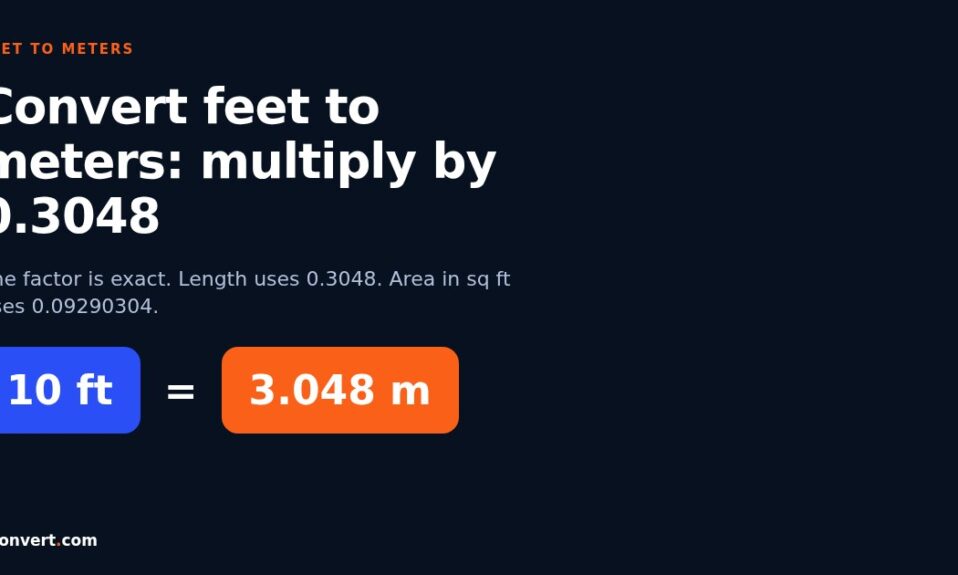
If kilometers are what you’re after, it’s simpler to go through meters: one foot is exactly 0.3048 meters, so 10,000 feet is 3,048 meters, or 3.048 km. I walked through that in more detail in the post on converting feet to meters for rooms and plots.
Multiplying instead of dividing
Feet are small, miles are big. Going from feet to miles, the number has to shrink a lot. If 2,000 feet turns into a five-digit figure in your spreadsheet, the formula is pointing the wrong way.
Treating inches as decimals
Say a measurement reads 250 feet 9 inches. Writing it as 250.9 is wrong, because 9 inches is 0.75 of a foot. The right figure is 250.75 feet. On a single length it hardly matters in miles. Add up a few hundred of them, though, and the error grows.
Forgetting which mile you mean
A nautical mile, used at sea and in the air for navigation, is exactly 1,852 meters, or about 6,076 feet. That’s roughly 15 percent longer than the 5,280-foot mile. If the figure comes from a marine chart or a flight plan, check before you divide.
The old survey foot
In some older land records in the United States, you’ll find the US survey foot. It differs from the standard foot by about 2 parts per million, and it has been retired for new work since the start of 2023. For everyday conversions it changes nothing. For very long surveyed boundaries, it’s worth knowing which foot the document used.
FAQ
How many feet are in a mile?
Exactly 5,280 feet. That’s also 1,760 yards, or 8 furlongs of 660 feet each.
How do I convert feet to miles?
Divide the feet by 5,280. For example, 15,840 feet ÷ 5,280 = 3 miles. You can also multiply by 0.000189394, which is the same factor rounded.
How many miles is 10,000 feet?
10,000 feet is about 1.894 miles (1.8939). In kilometers, it’s exactly 3.048 km.
How many feet is a quarter mile?
A quarter mile is exactly 1,320 feet, and a half mile is exactly 2,640 feet.
How high is 35,000 feet in miles?
35,000 feet is about 6.63 miles (6.6288). That’s a common cruising altitude for passenger jets.
Is a nautical mile 5,280 feet?
No. A nautical mile is exactly 1,852 meters, which is about 6,076 feet. It’s longer than the standard mile.
Check it before you rely on it
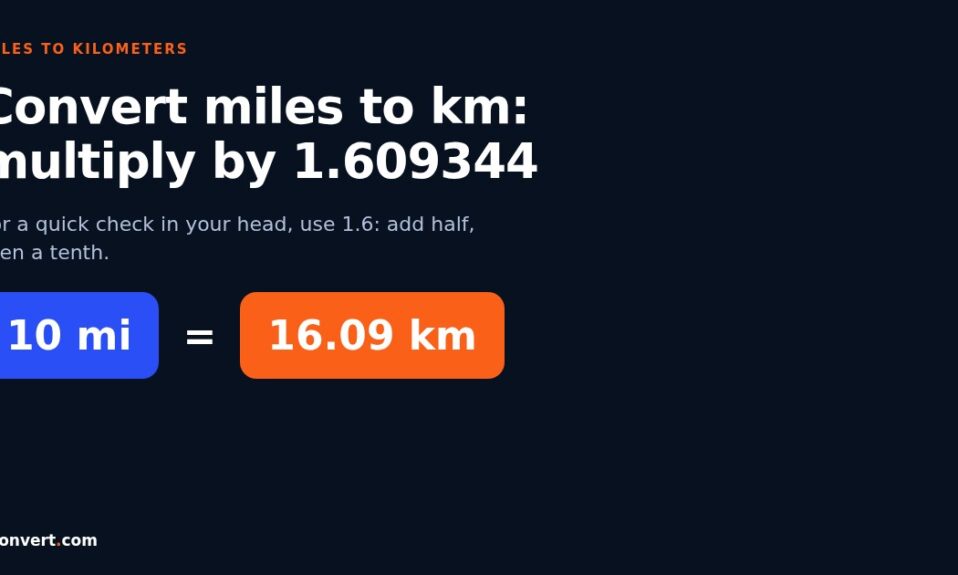
For a quick answer, the feet to miles tool is the fastest route. If you’re switching between imperial and metric distances too, my notes on converting miles to kilometers with a mental shortcut use the same estimate-first habit.
And if you run a site full of practical pages like these, our AEO and SEO audit starts with 1 free credit, then $2 per report, or 10 reports for $15 and 20 for $20. It shows whether search and answer engines are actually picking your pages up.
Last updated: November 2026