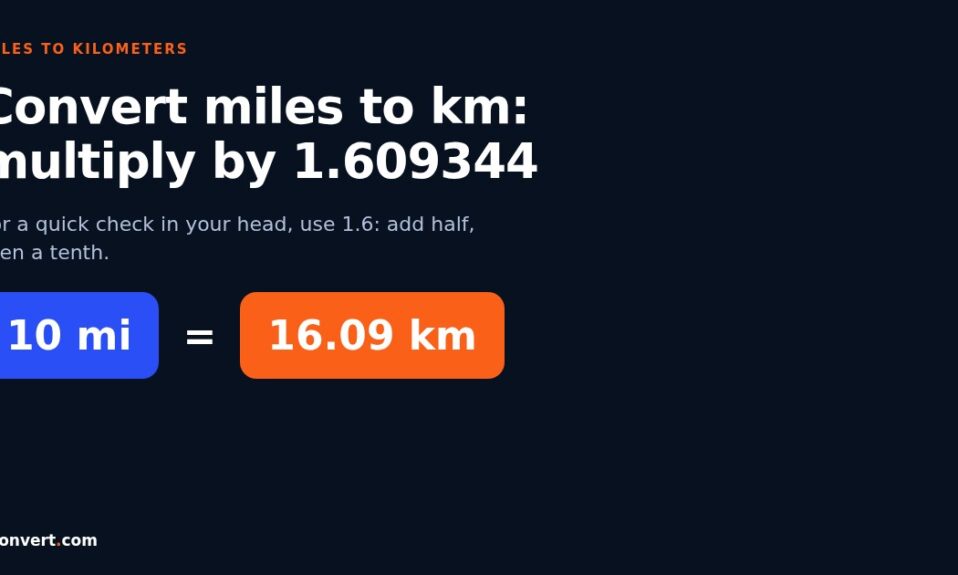
To convert miles to kilometers, multiply the miles by 1.609344. So 10 miles is 16.09344 km, 26.2 miles is about 42.16 km, and 100 miles is 160.9344 km. That factor is exact, because the international mile has been fixed at 1,609.344 meters since 1959.
Most people never need all those decimals. What they need is a number they can trust, quickly, and a way to catch themselves when a figure looks off. That’s what this post is for: the formula, a table of values that keep coming up, and a head-math shortcut good enough for a road trip.
The miles to kilometers formula
Written out:
km = miles × 1.609344
And the other way:
miles = km ÷ 1.609344 (or km × 0.621371)
A few worked examples, so you can test your own calculator:
- 3 miles × 1.609344 = 4.828032 km
- 12 miles × 1.609344 = 19.312128 km
- 250 miles × 1.609344 = 402.336 km
If you’d rather skip the typing, the miles to kilometers converter takes the miles in one box and gives you the kilometers straight away. Going the other direction, there’s a kilometers to miles converter too.
One honest note on rounding. The converter’s own page quotes the factor as 1.60934, which is the same number rounded to five decimals. Over a short distance you will never see the difference. Over 1,000 miles it’s about 4 meters. Nobody drives that precisely.
Miles to kilometers: the values I keep seeing
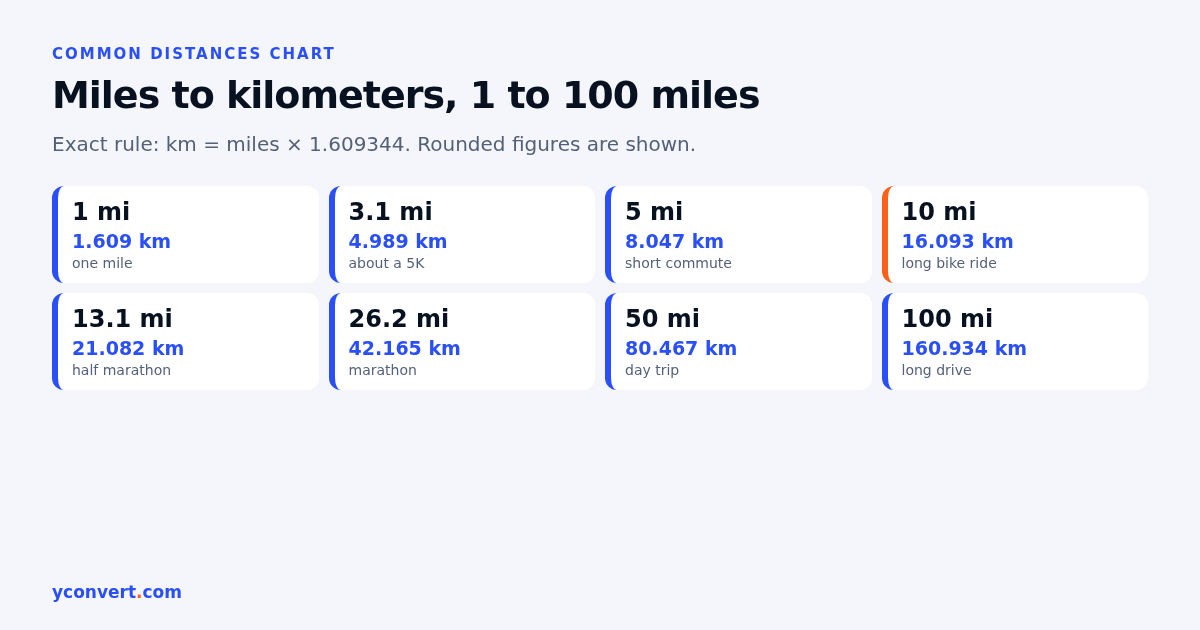
Here are the distances people actually look up. Running events, speed limits and route planning cover most of it.
| Miles | Kilometers | Where it shows up |
|---|---|---|
| 1 mile | 1.609 km | about four laps of a 400 m track |
| 3.1 miles | 4.989 km | a 5K, near enough |
| 5 miles | 8.047 km | a short commute |
| 10 miles | 16.093 km | a long bike ride |
| 13.1 miles | 21.082 km | a half marathon, rounded |
| 26.2 miles | 42.165 km | a marathon, rounded |
| 50 miles | 80.467 km | a day trip out of town |
| 100 miles | 160.934 km | a long drive |
| 250 miles | 402.336 km | a rail or road leg |
| 500 miles | 804.672 km | a day’s hard driving |
Notice that I rounded the half marathon and the marathon, because it matters. The official distances are 21.0975 km and 42.195 km. Converted to miles, those are 13.1094 and 26.2188. The familiar “13.1” and “26.2” are rounded, so converting them back gives a result 15 to 30 meters short of the official figure. Fine for a pace chart. Not fine for a course map.
A mental shortcut that works
You won’t always have a screen. Say you’re in a rental car with a dashboard in miles per hour and a road atlas in kilometers. Here’s the one I rely on.
Multiply the miles by 1.6. That’s all of it.
How do you do 1.6 in your head? Take the number, add half of it, then add a tenth. For 40 miles: 40 plus 20 plus 4 is 64 km. The exact answer is 64.37 km. Close.
Prefer a different route? Double the number, then take off a fifth. Forty doubled is 80, a fifth of 80 is 16, so 64 again.
Both are the same idea, and both come out slightly low because 1.6 is a hair under 1.609344. That’s about 0.6 percent. At 100 miles you’re 0.93 km under. I’ll take that on a motorway.
The Fibonacci trick
This one’s a party piece, but it works. The numbers 3, 5, 8, 13, 21, 34 each add the two before. Because the ratio between neighbours is close to 1.6, any Fibonacci number of miles is roughly the next one up in kilometers.
- 5 miles is about 8 km (actual 8.05)
- 8 miles is about 13 km (actual 12.87)
- 13 miles is about 21 km (actual 20.92)
- 21 miles is about 34 km (actual 33.80)
Handy for the numbers it fits. Useless for 17 miles. For everything else, use the 1.6 rule.
Going from kilometers to miles
Here’s where I see the most slips. People remember “times 1.6” and apply it both ways, which gives a wildly wrong answer. A kilometer is shorter than a mile, so converting km to miles must give a smaller number.
Multiply by 0.6, then nudge it up by about 3 percent. For 80 km: 80 × 0.6 is 48, plus a little is about 49.4. The exact figure is 49.71 miles. If you’re only after “roughly how far”, 0.6 alone is good enough.
Speed limits: the place it matters most
Distance mistakes cost you a bit of time. Speed mistakes cost you a fine.
Say a car hire counter hands you a car with a speedometer in mph, and you’re driving somewhere that posts limits in km/h. A sign reading 100 means 100 km/h, which is 62.14 mph. If you read it as 100 mph, you’re going far too fast.
| Speed in mph | Speed in km/h |
|---|---|
| 20 mph | 32.19 km/h |
| 30 mph | 48.28 km/h |
| 40 mph | 64.37 km/h |
| 50 mph | 80.47 km/h |
| 60 mph | 96.56 km/h |
| 70 mph | 112.65 km/h |
And the reverse, for the other kind of sign: 50 km/h is 31.07 mph, 80 km/h is 49.71 mph, and 120 km/h is 74.56 mph. Most dashboards print both scales in small type, so look for the second ring of numbers before you set off.
When the number comes with a catch
A plain distance is easy. These are the cases where I’ve seen the answer go sideways.
Decimal miles are not miles and yards
A route written as 3.5 miles is 3 and a half miles, so 5.633 km. But a runner’s log that says “3 miles 400 yards” is a different thing. A mile is 1,760 yards, so 400 yards is about 0.227 of a mile. Convert the yards to a fraction first, add it to the miles, then multiply.
Nautical miles are a different animal
A nautical mile is exactly 1.852 km. It’s used at sea and in the air, and it’s about 15 percent longer than the mile on a road sign. If a shipping or flight figure says “miles”, check which one. Mixing them up on a long route adds up to a real difference.
Rounding too early
Say a courier company calculates a delivery zone: a 7 mile radius. Convert to 11.265408 km and keep the decimals until the end. If you round to 11 first and then work out the area, you’ve lost over 2 percent of the radius, and the area is off by more than that.
Round once, at the end. Always.
Pace and speed are not the same thing
A runner who does 8 minutes per mile is not running 8 minutes per kilometer. Divide the time by 1.609344 to get the per-kilometer pace. 8 minutes per mile is about 4 minutes 58 seconds per kilometer. That’s a different conversion from distance, and it’s easy to confuse when you’re setting up a watch.
How to convert miles to kilometers in 4 steps
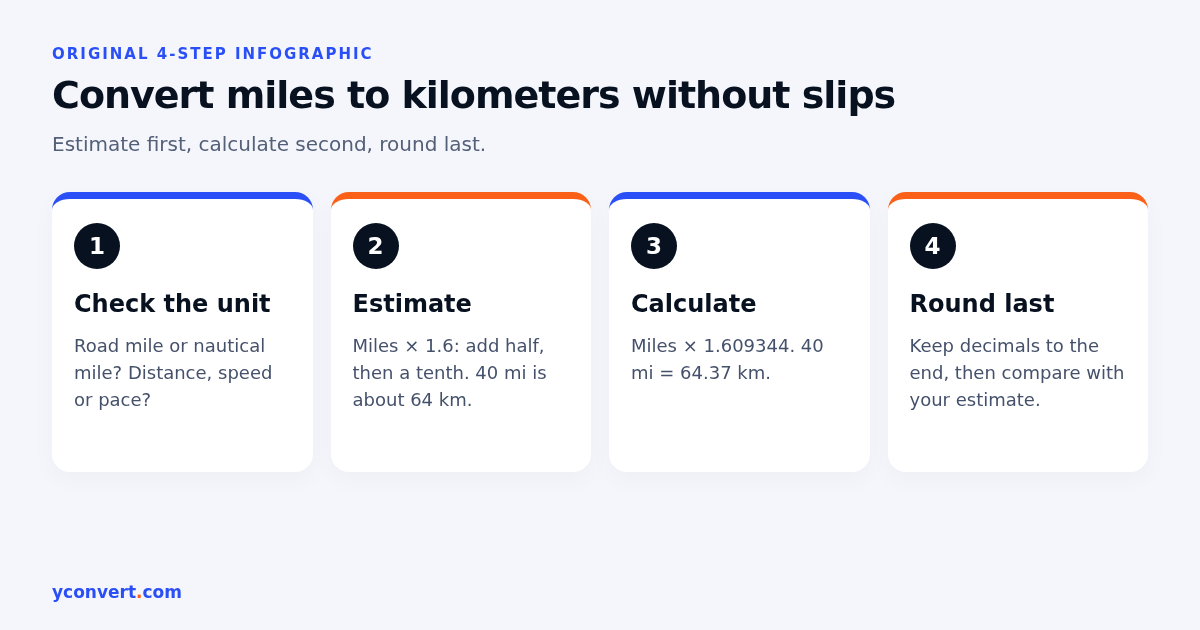
If you want a routine you can repeat, here’s mine:
- Check the unit. Is it a road mile or a nautical mile? Is it distance, speed or pace?
- Estimate first. Multiply by 1.6 in your head so you know roughly what to expect.
- Calculate. Multiply by 1.609344, or use the converter.
- Round last. Keep the decimals until the final figure, then compare it against your estimate.
That estimate step sounds fussy. It’s the one that catches a misplaced decimal point before it ends up in a quote, a route plan or a printed flyer.
Where the wrong answer comes from
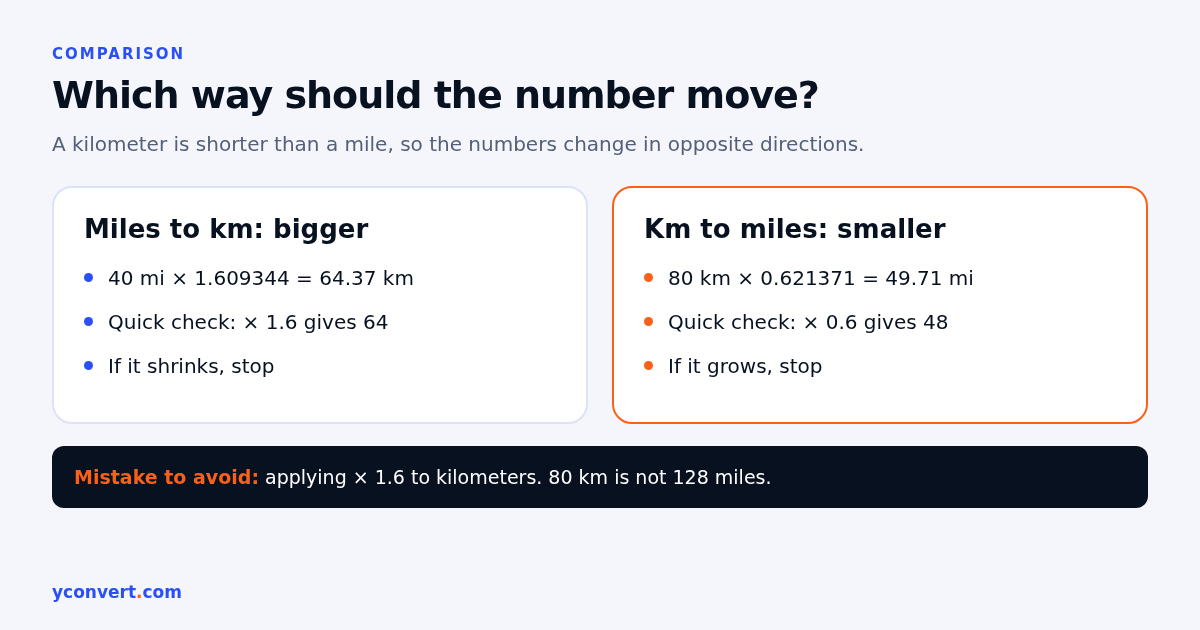
Looking back at the mistakes I’ve seen people make, they fall into a few types. A reversed factor is the biggest. Early rounding comes second. Then there’s reading a speed as a distance. None of them is about maths ability. They’re about not pausing to ask which way the answer should move.
My rule: if you’re going from miles to kilometers, the number should get bigger. If it’s shrinking, stop.
FAQ
How many kilometers are in a mile?
One mile is exactly 1.609344 kilometers. Rounded, that’s 1.61 km, or about 1.6 km for quick sums.
How do I convert miles to kilometers quickly in my head?
Multiply by 1.6. Take the number, add half of it and then a tenth. For 30 miles, that’s 30 + 15 + 3 = 48 km. The exact answer is 48.28 km.
How many miles is 10 km?
10 km is about 6.21 miles (6.21371). Multiply the kilometers by 0.621371, or by 0.6 and add a little for a rough answer.
Is a marathon 26.2 miles or 42.195 km?
Both, with rounding. The official distance is 42.195 km, which is 26.2188 miles. The usual “26.2” is a rounded figure.
What is 60 mph in km/h?
60 mph is 96.56 km/h. At 100 km/h you’re doing about 62.14 mph.
Is a nautical mile the same as a mile?
No. A nautical mile is exactly 1.852 km, while a standard mile is 1.609344 km. The nautical mile is the longer of the two.
Check it before you rely on it
For a single distance, the miles to kilometers tool is the quickest route. If you work with other measurements, the same habits apply: convert the pieces in the right order and estimate first. I covered that for feet and meters in rooms and plots, for centimeters and inches in everyday questions, and for heights from centimeters to feet.
If you also run a site full of practical pages like this, our AEO and SEO audit starts with 1 free credit, then $2 per report, or 10 reports for $15 and 20 for $20. It shows whether search and answer engines are picking up your pages.
Last updated: 20 November 2026