Last updated: October 2026
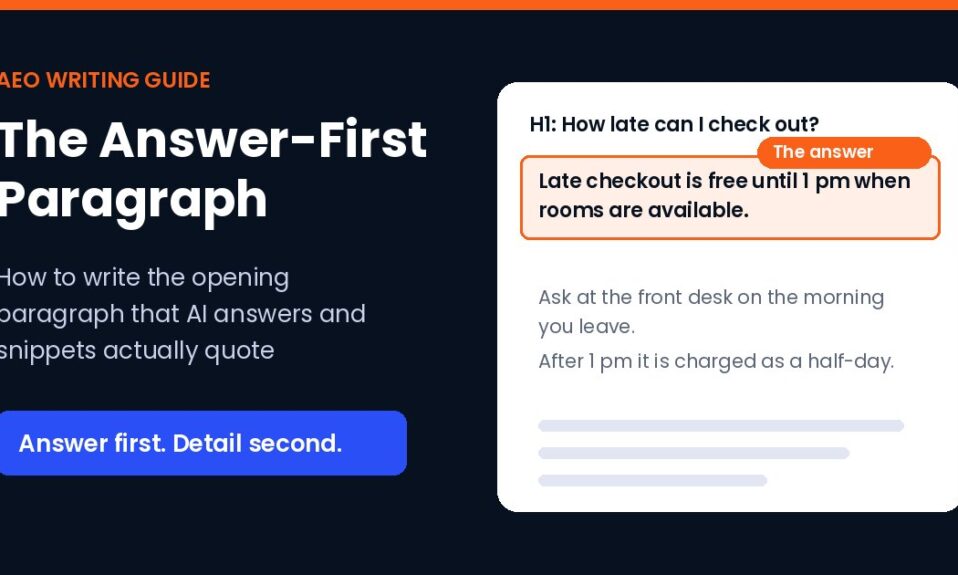
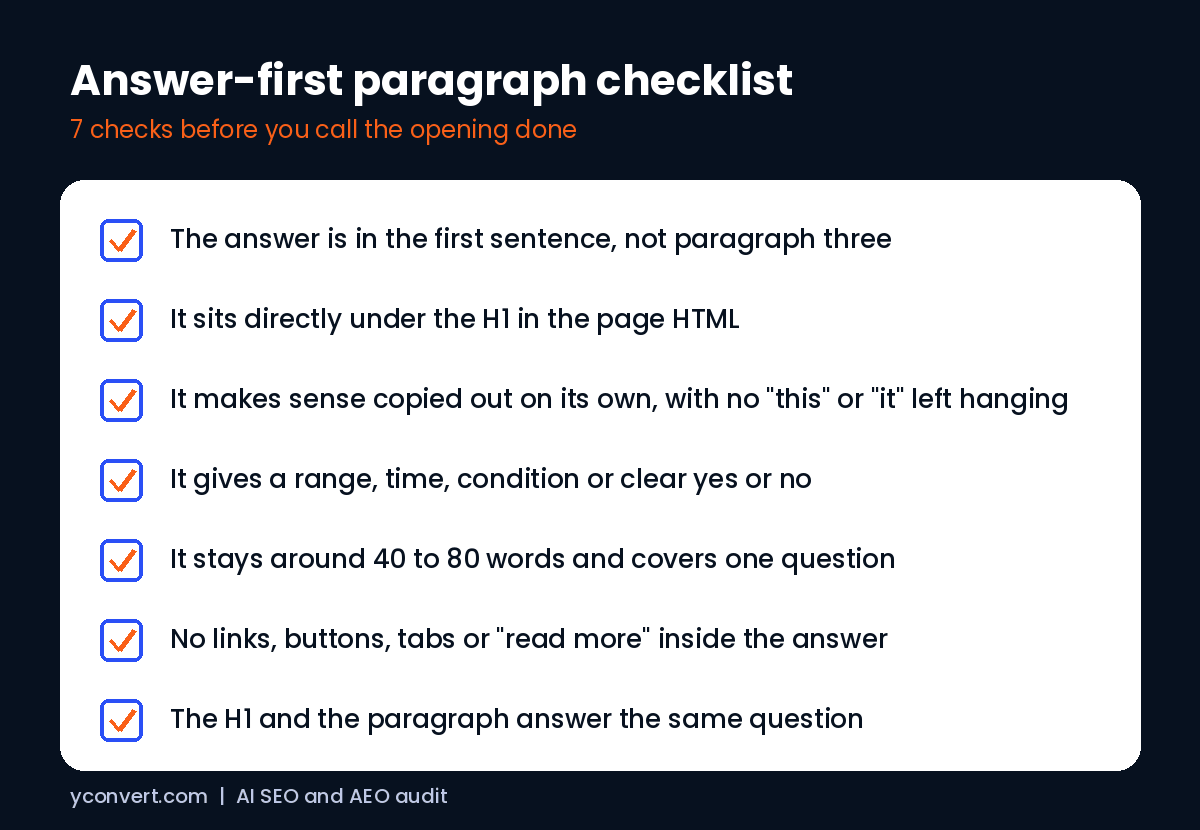
Short answer: an answer-first paragraph puts the direct answer to the page’s main question in its first sentence, then backs it up with one or two specific details, all in 40 to 80 words that still make sense if someone copies them out of the page. No warm-up, no “in this article we will”. AI answers and featured snippets lift passages, not whole pages, so the paragraph that answers cleanly and stands on its own is the one that gets quoted.
That’s the whole idea. Simple to say. Oddly hard to do.
I audit a lot of pages that rank well and still never show up in AI answers, and the opening paragraph is the most common culprit I find. The information is usually there. It’s just spread across six paragraphs, wrapped in background, and introduced with a sentence about how fast things are changing. A person scrolls past that. A system looking for one clean passage moves on to someone else’s page.
What an answer-first paragraph actually is
It’s the paragraph directly under your H1 that answers the question the page exists to answer. Not the intro. The answer.
Three things make it work:
- The conclusion comes first. Sentence one is the answer. Detail second. Background last, or further down the page.
- It stands alone. Paste it into an email to a stranger and it still makes sense. No “as mentioned above”, no “this” pointing at something three paragraphs up.
- It’s specific. A range, a timeframe, a condition, a clear yes or no. Something a reader could act on.
Most of us were taught to write the other way round. Set the scene, build the case, land the point at the end. That works in an essay. On a web page that has to compete for a single quoted passage, it buries the one sentence anyone wanted.
Why AI answers lift some paragraphs and skip others
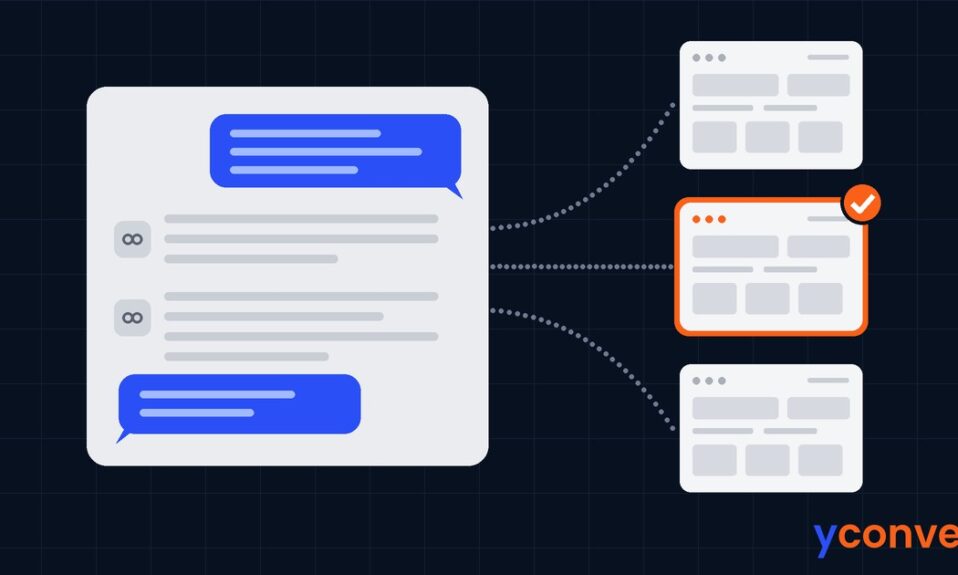
Answer engines don’t read your page top to bottom like a person with a cup of tea. They break it into chunks, find the chunks that match the question, and decide which ones are clean enough to reuse. A paragraph that holds the full answer in a few sentences is easy to reuse. A paragraph that only makes sense next to the one before it isn’t.
This is why I think the “write longer, more comprehensive content” advice gets misread. Depth still matters. It’s what earns trust and keeps readers on the page. But depth without a liftable opening means the system has to assemble your answer for you, and it would rather borrow a ready-made one from a page that did the work.
There’s a second, quieter reason. Pronouns. Once a paragraph is cut out of its page, “it” and “this approach” and “the former” lose whatever they referred to. I now repeat the noun in the answer paragraph even when it reads slightly clunky. Clunky and clear beats smooth and vague here.
How I write an answer-first paragraph, step by step
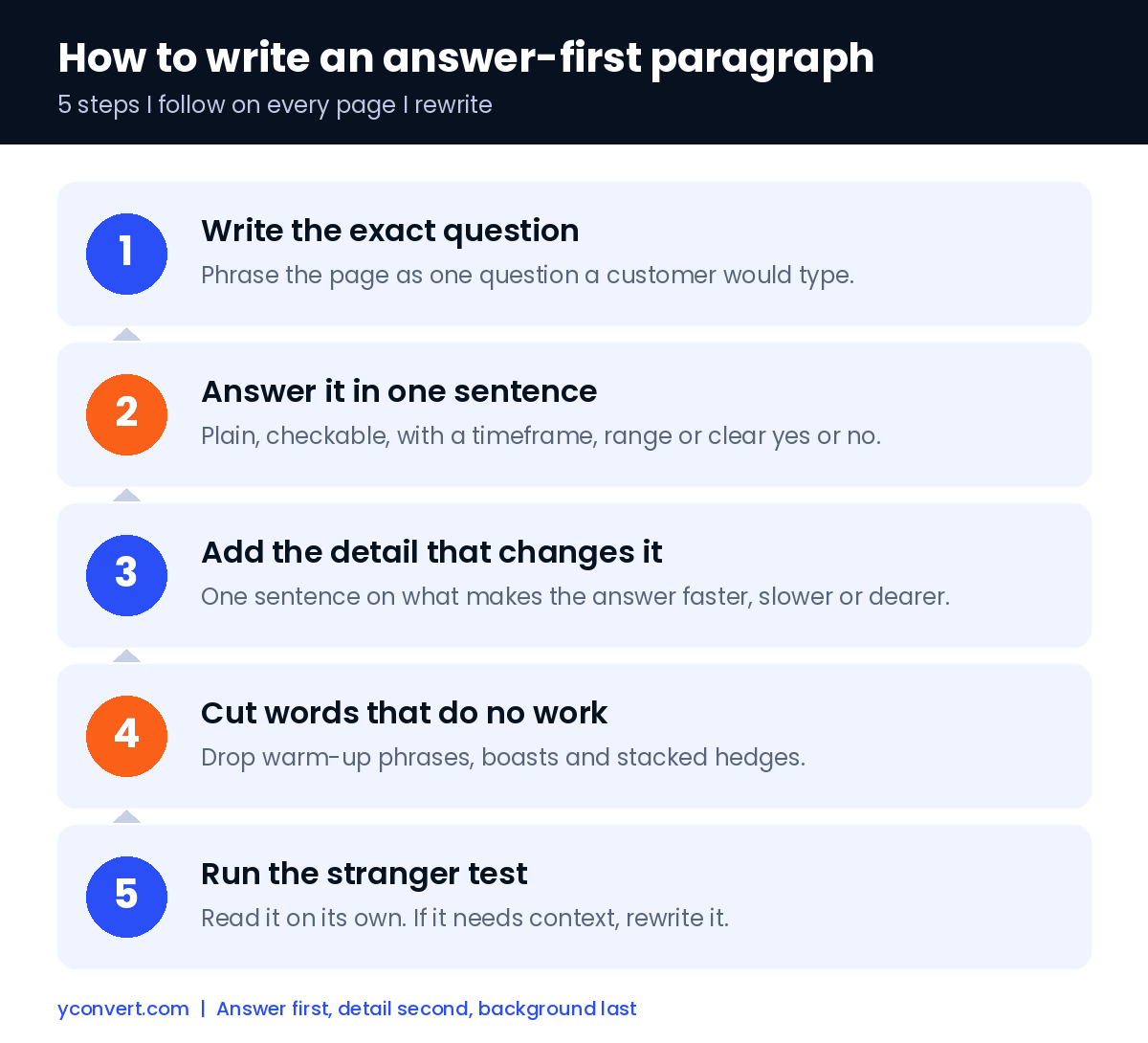
Here’s the routine I follow. I’ll use a plumber’s page about emergency call-outs as the example.
Step 1: Write down the exact question
Not the topic. The question. “How fast can an emergency plumber get to my house?” If you can’t phrase the page as one question, the page is probably trying to do two jobs, and that’s a different problem.
Step 2: Answer it in one sentence
“Most emergency call-outs in our area are reached within the same hour, and we answer the phone around the clock.” Plain. Checkable. If you can’t honestly commit to a number or timeframe, give the condition instead: “usually the same day, faster for burst pipes and no-water situations”.
Step 3: Add the one detail that changes the answer
What makes it faster or slower, cheaper or dearer? For the plumber, that’s location and time of night. One sentence.
Step 4: Cut every word that isn’t doing work
“We pride ourselves on” goes. “It’s worth mentioning that” goes. Anything a reader would skim goes.
Step 5: Run the stranger test
Read the paragraph on its own, ideally out loud. Would someone who has never seen the site understand it? Another check I like: paste it into an AI chat, ask for a one-line summary, and see if the summary matches the answer you meant. If it misses your main point, so will everyone else.
Before and after: three rewrites
These are made-up examples, but they follow patterns I see constantly.
A SaaS pricing page, before:
Choosing the right plan for your team is an important decision. We offer flexible options designed to grow with you, and our team is always happy to help you find the best fit for your needs.
After:
The Starter plan suits teams of up to five people and is billed monthly with no contract. Larger teams usually move to the Team plan, which adds shared workspaces and admin controls. Both plans include a free trial, and you can switch plans at any time.
The first version says nothing a competitor couldn’t also say. The second answers “which plan do I need?” before the reader has to ask. And notice there’s no “contact us for pricing” in it. Vague pricing language gives an answer engine nothing to quote, so it quotes the rival who gave a range.
An accountant’s page on filing deadlines, before:
Tax season can be stressful, and many small business owners find themselves unsure about what is required of them. In this guide, we’ll walk you through everything you need to know.
After:
Most sole traders need to file their return and pay any tax owed by the official annual deadline, and filing late usually brings an automatic penalty even if no tax is due. If your records aren’t ready, file an estimate on time and correct it later rather than missing the date.
I kept the jurisdiction generic on purpose here. On a real page, you’d name the actual deadline for your country. That’s the bit people come for.
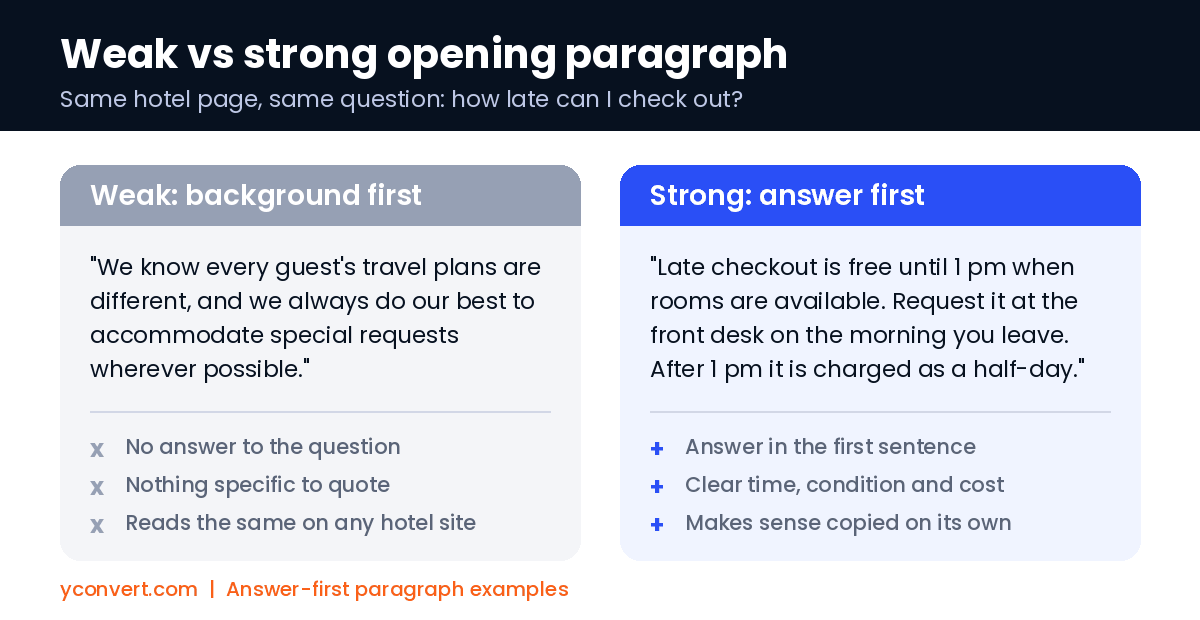
A hotel’s page on late checkout, before:
We know that every guest’s travel plans are different, and we always do our best to accommodate special requests wherever possible.
After:
Late checkout is free until 1 pm when rooms are available, and you can request it at the front desk on the morning you leave. Checkout after 1 pm is charged as a half-day.
Shorter, and far more useful. Length was never the goal.
Match the shape to the question
Not every question wants the same kind of answer. This is the cheat sheet I keep beside me when I rewrite openings:
| Question type | First sentence should give | Then add |
|---|---|---|
| What is X? | A plain definition in everyday words | How it works, when it’s used |
| How do I do X? | The number of steps and roughly how long it takes | What you need before you start |
| How much does X cost? | A realistic price range | What pushes the price up or down |
| X or Y? | Who each option suits | The one difference that usually decides it |
| Can I / should I? | Yes, no, or “it depends on” one named condition | The condition and what to do next |
The cost row is the one most businesses skip. I understand the nervousness about publishing prices. But a range with honest conditions (“most fillings fall within this range; deeper decay costs more”) is what a dental clinic’s page needs to get quoted on a cost question. Without it, the clinic simply isn’t in the answer.
Where the paragraph goes on the page
Directly under the H1, in the actual HTML. That sounds obvious, so here’s where it goes wrong in practice:
- A hero banner, a promo strip or an author box sits above it. Readers see the answer near the top, but in the source code it’s fourth or fifth in line.
- It’s inside an accordion, a tab or a “read more”. Some crawlers never open those. If the answer only appears after a click, treat it as missing.
- CSS moves it up visually. Source order is what gets read, not where it lands on screen.
- There’s a button or three links inside it. Keep the answer as clean text. Put links and calls to action in the next paragraph.
And don’t hold back half the answer to force a click. I’ve seen teams try this, hoping the teaser drives traffic. In my experience it just makes the passage look incomplete, and the incomplete passage isn’t the one that gets picked.
Mistakes I keep finding in audits
- The answer is in paragraph three, after two paragraphs of context.
- The opening is about the business (“We’ve served the area for years”) rather than the question.
- Every sentence hedges. “Can”, “may”, “might”, “in some cases”. One honest condition is fine. Five is fog.
- The paragraph runs past 150 words because it tries to answer three questions at once.
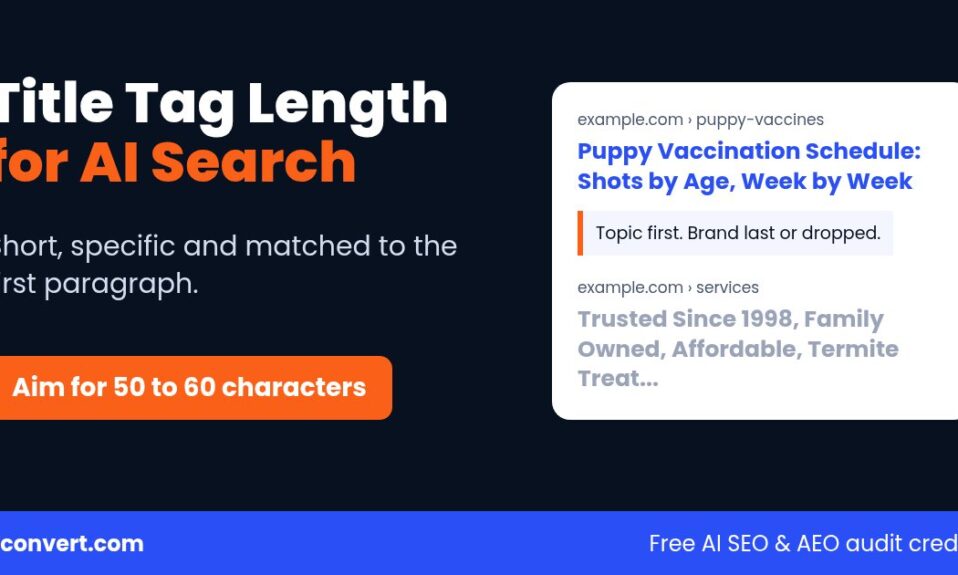
- The H1 asks one question and the first paragraph answers a slightly different one. I cover that mismatch from the title side in title tag length for AI search.
Does answer-first writing make every page sound the same?
It can. That’s my one worry with all of this.
I’m already seeing a drift toward flat, declarative prose everywhere, pages that read like they were written for a parser and nobody else. My take: the first paragraph can be lean and almost plain, because its job is to be quoted. Everything after it should sound like you. Your opinions, your real cases, the thing you’d tell a client over the phone. That’s what makes a page worth citing over the ten other pages that also open with a tidy answer, and it’s what converts the person who does click through.
If a page ranks and still isn’t being picked up, the opening paragraph is the first thing I’d check, then the wider issues I list in ranking but not cited in AI Overviews. For the AI Mode side of things, how to get cited in Google AI Mode goes deeper.
Check your opening paragraphs
You can do this by hand with the five steps above and a word counter to keep the answer tight. If you’d rather have it checked for you, the AI SEO and AEO audit checks if your page answers its main question early and cleanly, along with the other on-page signals I check by hand. You get 1 free credit to try it, then it’s $2 per report, or 10 reports for $15 and 20 for $20.
FAQ
What is an answer-first paragraph?
It’s the opening paragraph of a page that gives the direct answer to the page’s main question in its first sentence, then adds one or two supporting details. It’s written to make sense on its own, so it can be quoted without the rest of the page.
How long should an answer-first paragraph be?
Usually 40 to 80 words. Long enough to answer and add one useful detail, short enough that it holds a single idea. If it runs much past 100 words, it’s probably answering more than one question.
Where should the answer-first paragraph go?
Directly under the H1, as plain text in the page’s HTML. Not inside a tab, an accordion or below a large promo block, and without links or buttons inside the answer itself.
Does answer-first content still help normal Google rankings?
Yes. A clear answer near the top helps readers find what they came for, which supports engagement, and it’s the same kind of passage Google uses for featured snippets. It isn’t a ranking trick on its own, but it rarely hurts.
Can I add an answer-first paragraph to an existing page?
Yes, and it’s often the quickest fix in an audit. Write the page’s main question down, answer it in one sentence, add the key detail, and place it under the H1. Keep the rest of the page as it is unless it contradicts the new opening.