Last updated: November 2026
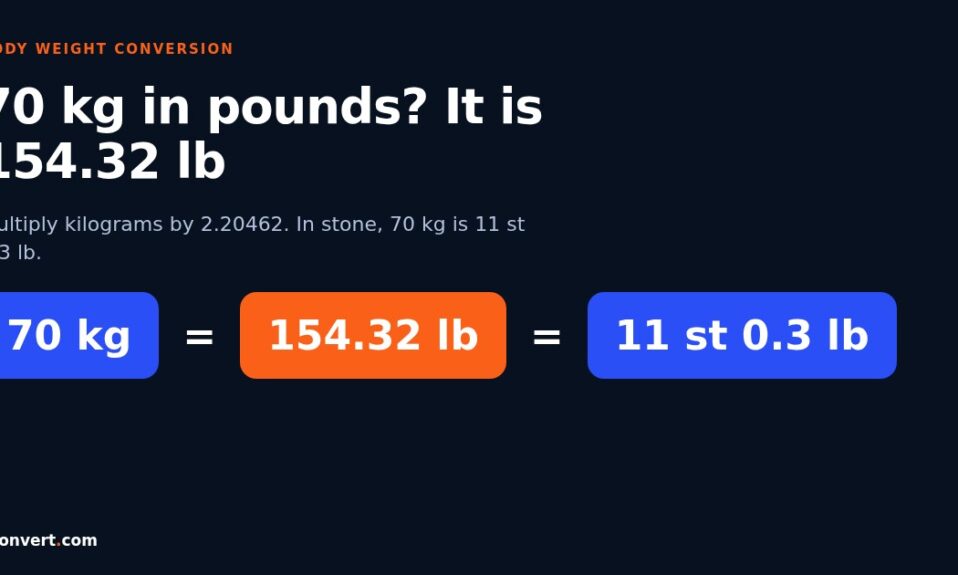
70 kg is 154.32 pounds. Most people round that to 154 lb, and in the UK it’s usually written as 11 stone and about a third of a pound. The exact rule is simple: one pound is defined as exactly 0.45359237 kg, so one kilogram is about 2.20462 lb, and you multiply your weight in kilograms by that number.
I picked 70 kg for the title because it’s one of the most common body weights people look up. It sits right in the middle of the range most adults fall into, and it shows up constantly on medical forms, fitness apps and visa paperwork. But the real questions people ask go beyond one number. Why does my scale disagree with my phone? Should I round? What on earth is a stone?
So this page is the body weight version of the conversion. If you want the full method with parcels, gym plates and spreadsheet formulas, my main guide on how to convert kilograms to pounds covers it step by step. Here I’m sticking to the questions about your own weight.
What is 70 kg in pounds, worked out
Here’s the arithmetic so you can check it on any calculator.
70 × 2.20462 = 154.32 lb.
That’s it. If you’d rather work from the exact definition, divide instead: 70 ÷ 0.45359237 = 154.3236 lb. Same answer, a couple more decimals.
The quick mental version is “double it and add 10%”. Double 70 is 140, add 10% of 140 and you get 154. Close enough for conversation, and it’s off by about a third of a pound. For a doctor’s form, use the exact figure.
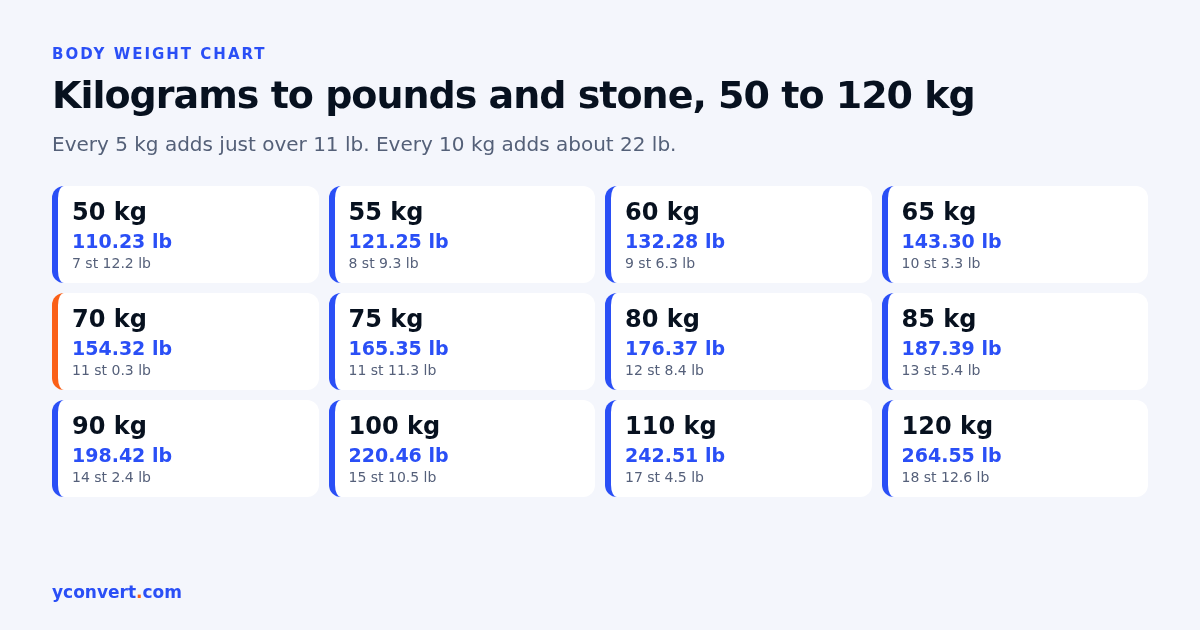
Body weights from 50 kg to 120 kg
Below are the values I get asked about most. I’ve kept two decimals for pounds and shown stone and pounds for anyone filling in a UK form.
| Kilograms | Pounds | Stone and pounds |
|---|---|---|
| 50 kg | 110.23 lb | 7 st 12.2 lb |
| 55 kg | 121.25 lb | 8 st 9.3 lb |
| 60 kg | 132.28 lb | 9 st 6.3 lb |
| 65 kg | 143.30 lb | 10 st 3.3 lb |
| 70 kg | 154.32 lb | 11 st 0.3 lb |
| 75 kg | 165.35 lb | 11 st 11.3 lb |
| 80 kg | 176.37 lb | 12 st 8.4 lb |
| 85 kg | 187.39 lb | 13 st 5.4 lb |
| 90 kg | 198.42 lb | 14 st 2.4 lb |
| 100 kg | 220.46 lb | 15 st 10.5 lb |
| 110 kg | 242.51 lb | 17 st 4.5 lb |
| 120 kg | 264.55 lb | 18 st 12.6 lb |
Notice the pattern. Every 5 kg adds just over 11 lb. Every 10 kg adds about 22 lb. Once that sticks, you can estimate any weight in your head and only reach for a converter when the number actually matters.
Is 154 lb the same as 70 kg?
Nearly. 154 lb converts back to 69.85 kg. So if you round 70 kg down to 154 lb and someone converts it back, they’ll see 69.9 kg, not 70.
This is the round trip problem, and it catches people out more than the conversion itself. A physiotherapy clinic I can picture easily: the intake sheet asks for weight in pounds, the patient writes 154, and the clinic software stores it in kilograms. Now the record says 69.85 kg while the patient’s own scale said 70.0. Nobody made a mistake. The rounding just happened twice.
My rule is to convert once, from whatever your scale actually displayed, and write down the result. Don’t convert a converted number.
Why does my scale show a different number than my app?
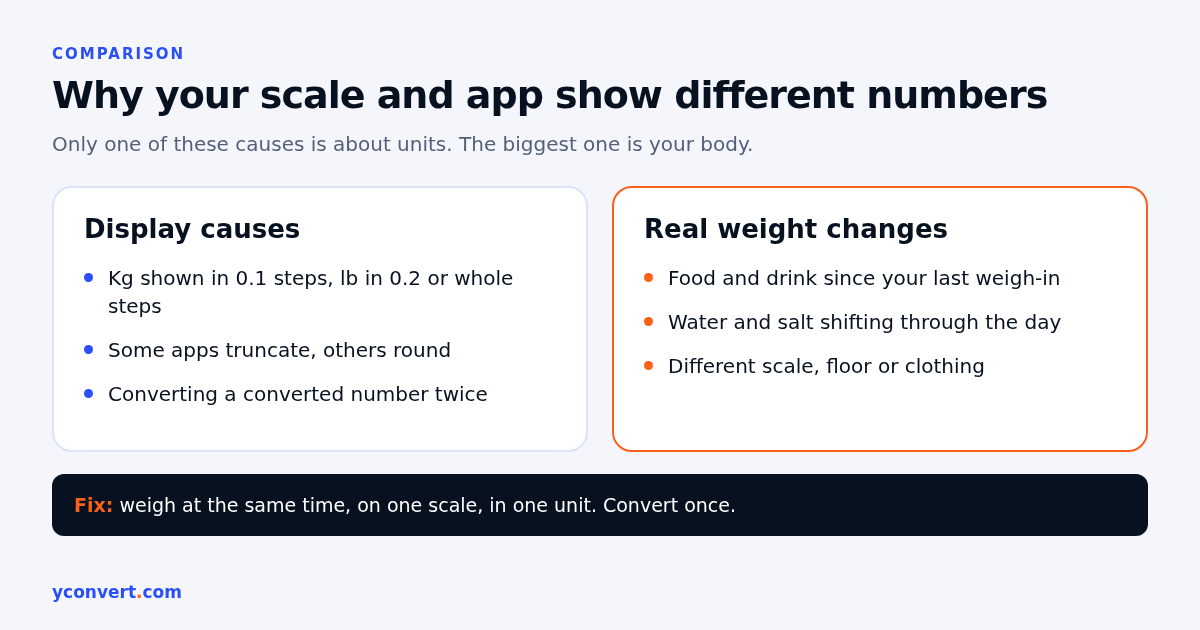
Usually it’s one of three things, and only one of them is about units.
Rounding steps. Many bathroom scales show kilograms in 0.1 kg steps but pounds in 0.2 lb steps, or whole pounds on cheaper models. Switch units and the reading can jump by a fraction even though you didn’t move.
Truncating instead of rounding. Some apps cut off the decimals rather than rounding. 154.32 becomes 154 either way, but 154.8 lb shows as 154 in a truncating app and 155 in a rounding one.
You actually weigh a different amount. This is the one people underestimate. Body weight moves through the day with food, water and salt. Weighing after dinner and again the next morning can easily show a difference bigger than any rounding error. That’s not a conversion problem at all.
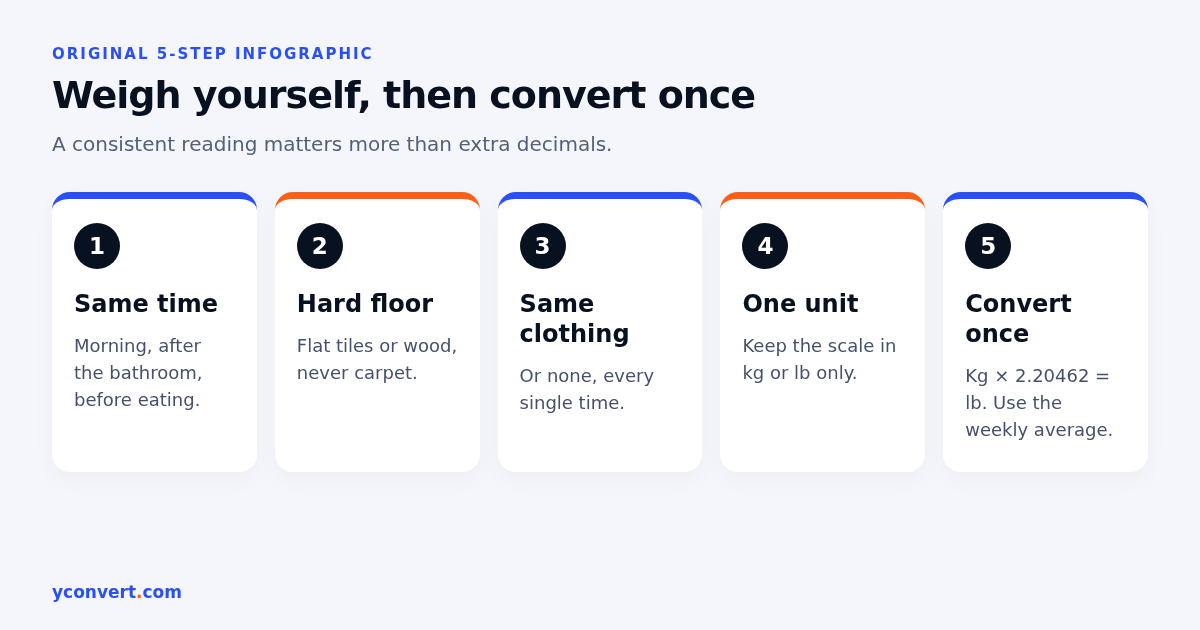
How to weigh yourself so the number is worth converting
There’s no point converting 70.3 kg to four decimal places if tomorrow’s reading will be 69.6. Consistency matters far more than precision here. What I’d do:
- Weigh at the same time each day, ideally in the morning after using the bathroom and before eating.
- Put the scale on a hard, flat floor. Carpet and uneven tiles throw readings off.
- Wear the same thing, or nothing, every time.
- Stick to one unit on the scale. Convert only when someone else asks for the other one.
- Look at the weekly average rather than any single day.
Coaches tend to say the same thing in different words: the trend is the signal and the daily number is mostly noise. A gym coach tracking a client’s progress over a month cares whether the average went from 72 to 70 kg, not whether Tuesday read 71.4.
What is a stone, and how do I convert kg to stone?
A stone is 14 pounds, which works out to exactly 6.35029318 kg. It’s still the everyday way to talk about body weight in the UK and Ireland, even though official records use kilograms.
To convert, first turn kilograms into pounds, then divide by 14. The whole number is your stone. Multiply the leftover decimal by 14 to get the remaining pounds.
Take 70 kg again. 154.32 ÷ 14 = 11.02. So that’s 11 stone, and 0.02 × 14 gives about 0.3 lb. Written out: 11 st 0.3 lb, or simply “11 stone” in conversation.
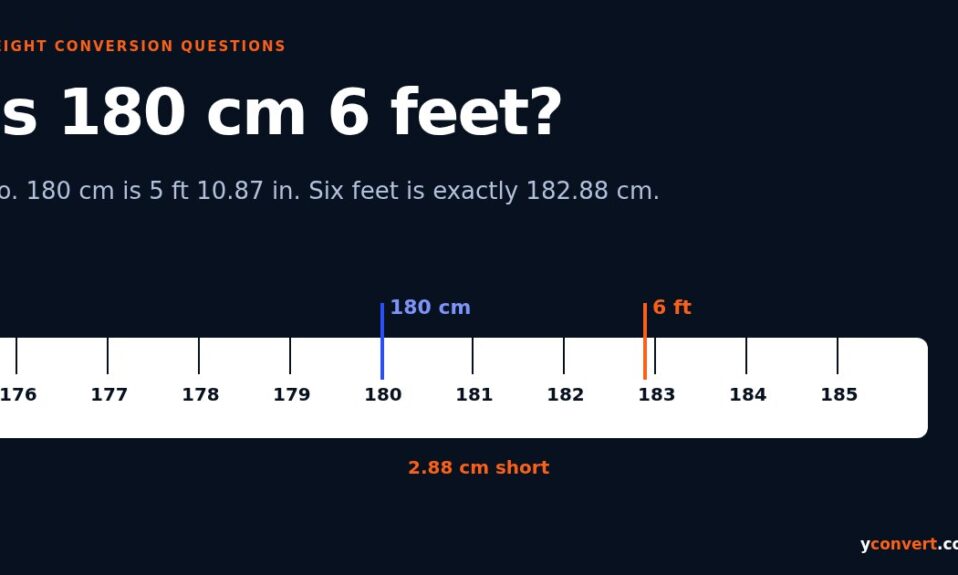
One thing I see go wrong: people write 11.02 stone and assume it means 11 stone 2 pounds. It doesn’t. Decimal stone and stone-and-pounds are different formats, the same trap as decimal feet versus feet and inches. I wrote about that height version in is 180 cm 6 feet, and the logic is identical.
Which number should I write on a form?
Use the unit the form asks for, every time. If a visa application wants kilograms, give kilograms straight from your scale. Don’t convert to pounds and back.
When a form asks for pounds and your scale shows kilograms, multiply by 2.20462 and round to the nearest whole pound unless it asks for decimals. That’s the usual convention.
Where it really matters is anything with a limit attached. A boxing gym’s weigh-in, a ride with a maximum passenger weight, a medical dose that a pharmacist calculates per kilogram. In those cases don’t round in your favour, and don’t estimate. If a clinician needs your weight in kilograms for a dose, give them the kilogram reading, not a converted pound figure. Better still, let them weigh you.
Going the other way: pounds to kilograms
If your scale is in pounds and you need kilograms, multiply by 0.45359237, or divide by 2.20462. 160 lb is 72.57 kg. 180 lb is 81.65 kg. 200 lb is 90.72 kg.
The full walkthrough, with the two mental shortcuts that miss in opposite directions, is in my guide to converting pounds to kilograms. The pounds to kilograms converter does it instantly.
The fastest way to check your number
For a single weight, the kilograms to pounds converter gives you the exact value with no sign-up. Type the kilograms, read the pounds. I use it whenever a number is going onto a form, because mental maths is fine for chat and not fine for paperwork.
And if you run a website and want to know whether pages like this one are set up to show up in AI answers, yconvert’s AEO and SEO audit gives you one free credit to try it. After that it’s $2 a report, 10 reports for $15 or 20 for $20.
FAQ
How many pounds is 70 kg?
70 kg is 154.32 lb. Multiply kilograms by 2.20462 to get pounds. Rounded to a whole number, 70 kg is 154 lb.
Is 70 kg 11 stone?
Almost exactly. 70 kg is 154.32 lb, and one stone is 14 lb, so 70 kg is 11 stone and about 0.3 lb.
How do I convert my weight from kg to lbs quickly?
Double the kilograms and add 10% of the result. For 70 kg, double is 140, plus 14 gives 154 lb. The exact answer is 154.32 lb, so the shortcut is close but not exact.
Why does my weight change when I switch the scale from kg to lb?
Many scales use different display steps for each unit, such as 0.1 kg but 0.2 lb or whole pounds. The weight is the same, but the rounding of the displayed number changes.
What is 154 lb in kg?
154 lb is 69.85 kg. Multiply pounds by 0.45359237 to get kilograms.