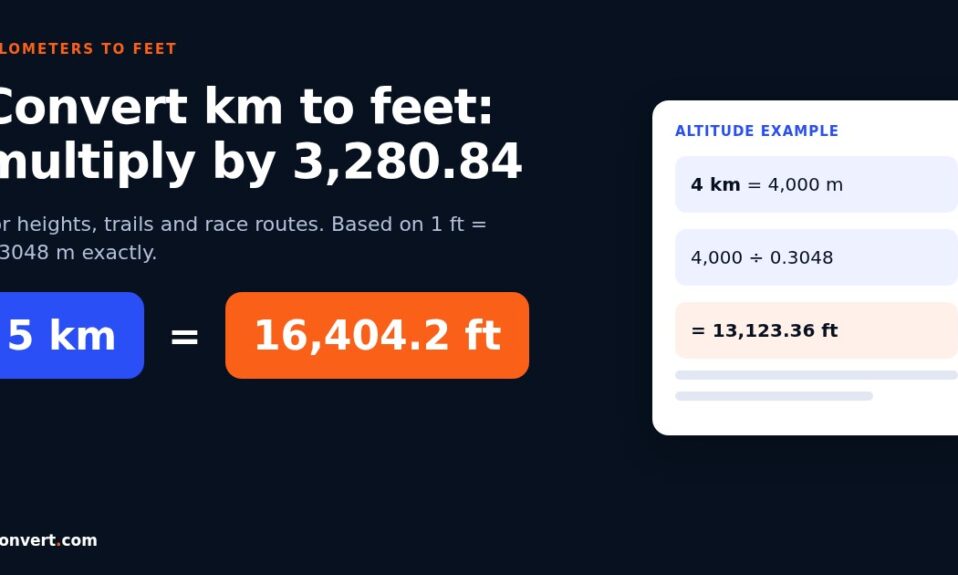
To convert kilometers to feet, multiply the kilometers by 3,280.84. So 1 km is about 3,280.84 ft, 2 km is about 6,561.68 ft and 5 km is about 16,404.2 ft. The factor comes from two exact definitions: a kilometer is 1,000 meters, and a foot is exactly 0.3048 meters. Divide 1,000 by 0.3048 and you get 3,280.8399 and a long tail of decimals, which is why every answer here is rounded somewhere.
That’s the whole formula. But I almost never get asked to turn a flat distance into feet for its own sake. The question usually shows up when two systems meet. A trail map in meters and a hiking app set to feet. A climb profile in kilometers and a rider who thinks in feet of gain. An exit altitude written one way on a booking page and read another way by a visitor. This guide covers the formula, a chart, a quick way to do it in your head and a few jobs where the conversion actually decides something.
The kilometers to feet formula
feet = kilometers × 3,280.84
And going back:
kilometers = feet ÷ 3,280.84
If you’d rather work from the exact definition, do it in two steps. Turn kilometers into meters (multiply by 1,000), then divide by 0.3048. That route never rounds until you choose to.
A few to check:
- 0.5 km × 3,280.84 = 1,640.42 ft
- 3 km × 3,280.84 = 9,842.52 ft
- 10 km × 3,280.84 = 32,808.4 ft
The kilometers to feet converter does this in one step. Type the kilometers, read off the feet. Decimal inputs like 0.75 or 2.4 work fine.
One thing worth knowing about that 3,280.84. It isn’t a measured value that might get revised. The foot was fixed at 0.3048 m by international agreement in 1959, so the factor is settled. The only choice you make is how many decimals to keep.
Kilometers to feet chart
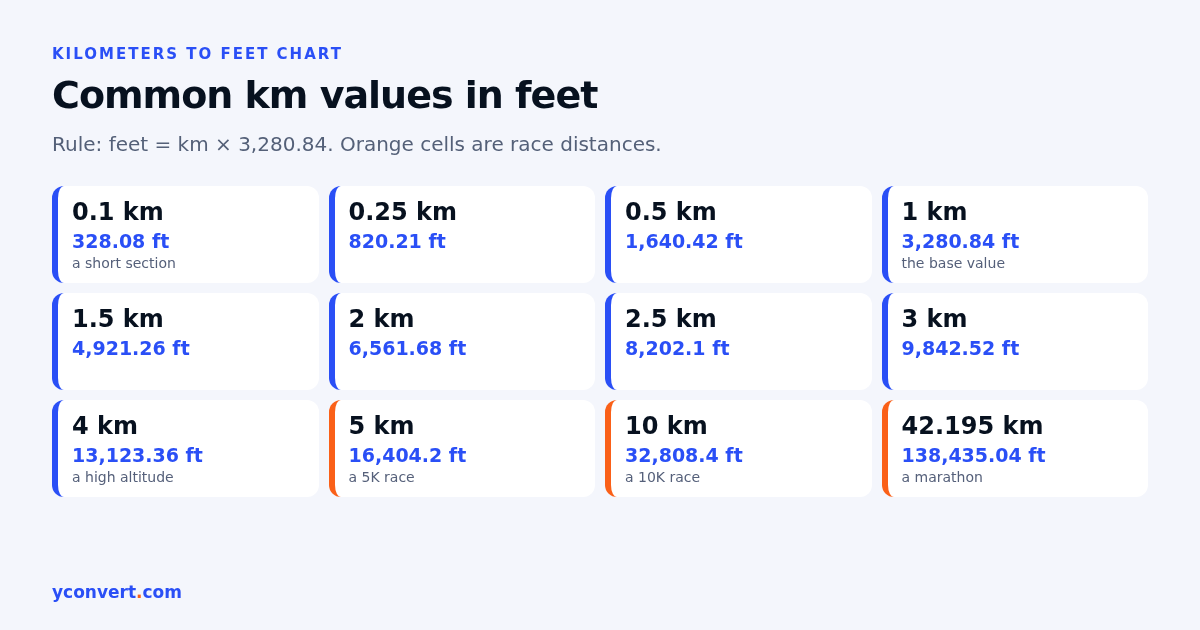
These are the values I see most often. Feet are rounded to one or two decimals.
| Kilometers | Feet | Where it tends to come up |
|---|---|---|
| 0.1 km | 328.08 ft | A short bridge or a sprint section |
| 0.25 km | 820.21 ft | A block of city streets |
| 0.5 km | 1,640.42 ft | A stretch of riverside path |
| 1 km | 3,280.84 ft | The base value |
| 1.5 km | 4,921.26 ft | A cloud base or a ridge height |
| 2 km | 6,561.68 ft | A survey traverse |
| 2.5 km | 8,202.1 ft | A mountain pass or high town |
| 3 km | 9,842.52 ft | A long cycling climb |
| 5 km | 16,404.2 ft | A 5K race |
| 10 km | 32,808.4 ft | A 10K race |
| 21.0975 km | 69,217.52 ft | A half marathon |
| 42.195 km | 138,435.04 ft | A marathon |
Notice how quickly the numbers grow. Feet are a small unit, so anything past a couple of kilometers turns into five or six digits. That’s often the first sign that feet might be the wrong unit for the reader. For flat distances over about a mile, most people in feet-based countries switch to miles anyway.
Doing it in your head
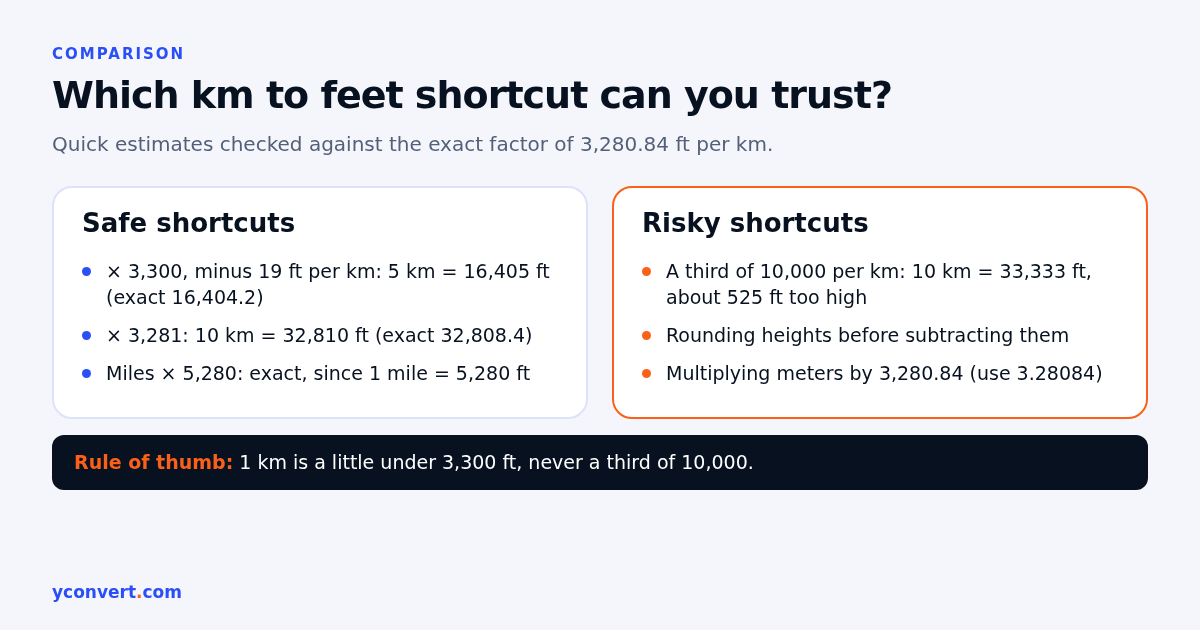
I use 3,300 and then correct it.
Multiply the kilometers by 3,300. Then take off about 19 ft for every kilometer, because 3,300 is 19.16 ft too high per km.
Say it’s 5 km. 5 × 3,300 = 16,500. Take off 5 × 19 = 95. That gives 16,405 ft. The exact answer is 16,404.2 ft. Close enough for almost anything you’d do without a calculator.
For a really rough figure, “a kilometer is a bit under 3,300 feet” works. Don’t use “a third of 10,000” (3,333). It sounds tidy, but it runs about 1.6% high, which over a long climb adds up to a few hundred feet you never actually climbed.
There’s also the miles route. One mile is exactly 5,280 ft and exactly 1.609344 km. If you already know a distance in miles, multiply by 5,280 and skip kilometers entirely. My post on converting feet to miles covers that side, and if your starting number is in miles, the guide to converting miles to kilometers has a shortcut of its own.
Where kilometers to feet actually matters
Same multiplication every time. What changes is the thing being measured (a distance along the ground, or a height above it) and how much rounding the job can take. A few patterns from different kinds of work.
A race organiser writing course notes
Say a 10K route crosses a bridge section that’s 0.4 km long and has a start corral 0.15 km deep. Local permits or venue staff may ask for those in feet: 1,312.34 ft and 492.13 ft. Nobody needs the decimals. Rounding to 1,312 ft and 492 ft is fine. What matters is not mixing units on the same sheet, which is how a marshal ends up standing in the wrong place.
A skydiving centre listing exit altitude
Altitude in aviation is commonly given in feet, even in countries that use metric everywhere else. So if a booking page says a jump goes from 4 km, a lot of visitors will expect to see that as roughly 13,000 ft. The exact figure is 13,123.36 ft. I’d show both on the page. It answers the question before anyone has to ask it, and it stops two staff members quoting slightly different numbers.
A mountain guiding company planning a trip
Trip notes might put a high camp at 3.2 km and a summit at 4.1 km. In feet that’s 10,498.69 ft and 13,451.44 ft, which makes the summit day a gain of 0.9 km, or 2,952.76 ft. Here’s the habit I’d keep: convert each height, then subtract. Or subtract first, then convert. Both give the same answer, as long as you don’t round the individual heights to the nearest hundred before subtracting. That’s where “about 3,000 ft” can quietly become 2,900 or 3,100.
A land survey firm handling older records
This one is subtle. The United States used two slightly different feet for years: the international foot (0.3048 m) and the US survey foot (1,200 ÷ 3,937 m). The survey foot was officially retired at the start of 2023, but older plats and records still use it. Over 2 km the gap is about 0.013 ft, around 4 mm. Over 100 km it grows to roughly 0.66 ft. For a garden it’s nothing. For a long control line tied to legacy coordinates, you need to know which foot the original surveyor meant.
A cycling club sharing a climb
A climb might be listed as 6 km long with 480 m of elevation gain. In feet that’s 19,685.04 ft of road and 1,574.8 ft of climbing. The average gradient is 8% in both systems, because a gradient is a ratio and the units cancel. I like pointing this out to riders who think the climb “looks steeper” in feet. It’s the same hill.
Convert kilometers to feet in 4 steps
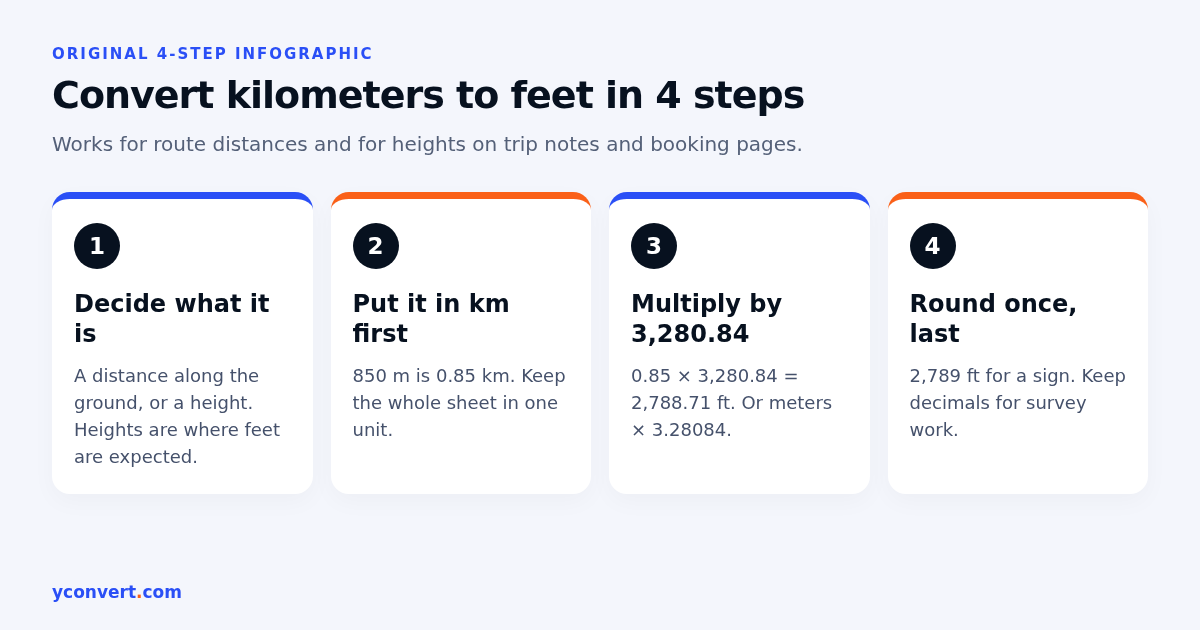
When a route sheet or trip plan mixes kilometers, meters and feet, this is the routine I follow:
- Decide what you’re converting. A distance along the ground, or a height. Heights are where feet are most often expected.
- Get everything into kilometers or meters first. 850 m is 0.85 km. Don’t convert half the sheet from meters and half from kilometers.
- Multiply by 3,280.84. Or meters by 3.28084. Or paste the value into the converter.
- Round once, at the end. Whole feet for signs and booking pages. One or two decimals for survey work.
A sanity check I always run: the answer in feet should be a little over three thousand times the kilometers. If 2 km comes out as 656 ft, a decimal has slipped. It’s 6,561.68.
Common mistakes with kilometers and feet
Using 3,333 instead of 3,280.84
Covered above. It feels like a neat shortcut, but it’s always too high. Use 3,300 and correct it, or just use the real factor.
Forgetting that meters sit in between
A lot of heights are written in meters, not kilometers. 2,500 m is 2.5 km, which is 8,202.1 ft. Multiply 2,500 by 3,280.84 by mistake and you get over 8 million feet. If your figure is already in meters, multiply by 3.28084 instead, and my guide to converting feet to meters walks through the reverse.
Rounding heights before subtracting them
Round each height to the nearest hundred feet and the difference between them can be off by up to a hundred feet either way. Keep the decimals, subtract, then round.
Giving distances in feet when miles would read better
138,435 ft is technically correct for a marathon. It’s also useless to a reader. Past a couple of kilometers, feet stop helping. Use miles for the distance and keep feet for heights and short sections.
FAQ
How do I convert kilometers to feet?
Multiply the kilometers by 3,280.84. For example, 3 km × 3,280.84 = 9,842.52 ft. For an exact result, multiply by 1,000 to get meters and then divide by 0.3048.
How many feet are in 1 kilometer?
One kilometer is about 3,280.84 feet. The exact value is 1,000 ÷ 0.3048, which is 3,280.8399 ft with more decimals after that.
How many feet is 5 km?
5 km is about 16,404.2 feet, because 5 × 3,280.84 = 16,404.2.
Why is altitude given in feet when distance is in kilometers?
Aviation commonly uses feet for altitude, including in many countries that use metric units for everything else. That’s why heights on flight-related pages often need converting even when distances don’t.
What is the difference between a US survey foot and an international foot?
The international foot is exactly 0.3048 m. The US survey foot is 1,200 ÷ 3,937 m, very slightly longer. The survey foot was retired at the start of 2023, but older survey records may still use it.
How do I convert feet back to kilometers?
Divide the feet by 3,280.84. For example, 9,842.52 ft ÷ 3,280.84 = 3 km.
Before you print the route sheet
If you want the figure without the long multiplication, the km to feet converter gives it in one step. And if your number is a road distance rather than a height, the kilometers to miles converter will probably serve your reader better.
And if you run a site full of practical pages like this one, our AEO and SEO audit starts with 1 free credit, then $2 per report, or 10 reports for $15 and 20 for $20. It shows whether search and answer engines are picking up your pages.
Last updated: 26 November 2026