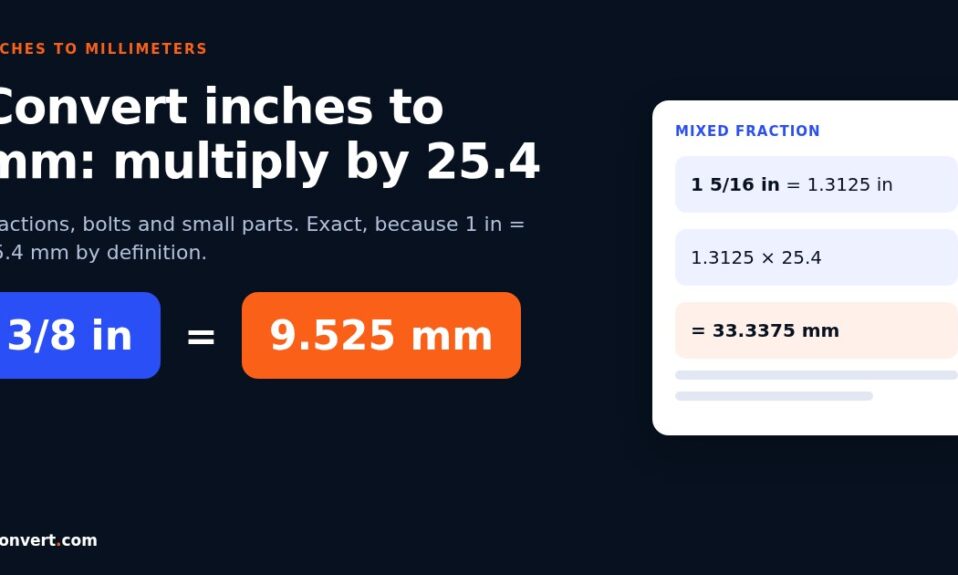
To convert inches to mm, multiply the inches by 25.4. So 1 inch is 25.4 mm, 2 inches is 50.8 mm and 6 inches is 152.4 mm. That factor is exact. The inch has been defined as precisely 25.4 millimeters since 1959, so there’s no rounding hidden inside it. For a fraction like 3/8 in, divide the top number by the bottom one first (3 ÷ 8 = 0.375), then multiply: 0.375 × 25.4 = 9.525 mm.
Simple enough on paper. In practice, the inches I get asked about are rarely whole numbers. They’re 5/16, 1 3/8, 0.005. They’re stamped on a bolt head, printed on a drill index or buried in a parts drawing from another country. This guide is about those small, awkward numbers: the formula, a fractions chart, a way to do it in your head, and a few jobs where half a millimeter is the difference between fitting and not.
The inches to mm formula
One line:
mm = inches × 25.4
And the reverse:
inches = mm ÷ 25.4
A few to check on your own calculator:
- 4 in × 25.4 = 101.6 mm
- 0.75 in × 25.4 = 19.05 mm
- 12 in × 25.4 = 304.8 mm
The inches to mm converter does the multiplication for you. Type the inches in decimal form, convert, and read off the millimeters. If you have a fraction, turn it into a decimal first. More on that below.
Why trust 25.4 to every decimal place? Because it isn’t a measurement anyone took. It’s a definition. Countries agreed on it so that an inch in one workshop matches an inch in another, and a millimeter figure worked out from it is exact too, as long as you don’t round along the way.
Fractions of an inch in mm
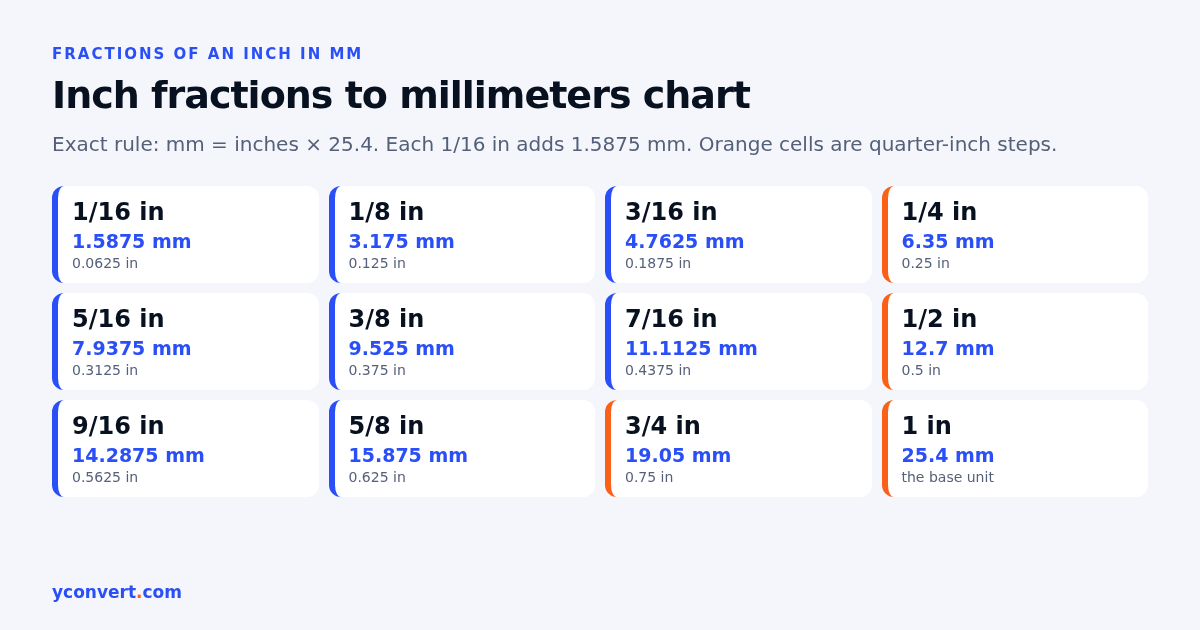
Fractions are where most people slow down, so here’s the chart I’d pin above a workbench. Every value is exact.
| Inches | Decimal inches | Millimeters |
|---|---|---|
| 1/16 in | 0.0625 | 1.5875 mm |
| 1/8 in | 0.125 | 3.175 mm |
| 3/16 in | 0.1875 | 4.7625 mm |
| 1/4 in | 0.25 | 6.35 mm |
| 5/16 in | 0.3125 | 7.9375 mm |
| 3/8 in | 0.375 | 9.525 mm |
| 7/16 in | 0.4375 | 11.1125 mm |
| 1/2 in | 0.5 | 12.7 mm |
| 9/16 in | 0.5625 | 14.2875 mm |
| 5/8 in | 0.625 | 15.875 mm |
| 3/4 in | 0.75 | 19.05 mm |
| 7/8 in | 0.875 | 22.225 mm |
| 1 in | 1 | 25.4 mm |
A pattern worth noticing. Every sixteenth is 1.5875 mm. So any fraction in sixteenths is just “how many sixteenths × 1.5875”. Take 11/16: 11 × 1.5875 = 17.4625 mm. No chart needed.
That’s also why the millimeter values look so long. The fractions halve again and again, and each halving adds a decimal place. You’ll almost never need all of them. But you should decide how many to keep, rather than letting the calculator decide for you.
Mixed numbers like 1 5/16 in
Mixed numbers trip people up because there are two parts to handle. I do it in three moves:
- Split the whole inches from the fraction. 1 5/16 is 1 and 5/16.
- Turn the fraction into a decimal. 5 ÷ 16 = 0.3125, so the total is 1.3125 in.
- Multiply by 25.4. 1.3125 × 25.4 = 33.3375 mm.
Another one: 2 3/8 in is 2.375 in, and 2.375 × 25.4 = 60.325 mm.
The mistake I see most is typing 1 5/16 as 1.516 or 1.5. Neither is right. Fractions and decimals aren’t interchangeable just because they share digits.
Converting inches to mm in your head
Without a calculator, I split 25.4 into 25 and 0.4.
Say it’s 7 inches. 7 × 25 = 175. Then 7 × 0.4 = 2.8. Add them: 177.8 mm. Exact.
Multiplying by 25 is easier than it looks, too. It’s the same as multiplying by 100 and dividing by 4. Seven hundred divided by four is 175.
For quick estimates, “an inch is about 25 mm” works. Just know it always comes out short, by 0.4 mm per inch. Over 10 inches you’re 4 mm under. On a shelf, nobody cares. On a bearing seat or a printed part that has to clip into something, it matters a lot.
Where inches to mm actually matters
Same multiplication every time. What differs is how much error each job can absorb. A few situations I run into, each from a different kind of business.
A car repair workshop matching spanners to bolts
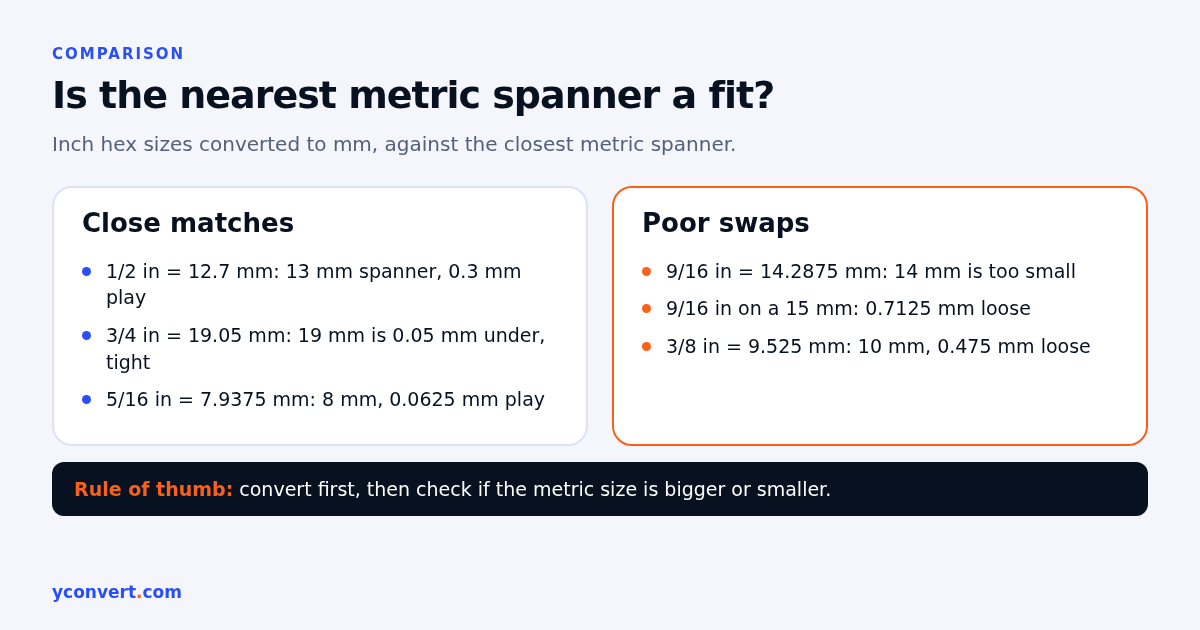
Classic cars, some motorcycles and a lot of older machinery use inch-sized fasteners, while the toolbox is often mostly metric. Spanner sizes are measured across the flats of the hex head. A 1/2 in head is 12.7 mm, so a 13 mm spanner fits with 0.3 mm of play. Usable. A 3/4 in head is 19.05 mm, and a 19 mm spanner is only 0.05 mm smaller, which is close enough that it may or may not go on. A 9/16 in head is 14.2875 mm, so a 14 mm spanner is too small and a 15 mm one is loose by more than 0.7 mm. That’s the one that rounds off corners. Converting before you reach for the tool saves the bolt.
A 3D printing service receiving customer files
Common mesh formats used for printing don’t store units. A part a customer designed in inches arrives as plain numbers, and most slicing software reads those numbers as millimeters. The result: a 2 in bracket shows up as a 2 mm speck on the build plate. The fix is to scale by 25.4, which is 2540%. I’d still check one known dimension after scaling, like a hole that should be 1/4 in, which should now read 6.35 mm.
A machine shop quoting tolerances
Machinists often work in thousandths of an inch, called “thou”. One thou is 0.0254 mm. A tolerance of plus or minus 0.005 in becomes plus or minus 0.127 mm. Here, rounding 25.4 down to 25 isn’t a shortcut, it’s an error that changes whether a part passes inspection. Keep every decimal until the final figure, then round to the precision the drawing asks for.
A hardware store helping with drill bits
A customer needs a 1/4 in hole but the shelf only has metric bits. 1/4 in is 6.35 mm. A 6.5 mm bit is 0.15 mm oversize, while a 6 mm bit is 0.35 mm undersize. For a clearance hole, go a little bigger. For a hole a screw needs to bite into, smaller is usually the better choice. The conversion tells you the gap. The job tells you which way to round.
A guitar repair shop ordering a replacement nut
Instrument specs often come in fractional inches. Say a customer asks for a nut that’s 1 11/16 in wide. That’s 27/16 in, or 1.6875 in, which is 42.8625 mm. Suppliers who list in millimeters might show 42.86 or 43. The 0.14 mm difference sounds tiny, but on a part that sits flush with the neck edge, you can usually feel it. I’d order the closest match and expect to do a little filing.
Convert inches to mm in 4 steps
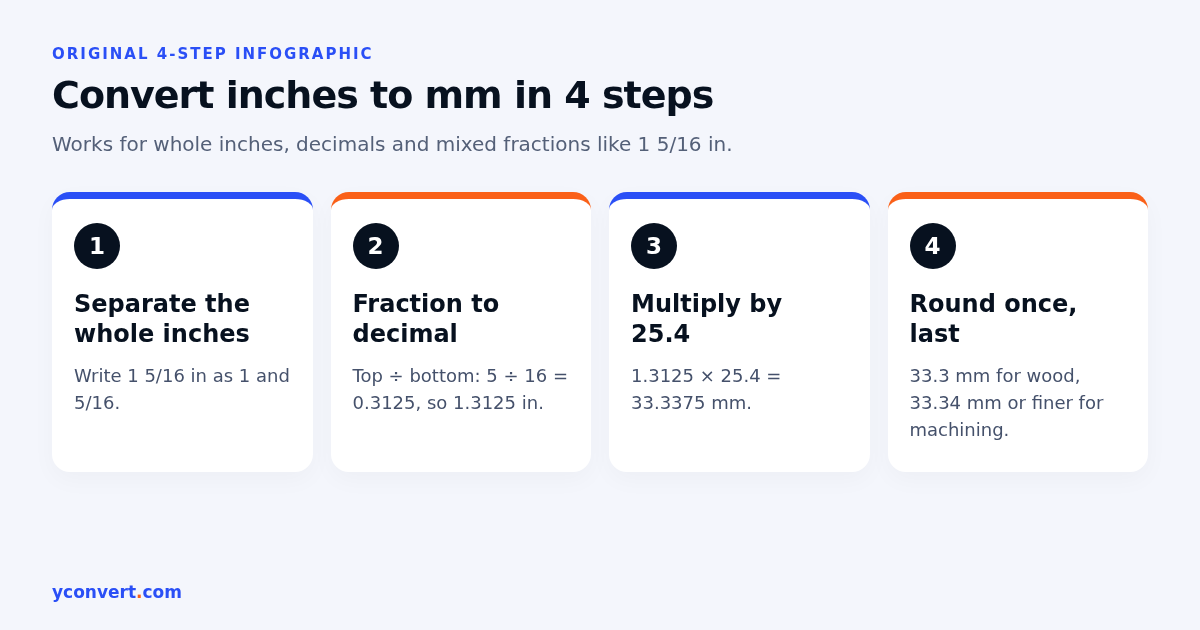
When a parts list has a mix of fractions, decimals and whole inches, this is the routine:
- Separate whole inches from fractions. Write 1 5/16 as 1 and 5/16.
- Turn every fraction into a decimal. Top divided by bottom. 5 ÷ 16 = 0.3125.
- Multiply by 25.4. 1.3125 × 25.4 = 33.3375 mm. Or paste the decimal into the converter.
- Round to what the job needs. A woodworker might write 33.3 mm. A machinist keeps 33.34 mm or more.
A quick sanity check I always run: the millimeter value should be roughly 25 times the inch value. If 3/8 in comes out as 95 mm, a decimal point has slipped. It’s 9.525.
Common mistakes with inches and mm
Reading fractions as decimals
Already mentioned, but it’s the big one. 1 5/16 is not 1.516. And 3/8 is not 3.8. Always divide.
Assuming the nearest metric size is “the same”
It isn’t, and the error goes in a direction. A 9/16 in part converts to more than 14 mm, so a 14 mm tool or socket won’t fit it. Check whether the metric option is bigger or smaller before you assume it’ll work.
Rounding at every step
If you round 1/16 to 1.6 mm and then multiply by 11, you get 17.6 mm instead of 17.4625. Over a long list, the errors pile up. Round once, at the end.
Mixing up mm and cm
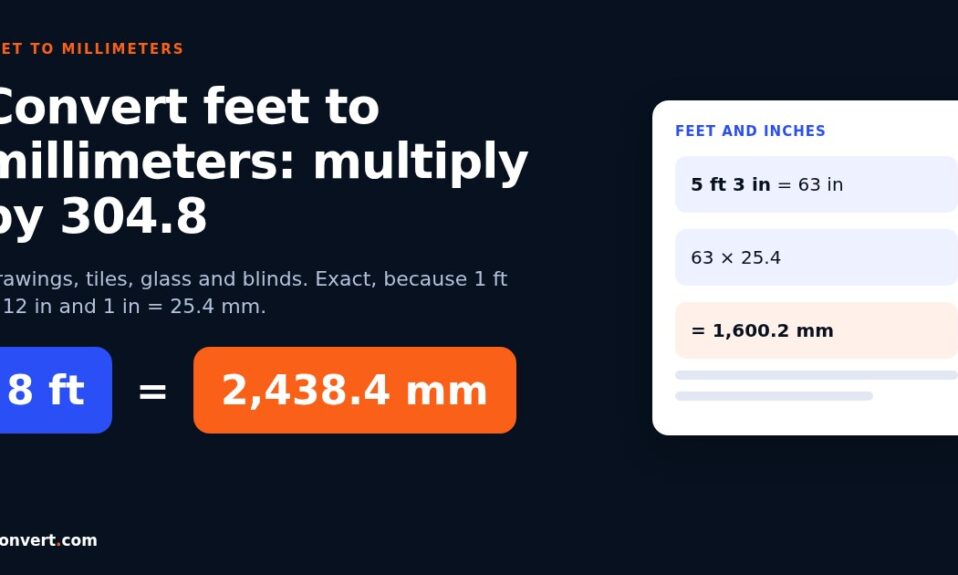
25.4 mm is 2.54 cm. If your figures are in centimeters instead, my guide to converting inches to centimeters walks through that version. And for longer lengths in feet, the post on feet to millimeters for drawings and fit-outs uses 304.8 instead.
Going the wrong way
Got millimeters and need inches? Divide by 25.4. 10 mm is about 0.3937 in, a little more than 3/8 in (0.375). The millimeters to inches converter handles that direction, and it’s handy when you’re trying to find the closest fraction to a metric size.
FAQ
How do I convert inches to mm?
Multiply the inches by 25.4. For example, 4 in × 25.4 = 101.6 mm. For a fraction, turn it into a decimal first, then multiply.
How many mm is 1 inch?
One inch is exactly 25.4 mm. That value has been the official definition of the inch since 1959, so it involves no rounding.
How many mm is 1/4 inch?
1/4 inch is 6.35 mm, because 0.25 × 25.4 = 6.35.
What is 3/8 inch in mm?
3/8 inch is 9.525 mm. Divide 3 by 8 to get 0.375, then multiply by 25.4.
Is a 1/2 inch spanner the same as a 13 mm spanner?
No. 1/2 inch is 12.7 mm, which is 0.3 mm smaller than 13 mm. A 13 mm spanner will usually turn a 1/2 in hex head with a little play, but a 1/2 in spanner won’t fit over a 13 mm head.
How do I convert mm back to inches?
Divide the millimeters by 25.4. For example, 50.8 mm ÷ 25.4 = 2 in.
Before you order the part
If you want the exact figure without the long multiplication, the inches to millimeters converter gives it in one step. Convert the fraction to a decimal, enter it, and round only once you know how precise the job needs to be.
And if you run a site full of practical pages like this one, our AEO and SEO audit starts with 1 free credit, then $2 per report, or 10 reports for $15 and 20 for $20. It shows whether search and answer engines are picking up your pages.
Last updated: November 2026