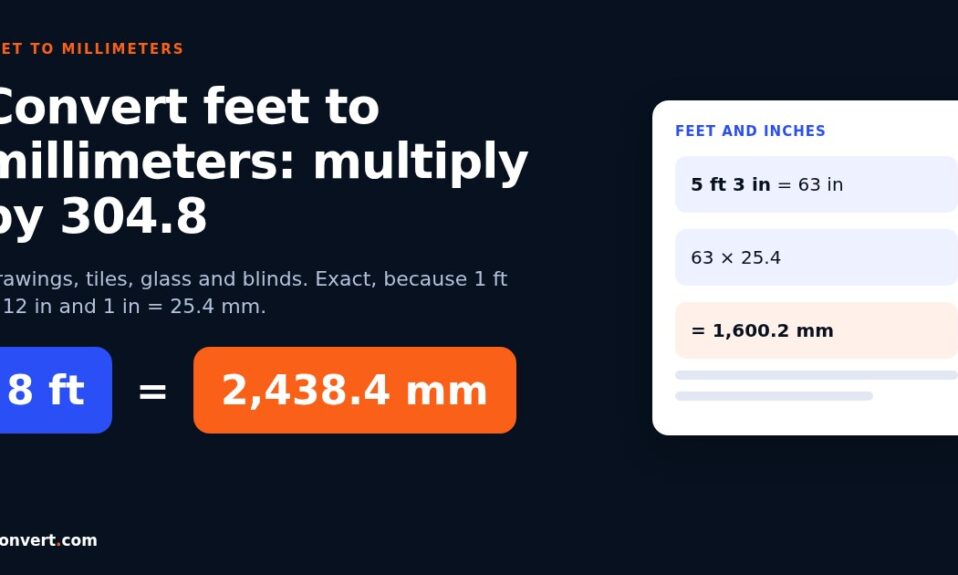
To convert feet to millimeters, multiply the feet by 304.8. So 1 foot is 304.8 mm, 5 feet is 1,524 mm and 8 feet is 2,438.4 mm. That number is exact, not a rounded estimate, because the international foot is defined as 0.3048 meters. If your measurement is in feet and inches, turn it into inches first, then multiply by 25.4.
That’s the whole method. The trouble starts in the handover. Someone measures in feet, someone else cuts, prints or orders in millimeters, and a few millimeters get lost in between. I see it with site drawings, shop quotes and product listings all the time. Below is the formula, a table you can keep open, the feet-and-inches version, a mental shortcut, and five real situations where the conversion decides whether something fits.
The feet to millimeters formula
Here it is:
mm = feet × 304.8
And going back:
feet = mm ÷ 304.8
Three to try on your own calculator:
- 3 ft × 304.8 = 914.4 mm
- 10 ft × 304.8 = 3,048 mm
- 0.5 ft × 304.8 = 152.4 mm
The feet to millimeters converter does this in one box. Enter the feet, press convert, read the millimeters. Its own table runs from 1 to 20 feet, which covers most room, furniture and panel sizes.
Why 304.8? One foot is 12 inches, and one inch is exactly 25.4 mm. Twelve times 25.4 is 304.8. Nothing is rounded anywhere in that chain, so you can trust the result to the decimal.
Feet to millimeters table
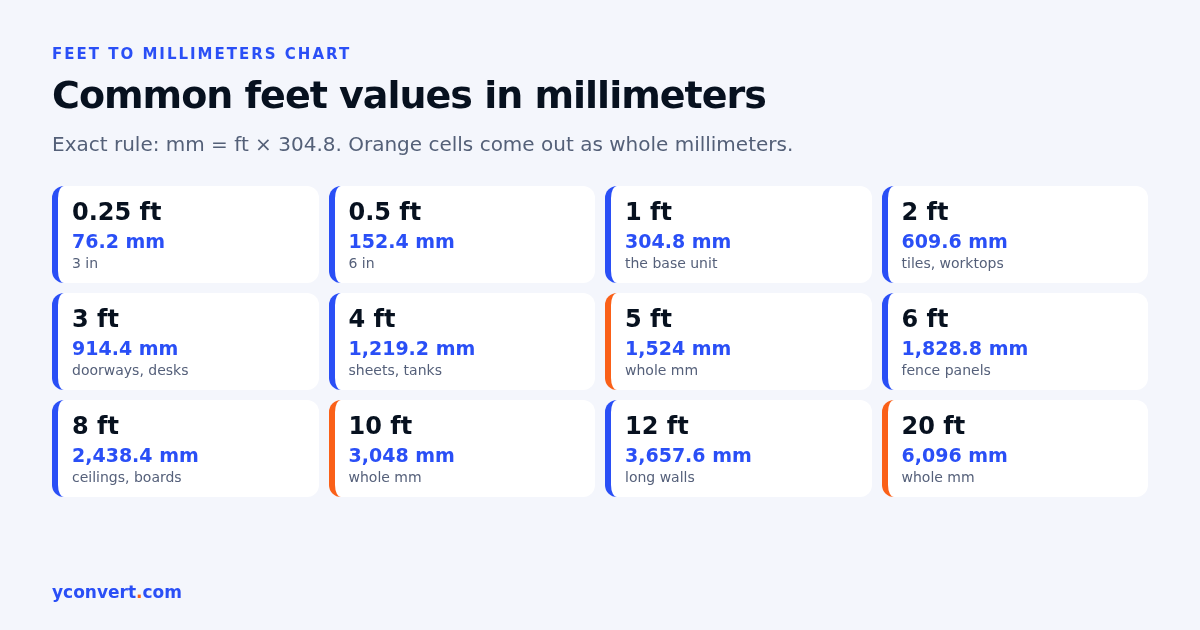
These are the values I end up typing most. All of them are exact.
| Feet | Millimeters | Where it tends to show up |
|---|---|---|
| 0.25 ft (3 in) | 76.2 mm | trim, skirting height |
| 0.5 ft (6 in) | 152.4 mm | shelf depth, small parts |
| 1 ft | 304.8 mm | the base unit |
| 2 ft | 609.6 mm | tiles, worktop depth |
| 3 ft | 914.4 mm | doorway widths, desks |
| 4 ft | 1,219.2 mm | sheet goods, tanks |
| 5 ft | 1,524 mm | windows, beds |
| 6 ft | 1,828.8 mm | fence panels, cupboards |
| 8 ft | 2,438.4 mm | ceiling heights, boards |
| 10 ft | 3,048 mm | room lengths |
| 12 ft | 3,657.6 mm | long walls, timber |
| 20 ft | 6,096 mm | containers, garages |
Notice that only the 5, 10 and 20 rows land on whole millimeters. Any multiple of 5 feet does, since 5 × 304.8 = 1,524. Every other foot count leaves a decimal, and that’s where rounding decisions creep in.
Feet and inches to millimeters
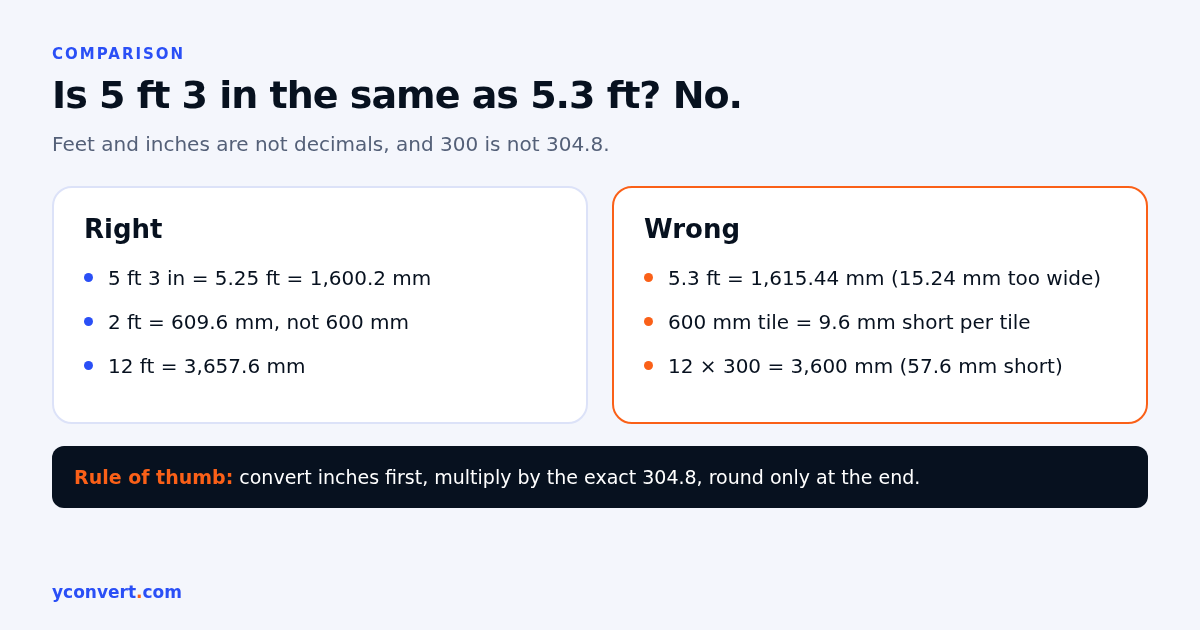
Most real measurements aren’t clean feet. They’re things like 5 ft 3 in. Don’t type that as 5.3 feet. Three inches is a quarter of a foot, so 5 ft 3 in is 5.25 ft, not 5.3.
The safest route goes through inches:
- Multiply the feet by 12 and add the inches. 5 ft 3 in = 60 + 3 = 63 in.
- Multiply the inches by 25.4. 63 × 25.4 = 1,600.2 mm.
Two more so you can check yourself. A common 6 ft 8 in door height is 80 in, and 80 × 25.4 = 2,032 mm. A 10 ft 6 in wall is 126 in, which is 3,200.4 mm.
If you only have inches to deal with, the inches to millimeters converter skips the first step entirely.
A mental shortcut that’s still exact
When I’m standing in a shop without a calculator, I split 304.8 into 300 and 4.8.
Take 8 feet. 8 × 300 = 2,400. Then 8 × 4.8 = 38.4. Add them: 2,438.4 mm. Same as the table, no rounding involved.
For a rough figure, “a foot is about 300 mm” is fine. Just remember it’s short by almost 5 mm per foot. Over 12 feet, that gap grows to 57.6 mm, which is more than two inches. Rough is for conversations, not cut lists.
Where feet to millimeters actually matters
The math doesn’t change. What changes is how much a few millimeters cost you. Here’s how it plays out in different lines of work.
An architecture practice converting an old drawing
Say a drafting team inherits a floor plan drawn in feet and needs it in millimeters for a metric client. In most drawing software, the clean way is to scale everything by 304.8 once, not to retype dimensions one by one. One catch I’d check before doing it: is the file really in feet, or is it in inches with feet shown on the labels? If the base unit is inches, the factor is 25.4. Scale by the wrong one and the building comes out 12 times too big or too small. It gets noticed quickly, but only after someone has wasted an afternoon.
A tile and flooring showroom
Customers often ask for “2 by 2 foot” tiles. Many of the tiles on the shelf are actually 600 × 600 mm. Close, but 2 ft is 609.6 mm, so each metric tile is 9.6 mm shorter. Across 10 tiles in a row, that’s 96 mm, nearly a full extra strip to cut. Converting the room dimensions to millimeters first, then counting tiles in millimeters, gives a far more honest quote.
A freight forwarder explaining container sizes
A “20-foot” container sounds like 6,096 mm. The standard outside length is usually 6,058 mm, which is 19 ft 10.5 in. The name is a nominal size, not a measurement. If a client is planning a load or a site layout from the name alone, the 38 mm difference might not matter. Inside dimensions are a different story, so I’d always ask for the actual spec sheet in millimeters.
An aquarium shop ordering glass
A customer wants a 4 ft tank, 18 inches deep. The glass supplier works in millimeters. 4 ft is 1,219.2 mm and 18 in is 457.2 mm. A glass cutter will usually want whole millimeters, so the order goes in as 1,219 × 457 mm. Fine for the panels. What matters is that the shop decides the rounding, not whoever reads the order slip.
A window blinds maker taking measurements
The customer measures a window with a tape and says 5 ft 3 in. Blinds are made to the millimeter. The right figure is 1,600.2 mm. If someone types 5.3 ft into a converter, they get 1,615.44 mm, which is 15.24 mm too wide. For an inside-the-frame fit, that blind won’t go in. I’d rather the measurer write down inches only and convert later.
Convert feet to millimeters in 4 steps
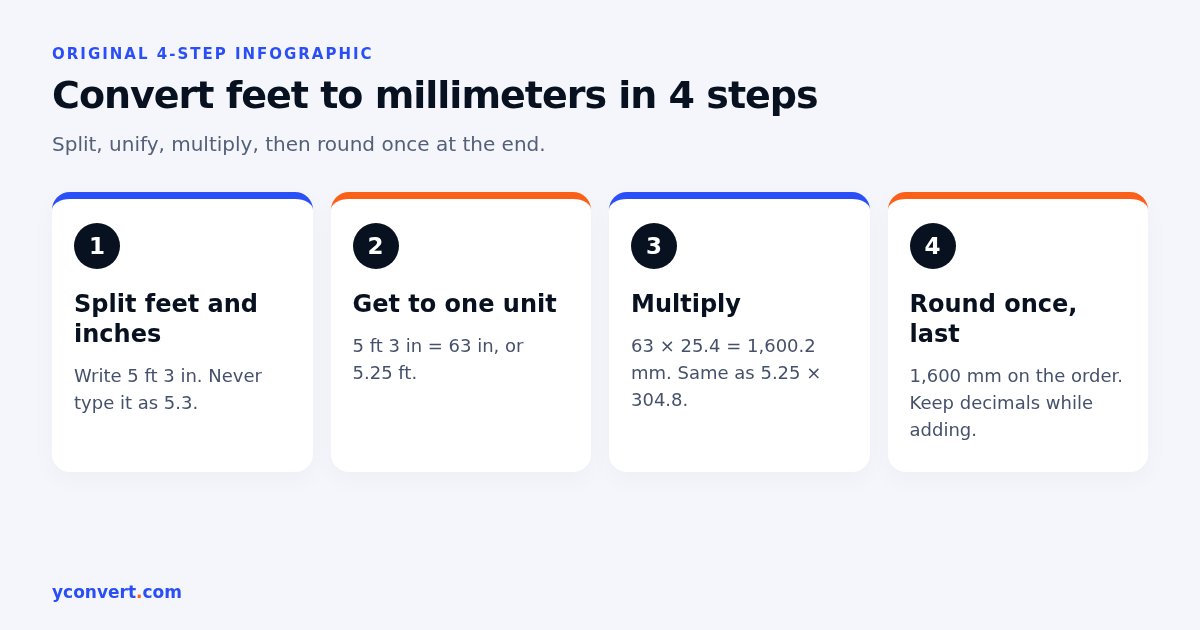
This is the routine I follow when a whole list of measurements needs converting:
- Split feet and inches. Write 5 ft 3 in, never 5.3. If it’s already decimal feet, note that clearly.
- Get to one unit. Either decimal feet (5.25) or total inches (63). Pick one for the whole list.
- Multiply. Feet × 304.8, or inches × 25.4. Or paste the value into the converter.
- Round once, at the end. Whole millimeters for cutting and ordering. Keep the decimal while you’re still adding things up.
A sense check that has saved me more than once: the millimeter figure should be roughly 300 times the feet figure. If 6 feet comes out near 18 or 180, a step got skipped.
The mistakes I see most often
Treating inches as decimals
The top one, by a distance. 5 ft 3 in is 5.25 ft, and 5 ft 6 in is 5.5 ft. No inch value survives being typed after the point: 5 ft 6 in becomes 5.6 instead of 5.5, and 5 ft 9 in becomes 5.9 instead of 5.75.
Using 300 when you meant 304.8
Fine for a guess. Not for anything that gets cut, printed or shipped. The error is 4.8 mm per foot, and it always runs short.
Rounding every line
If you round each converted dimension and then add them, the rounding errors stack. Add the feet first, then convert the total. Or keep one decimal place until the last step.
Mixing up mm and cm
304.8 mm is 30.48 cm. A misplaced decimal turns a 2-foot shelf into a 6-meter one on paper. If your other figures are in centimeters, my feet to centimeters guide covers that version, and for bigger spaces like rooms and plots I usually go to meters instead, as in the post on converting feet to meters for rooms and plots.
Converting the wrong direction
Got a measurement in millimeters and need feet? Divide by 304.8 instead. 2,400 mm comes to about 7.874 ft, or roughly 7 ft 10.5 in. The millimeters to feet converter handles that direction.
FAQ
How do I convert feet to millimeters?
Multiply the feet by 304.8. For example, 6 ft × 304.8 = 1,828.8 mm.
How many millimeters are in 1 foot?
There are exactly 304.8 mm in 1 foot, because 1 foot is 12 inches and each inch is 25.4 mm.
How many mm is 5 feet?
5 feet is 1,524 mm. Since 5 × 304.8 has no decimal left over, it’s one of the few clean results.
How do I convert feet and inches to mm?
Turn everything into inches, then multiply by 25.4. For 5 ft 3 in, that’s 63 in × 25.4 = 1,600.2 mm.
Is a 2 ft tile the same as a 600 mm tile?
No. 2 ft is 609.6 mm, so a 600 mm tile is 9.6 mm smaller on each side. Over a long run of tiles, the difference adds up.
How do I convert millimeters back to feet?
Divide the millimeters by 304.8. For example, 3,048 mm ÷ 304.8 = 10 ft.
Before you cut or order
For a fast, exact answer, the feet to mm converter is the quickest route. Convert once, round once, and write the unit next to every number.
If you also look after a website full of practical pages like this, our AEO and SEO audit starts with 1 free credit, then $2 per report, or 10 reports for $15 and 20 for $20. It shows whether search and answer engines are actually picking up your pages.
Last updated: November 2026