Last updated: October 2026
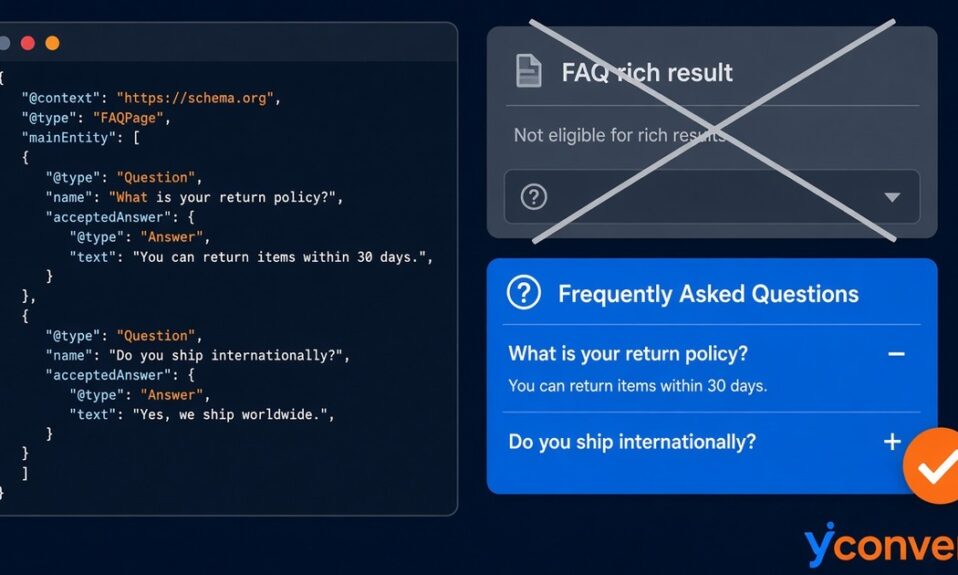
Short answer: FAQ schema no longer gets you the expandable FAQ result in Google. That display was retired in 2026. The markup itself still works as a label for real questions on your page, and it’s harmless when it matches what visitors see. What still helps, a lot, is a visible FAQ written from questions people actually ask. That’s the part AI Overviews and AI Mode can read and lift. The JSON-LD is optional. The answers are not.
I get this question in nearly every audit call now. Usually it’s phrased as panic: “Our FAQ snippets disappeared, did we get penalised?” No. Google changed the feature for everyone. And for most commercial sites, the drop-down had already been gone for years. The May notice just made it official.
What actually changed
Here’s the timeline I work from when a client asks what happened:
| When | Change | What it means for you |
|---|---|---|
| 2023 | FAQ rich results limited mostly to government and health sites | Most businesses already lost the visual result |
| May 2026 | FAQ rich results stop showing in Google Search | No more expandable FAQ in results for anyone |
| June 2026 | Related Search Console report and Rich Results Test support removed | You can’t use those tools to “validate” FAQ visibility any more |
| Ongoing | Google says no special schema is needed for AI Overviews or AI Mode | Markup isn’t a citation shortcut |
So the display is gone. The schema.org FAQPage type isn’t. Those are different things, and mixing them up leads to bad decisions in both directions.
The mistake I saw after the May change was people treating the announcement like a penalty notice. They stripped FAQ sections from service pages, pricing pages, local pages. That’s the wrong lesson. Google stopped rewarding a search appearance. It did not say clear question-and-answer content is bad. Useful is the word that still matters.
Why I don’t tell clients to delete it all
When the snippets vanished, some people stripped FAQPage from every page. I understand the instinct. But if the markup mirrors a real, visible FAQ, it costs nothing to keep. Other parsers outside Google can still read it. And when I compare pages that keep accurate markup with pages that leave orphaned blocks behind, the orphaned ones are the ones that look sloppy in an audit.
When I do remove it:
- The questions in the JSON-LD aren’t visible on the page.
acceptedAnswer.textis empty or missing. I see this more than you’d think, especially on WordPress sites where a plugin generated the block and nobody filled it in.- Someone edited the answer on the page but the schema still says the old thing. Think of a salon that updated its colour-correction price on the page while the FAQPage markup still quotes last season’s price.
- The questions are filler. “What is SEO?” on a booking page for a local service.
- The same FAQ block was pasted across dozens of pages with no local detail. One set of answers for every city page is usually a tell.
That last one is the real problem. Orphaned markup doesn’t help anyone. Matching markup is just housekeeping.
The filler FAQ problem
On a lot of landing pages I audit, the FAQ was written to stuff keywords. You get eight questions, five of them unrelated to what the page sells. That hurts in two ways.
Picture a law firm’s consultation page with an FAQ about the firm’s founding story, careers and office parking. Readers skip it. And when AI systems look for a clean answer to the buyer’s question (fees, timeline, what to bring), they find a block that mostly answers other things.
Same pattern on an online store’s category page for running shoes with FAQs about gift cards and return policy for the whole site. Fine questions. Wrong page.
Our audit tool has a “remove / reduce” check for exactly this, because cutting unrelated FAQs is often a faster win than adding new ones.
Another pattern I push back on: chasing FAQPage on a commercial category or product-list page just to occupy search space. That used to be a common SERP hack. It muddied page intent. A comparison or buying guide is often the better shape for that content. Schema that fights the page’s job is not clever. It’s noise.
How I write an FAQ that’s worth having
My process for one landing page:
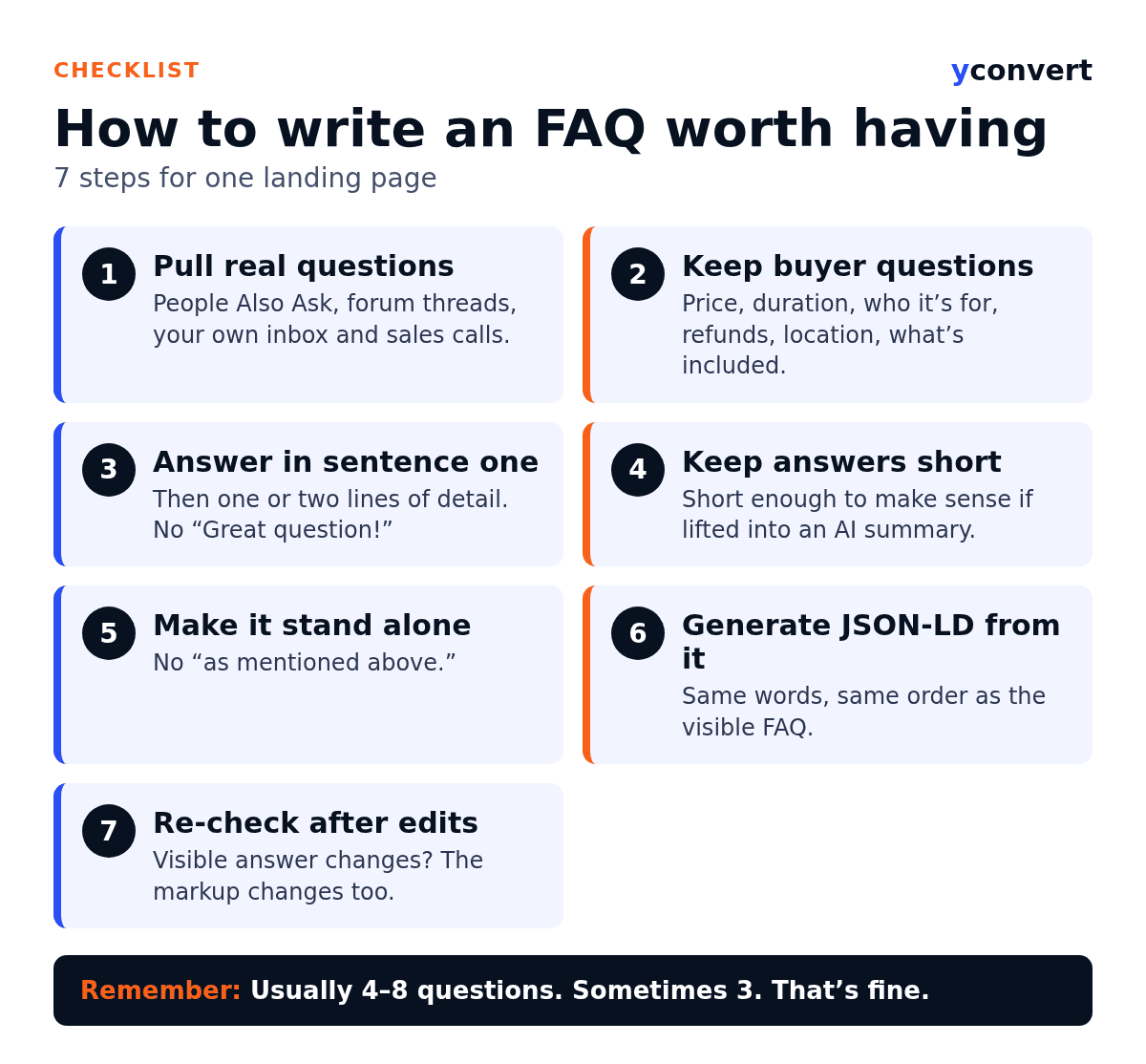
- Pull real questions. People Also Ask for the main keyword, forum threads, and the client’s own inbox or sales calls. The inbox is gold and almost nobody uses it.
- Keep the ones a buyer needs to decide. Price, duration, who it’s for, refunds, location, what’s included.
- Answer in the first sentence. Then add one or two lines of detail. No “Great question!”
- Keep each answer short enough to stand alone. If someone lifts only that answer into an AI summary, does it make sense? Long essays get trimmed. Short, clear ones get used.
- Write the answer so it stands alone. Same idea from a different angle: no “as mentioned above.”
- Generate the JSON-LD from the same text. Same words, same order. If you use a plugin, check that it does this.
- Re-check after edits. Every time the visible answer changes, the markup has to change too.
Usually that lands at four to eight questions. Sometimes three. That’s fine.
Say a SaaS pricing page. Real questions look like: what’s included in the free credit, what happens after you use it, can you buy packs, does unused credit expire. Fake questions look like: “What is cloud software?” Cut those.
Does FAQ schema help with AI citations?
Honest answer: I’ve not seen clear evidence that adding the markup alone gets you cited in Google’s AI features. Google says you don’t need special markup for them.
What I do see is that pages with a clean, visible Q&A block are easier to quote. Question-shaped passages match how people ask follow-ups in AI Overviews, AI Mode and the chat assistants. The JSON wrapper is just the wrapper. Treat FAQ schema as a consistency layer, not a lever.
Some people still talk about schema as a magic switch for AI citations. Others say schema is useless and only “content quality” matters. Both camps oversell. Schema is closer to a translator. It labels facts so a system doesn’t have to guess which string is a price, an author or an answer. If the label and the visible text disagree, you’ve made things worse, not better. Content mismatch is the failure mode I flag first.
So: keep accurate FAQPage when you have a real FAQ. Don’t expect the markup to force a citation. Fix the answers first.
Other schema I check while I’m in there
Since clients usually ask “so what schema should I care about?”, here’s my quick view for landing pages:
- Organization / LocalBusiness: accurate name, address as a proper PostalAddress object, phone, opening hours. Must match the Google Business Profile.
- BreadcrumbList: simple and useful.
- Product / Offer or SoftwareApplication: prices must match the visible page. Mismatches here are common on tool and SaaS pages.
- HowTo: only if the page is truly step-by-step.
The rule for all of them is the same: markup describes what’s already on the page. It doesn’t add claims the page doesn’t make. And stop promising rich-result CTR lifts from FAQ schema in proposals. That promise is outdated.
A quick self-check you can do in ten minutes
Open your landing page and the page source side by side. Read the visible FAQ out loud, then read the FAQPage block. Ask three questions. Is every question in the markup also visible on the page? Is every answer word-for-word the same, including prices and dates? Would a real buyer ask each question before paying?
If any answer is no, fix the visible FAQ first and regenerate the markup from it. Then search your main keyword and see whether your answers would make sense quoted alone in an AI summary. If one wouldn’t, rewrite its first sentence until it does. That small edit usually does more than any schema change.
Related on Yconvert: pages that rank but aren’t cited; word counter.
Frequently asked questions
Does FAQ schema still work in 2026? FAQPage markup is still valid schema.org vocabulary, but Google no longer shows FAQ rich results. Its value now is describing a genuine visible FAQ accurately, not winning extra search space.
Should I remove FAQ schema from my site? Not automatically. Existing markup that matches visible questions does no harm. Remove it if it’s broken, out of sync with the page, or covers filler questions nobody asks.
Does FAQ schema help AI Overviews citations? Google says no special schema is needed for AI Overviews or AI Mode, and I haven’t seen a clear citation lift from adding markup alone. The visible question and answer text is what gets read.
What is the most common FAQ schema mistake? Markup that doesn’t match the page: questions in JSON-LD that aren’t visible, empty acceptedAnswer text, or answers edited on the page but not in the schema.
How many FAQs should a landing page have? As many as real buyers ask, usually four to eight. Each should help someone decide. Unrelated questions added for keywords make the page weaker.
Check your page’s FAQ and schema in one go
Our AI SEO & AEO audit reviews FAQPage, BreadcrumbList, Offer and other schema on one URL, flags unrelated FAQs to cut, and pulls People Also Ask questions you’re missing. The first report credit is free. After that it’s $2 per report, or 10 reports for $15 and 20 for $20.