Last updated: October 2026
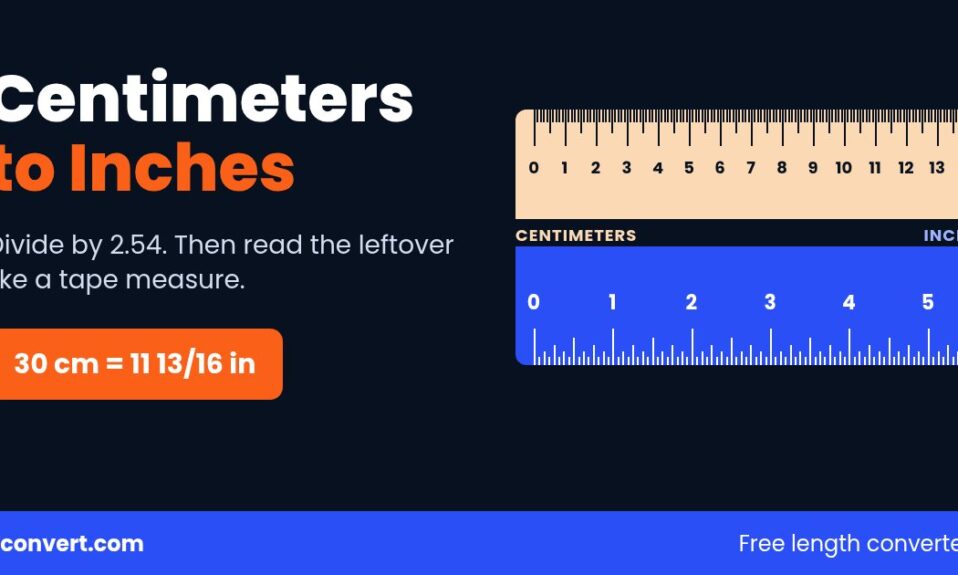
Short answer: to convert centimeters to inches, divide the centimeters by 2.54. So 30 cm ÷ 2.54 = 11.81 inches. If you need the answer the way a tape measure shows it, take the decimal part, multiply it by 16, round to a whole number, and that’s your sixteenths: 11.81 in becomes 11 13/16 in.
Dividing is the easy bit. The part people get wrong is what happens after the decimal point, because a hardware store, a frame shop and a spreadsheet all want that leftover written in a different way.
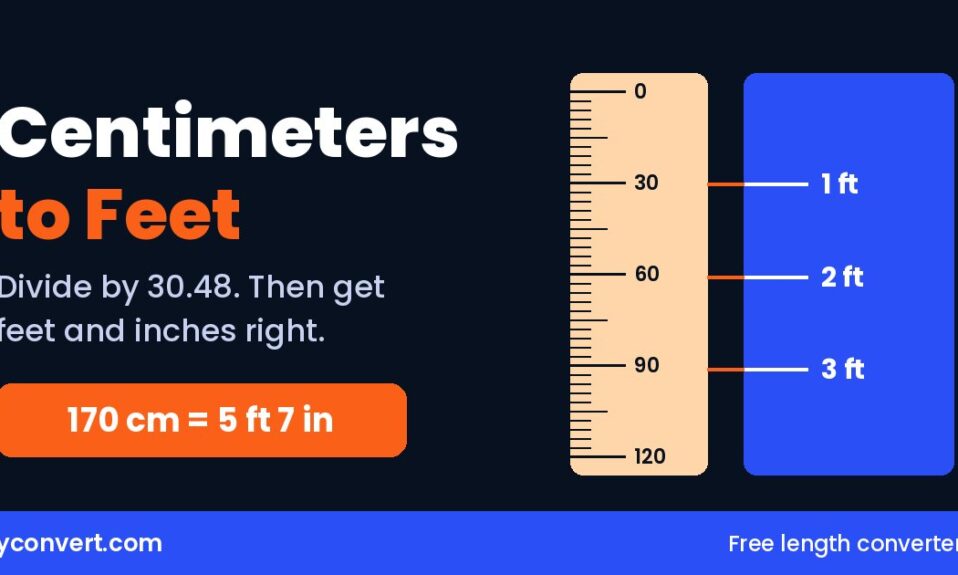
I deal with cm to inches mostly on small stuff. Print sizes, screen specs, parts on a supplier sheet, a box that has to fit inside another box. Not heights. (If you’re converting a height, my centimeters to feet guide is the one you want.) This post is about the fiddly end of the ruler, where a 1/16 of an inch actually matters.
The only number to remember: 2.54
One inch is exactly 2.54 centimeters. That’s a defined value, not a measurement someone took, so there’s no rounding hiding inside it.
Which gives you the rule in two forms:
- inches = centimeters ÷ 2.54
- inches = centimeters × 0.3937
I always divide. 0.3937 is a rounded figure, so the answer drifts somewhere around the third or fourth decimal place. For a shelf, nobody will ever see it. For a spreadsheet that feeds a cutting machine, I’d rather not have a rounded number sitting inside the formula. 2.54 is exact, so use it.
How to convert cm to inches, step by step
Let’s take a real-ish number: a part that measures 4.3 cm on the drawing.
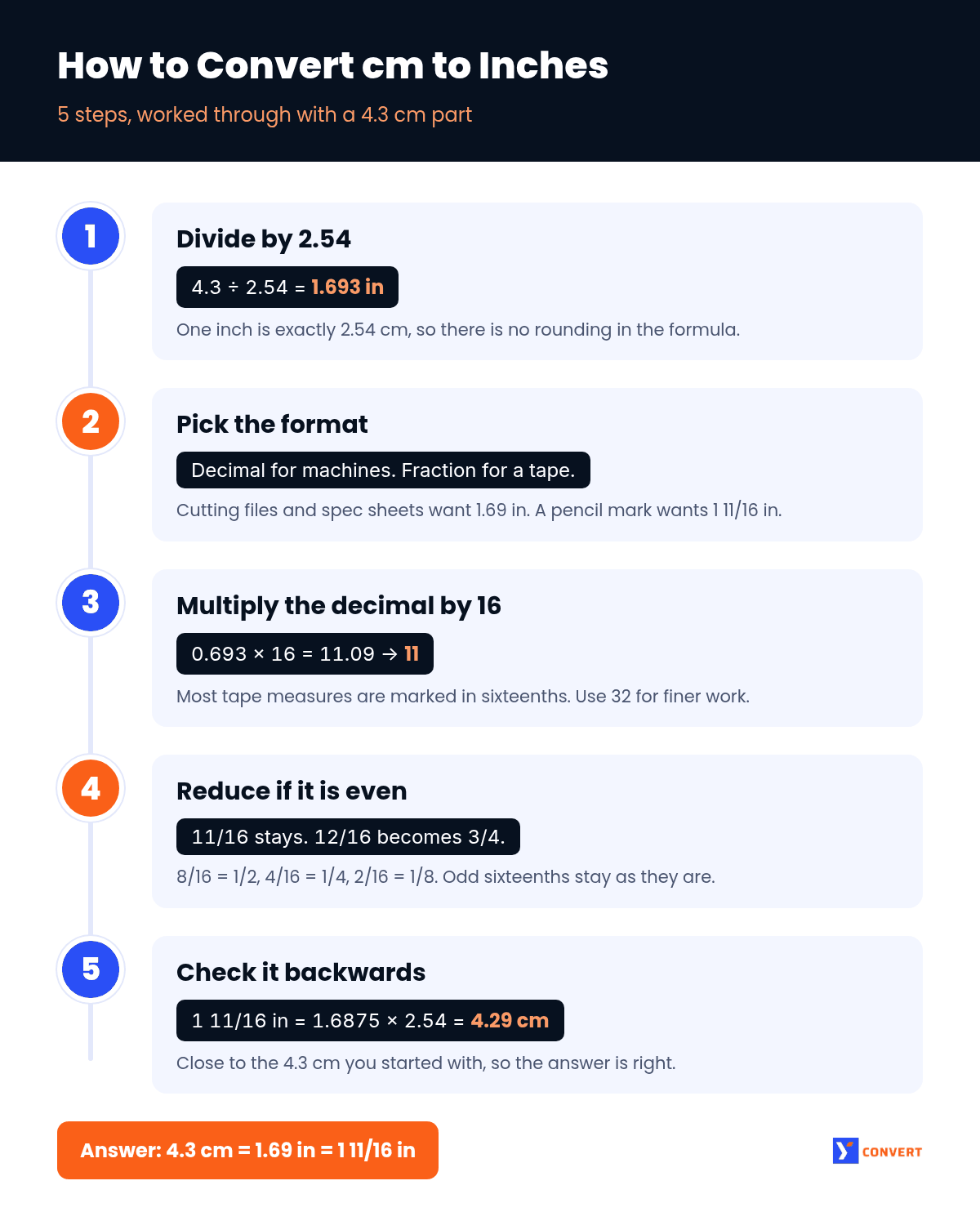
Step 1: Divide by 2.54
4.3 ÷ 2.54 = 1.693 inches.
Keep three decimals at this stage. You’ll round later, and you want something left to round.
Step 2: Ask who’s going to read the answer
This is the step everyone skips. There are two kinds of inch answer and they’re used by different people:
- Decimal inches (1.69 in). Engineering drawings, CNC and laser cutting files, spec sheets, most spreadsheets.
- Fractional inches (1 11/16 in). Tape measures, rulers, lumber, frames, fabric, anything a person will mark with a pencil.
If the answer is going into a cutting file, stop here and round to two or three decimals. If someone’s going to hold a tape against it, keep going.
Step 3: Turn the decimal into sixteenths
Take only the part after the decimal point: 0.693.
Multiply by 16: 0.693 × 16 = 11.09. Round to the nearest whole number: 11.
So the answer is 1 and 11/16 inches.
Why 16? Because most tape measures in inch markets are marked down to 1/16 of an inch. Some go to 1/32 near the start of the blade, and if you need that, multiply by 32 instead. For woodwork and framing, sixteenths are plenty.
Step 4: Reduce the fraction
A tape measure won’t say “12/16”. Nobody says “12/16”. So if your sixteenths come out even, simplify:
- 8/16 → 1/2
- 4/16 or 12/16 → 1/4 or 3/4
- 2/16, 6/16, 10/16, 14/16 → 1/8, 3/8, 5/8, 7/8
Odd numbers (1, 3, 5, 7, 9, 11, 13, 15) stay as sixteenths. A quick way to tell: on the tape, the odd sixteenths are always the shortest lines.
Example: 12 cm ÷ 2.54 = 4.724. Then 0.724 × 16 = 11.58, which rounds to 12. That’s 12/16, so 4 3/4 inches.
Step 5: Check it backwards
Multiply your answer by 2.54. 1 11/16 in is 1.6875 in, and 1.6875 × 2.54 = 4.29 cm. Our part was 4.3 cm. That’s a gap of just over a tenth of a millimetre, which is about as close as a tape measure lets you get anyway.
Decimal inches vs fractions: when each one bites
Here’s the thing I’ve learned to watch for. The number is right, but the format is wrong for the person using it, and they misread it.
A decimal like 1.69 in looks like “1 and 69 something”. On a tape, there is no 69. Someone in a hurry reads it as “1 and a bit over half”, marks it at 1 5/8, and they’re off by nearly 2 mm. On one cut, nobody notices. On a cabinet face with six doors, the gaps start looking uneven.
The opposite also happens. A fraction typed into a quote or a spreadsheet as “1 11/16” turns into text, and suddenly the column won’t add up.
My rule is simple. If a machine will read it, use decimals. If a hand will mark it, use fractions. If both will, write both: “4.72 in (4 3/4 in)”.
Quick mental maths for cm to inches
When someone reads out a number on a call and you need a feel for it:
Multiply by 4, then divide by 10. 30 cm × 4 = 120, ÷ 10 = 12 in. The real answer is 11.81 in. This shortcut runs about 1.6% high because 0.4 is a bit bigger than 0.3937. Fine for “will this fit on the shelf”, not for ordering glass.
10 cm is just under 4 inches. 3.94 in, or 3 15/16 on a tape. I use this as an anchor and count up in tens.
1 cm is a hair over 3/8 of an inch. Useful for small gaps, margins and hole spacing.
When the number goes into an order, an invoice or a cut list, stop guessing and divide properly.
Common cm to inches values (with the tape-measure fraction)
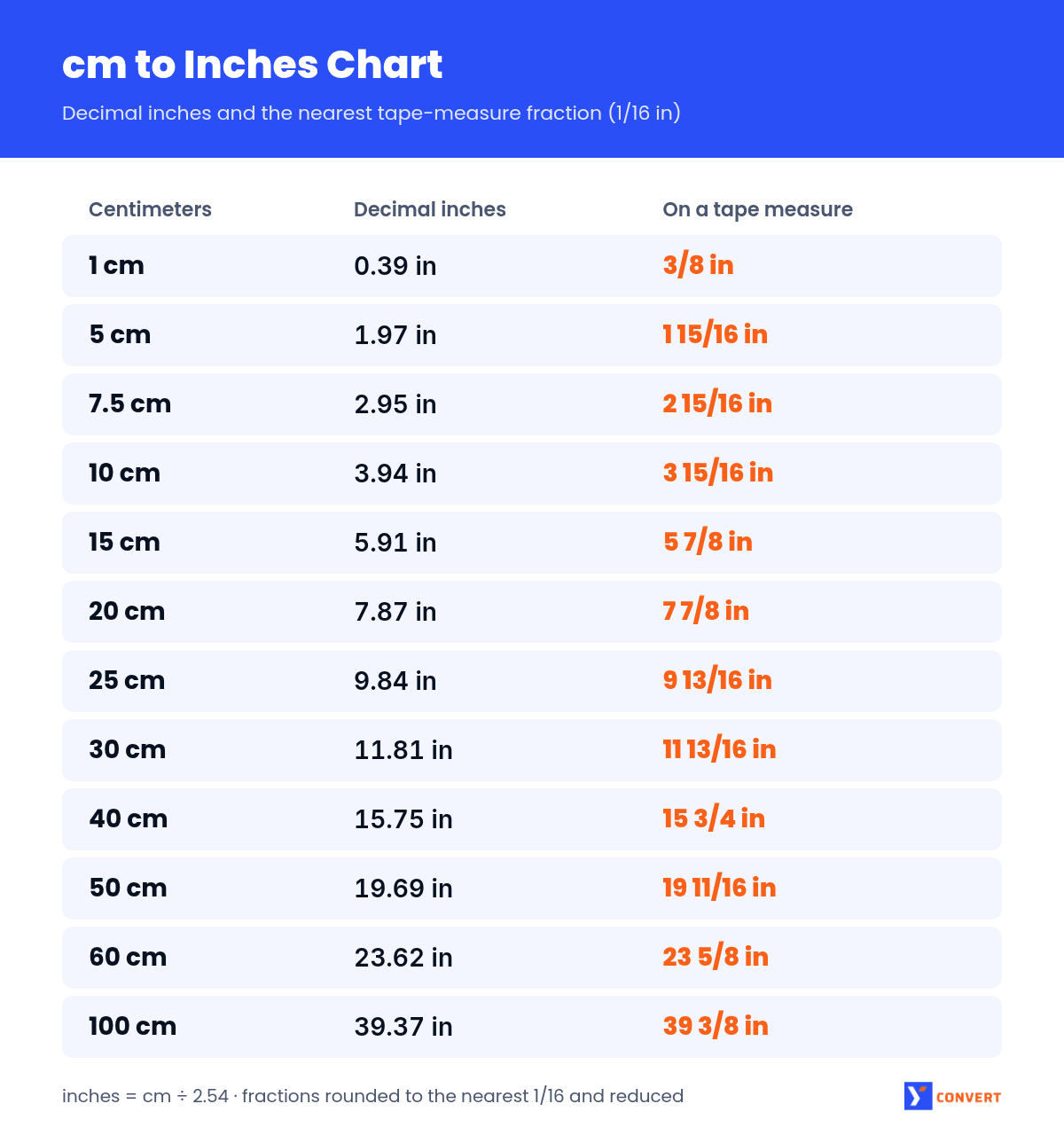
I rebuild this table more often than I’d like, so here it is. Fractions are rounded to the nearest 1/16 and reduced.
| Centimeters | Decimal inches | Nearest fraction |
|---|---|---|
| 1 cm | 0.39 in | 3/8 in |
| 5 cm | 1.97 in | 1 15/16 in |
| 7.5 cm | 2.95 in | 2 15/16 in |
| 10 cm | 3.94 in | 3 15/16 in |
| 15 cm | 5.91 in | 5 7/8 in |
| 20 cm | 7.87 in | 7 7/8 in |
| 25 cm | 9.84 in | 9 13/16 in |
| 30 cm | 11.81 in | 11 13/16 in |
| 40 cm | 15.75 in | 15 3/4 in |
| 50 cm | 19.69 in | 19 11/16 in |
| 60 cm | 23.62 in | 23 5/8 in |
| 100 cm | 39.37 in | 39 3/8 in |
Where cm to inches trips people up at work
These come from very different kinds of businesses, which is sort of the point. The conversion is the same. The trap is different every time.
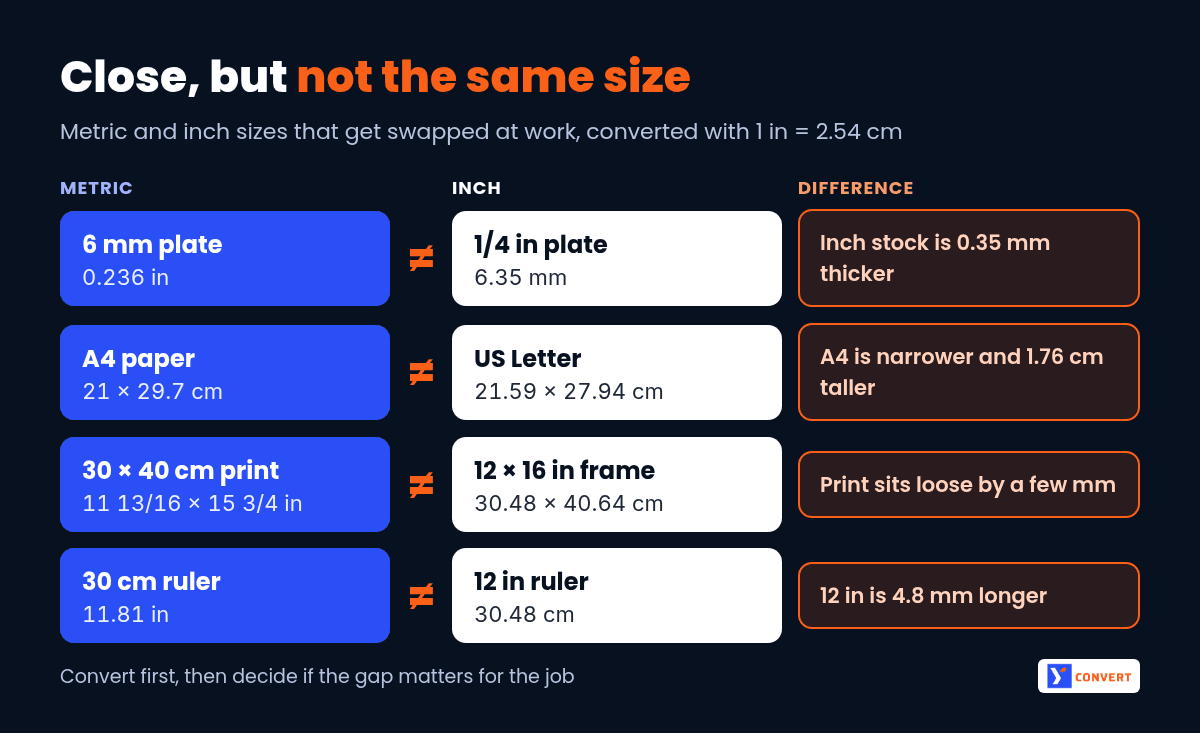
A picture framing shop. A customer brings in a 30 × 40 cm print. The shop’s ready-made frames are in inches, and 12 × 16 in sounds about right. It isn’t quite. 12 × 16 in is 30.48 × 40.64 cm, so the print sits loose by a few millimetres on each side. With a mat, that’s fine. Without one, the print slides around behind the glass. Converting first (11 13/16 × 15 3/4 in) tells the framer straight away that they need a mat or a custom cut.
A print shop. A4 paper is 21 × 29.7 cm, which is 8.27 × 11.69 in. US Letter is 8.5 × 11 in. They look interchangeable on screen. They aren’t. Send an A4 file to a Letter printer with “fit to page” turned off and the bottom of the page gets cropped. A print shop that quotes both sizes in both units saves itself a lot of reprints.
A metal fabrication workshop. A drawing calls for 6 mm plate. Someone grabs 1/4 inch stock because “it’s basically 6 mm”. 1/4 in is 6.35 mm. For a bracket, nobody cares. For a slot that another 6 mm part has to slide into, it’s a tight fit or no fit at all. Converting to decimal inches (0.236 in) makes the difference obvious on paper before anyone cuts.
An electronics retailer. Screen sizes from some suppliers come in centimeters, but shoppers search in inches. A 68.6 cm monitor is a 27 inch monitor. An 81.3 cm one is 32 inches. If the product title only says “68.6 cm”, it misses most of the people looking for it.
A bicycle shop. Road bike frames are usually sized in centimeters, while a lot of mountain bike frames are still talked about in inches. A 54 cm frame works out to about 21 1/4 in. Brands measure frames from different points, so I treat this as a rough comparison only. But having the conversion on the sizing page stops a lot of “is a 54 the same as a medium?” back and forth.
cm to inches in Excel or Google Sheets
For a column of centimeters in column A, these are the formulas I use (they work in both Excel and Google Sheets):
- Decimal inches:
=A2/2.54 - Same thing with the built-in function:
=CONVERT(A2,"cm","in") - To show a tape-measure fraction, put
=A2/2.54in the cell and use the custom number format# ??/16
One catch with that last one: it always shows sixteenths, so you’ll see 12/16 instead of 3/4. That’s fine for a cut list. For anything a customer will read, I reduce it by hand.
Use the converter for the one-off numbers
For a quick answer, the centimeters to inches converter does the division and shows the formula with a reference table on the same page. Free, no sign-up.
For the reverse, use the inches to cm converter. If your number started out in millimetres, the mm to inches converter saves you a step. And for heights or anything over a foot, the centimeters to feet guide covers feet and inches properly.
FAQ
How many centimeters are in an inch?
Exactly 2.54. The inch is defined as 2.54 cm, so there’s no rounding involved.
What is the formula to convert cm to inches?
Divide the centimeters by 2.54. For example, 25 cm ÷ 2.54 = 9.84 inches. You can also multiply by 0.3937, but that number is rounded, so dividing by 2.54 is more accurate.
How do I convert cm to inches and fractions?
Divide by 2.54, then multiply the decimal part by 16 and round to the nearest whole number. That gives you sixteenths of an inch. 12 cm is 4.724 in, and 0.724 × 16 rounds to 12, so the answer is 4 12/16, which reduces to 4 3/4 inches.
Is 30 cm the same as 12 inches?
No, but it’s close. 30 cm is 11.81 inches, or 11 13/16 on a tape measure. 12 inches is exactly 30.48 cm, so a 30 cm item is about 5 mm shorter than a foot.
What is 10 cm in inches?
10 cm is 3.94 inches, which is 3 15/16 inches on a tape measure. It’s just under 4 inches.