Last updated: October 2026
Short answer: audit a landing page with one URL, one primary keyword and one country. Then check, in this order: does the page match search intent, does it answer the query in the first 100 to 150 words, is it cited in AI Overviews or AI Mode, what do the top competitors cover that you don’t, and are schema, internal links and trust signals clean. Write the fixes as a short ranked list. Most pages need four or five changes, not forty.
I run these audits most weeks, and the biggest mistake I see is running a full site crawler on a problem that belongs to one page. You get 600 warnings about image alt text and still don’t know why the money page is stuck on page two.
So here’s the checklist I actually use.
Before you start: set the frame
Write three things at the top of your notes:
- URL: the exact page.
- Primary keyword: one. Not five, not a comma list.
- Country: results differ a lot between India, the US and the UK.
If you can’t pick one keyword, that’s finding number one. The page is probably trying to rank for too much.
The checklist
| # | Check | What “good” looks like | Common failure |
|---|---|---|---|
| 1 | Search intent | Page type matches the top results (guide vs pricing vs booking) | Sales page trying to rank for an informational query |
| 2 | Title tag | Under ~60 chars, keyword near the front | 80+ chars, brand first, truncated |
| 3 | H1 and opening answer | H1 matches title; answer in first 100-150 words | Welcome text, hero slogan, no answer |
| 4 | AI citation status | Cited, or you know who is and why | Never checked |
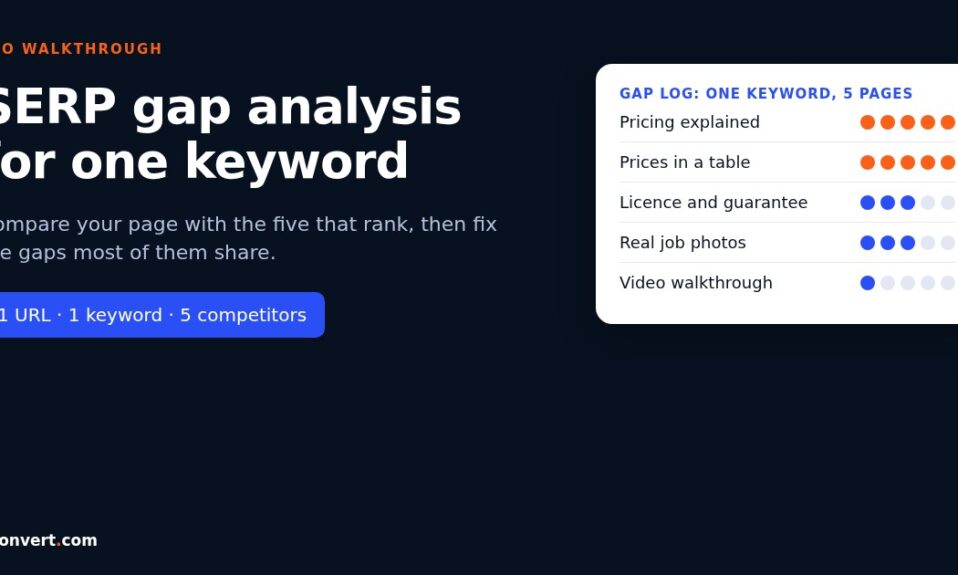
| 5 | Competitor SERP gap | You cover the sub-topics the top 5 cover | Missing price, duration, comparison |
| 6 | People Also Ask coverage | Real questions answered on page | FAQ written from imagination |
| 7 | Remove / reduce | Every section serves the keyword | Unrelated FAQs, repeated intros |
| 8 | Schema | Matches visible content, no errors | Prices in schema differ from the page |
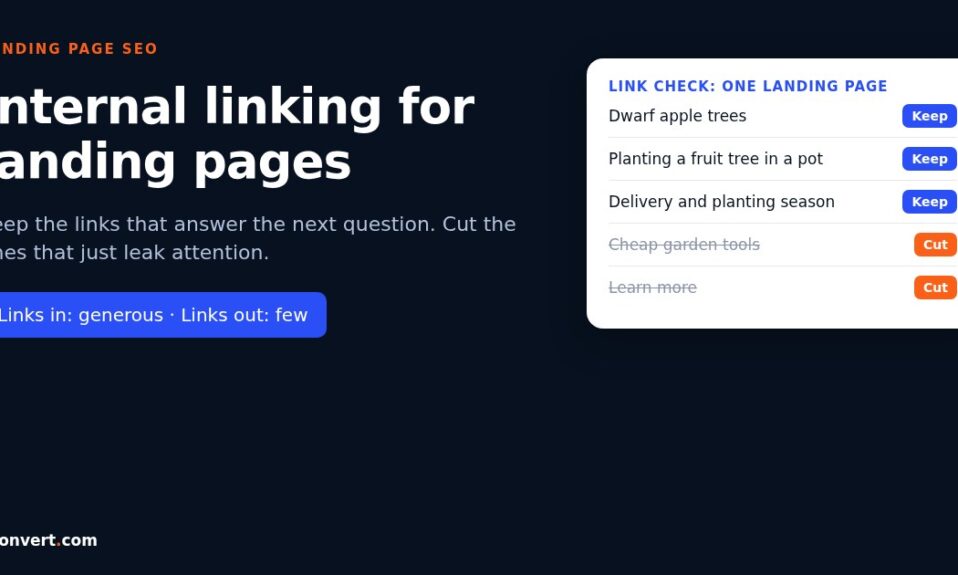
| 9 | Internal links | Links to and from related pages | Footer links to unrelated tools |
| 10 | Trust signals | Author, updated date, contact, policies | Placeholder testimonials, no author |
| 11 | Meta description | 140-155 chars, specific | Missing or duplicated |
| 12 | Mentions off-site | Discussed on forums, reviews, directories | Brand appears nowhere but its own site |
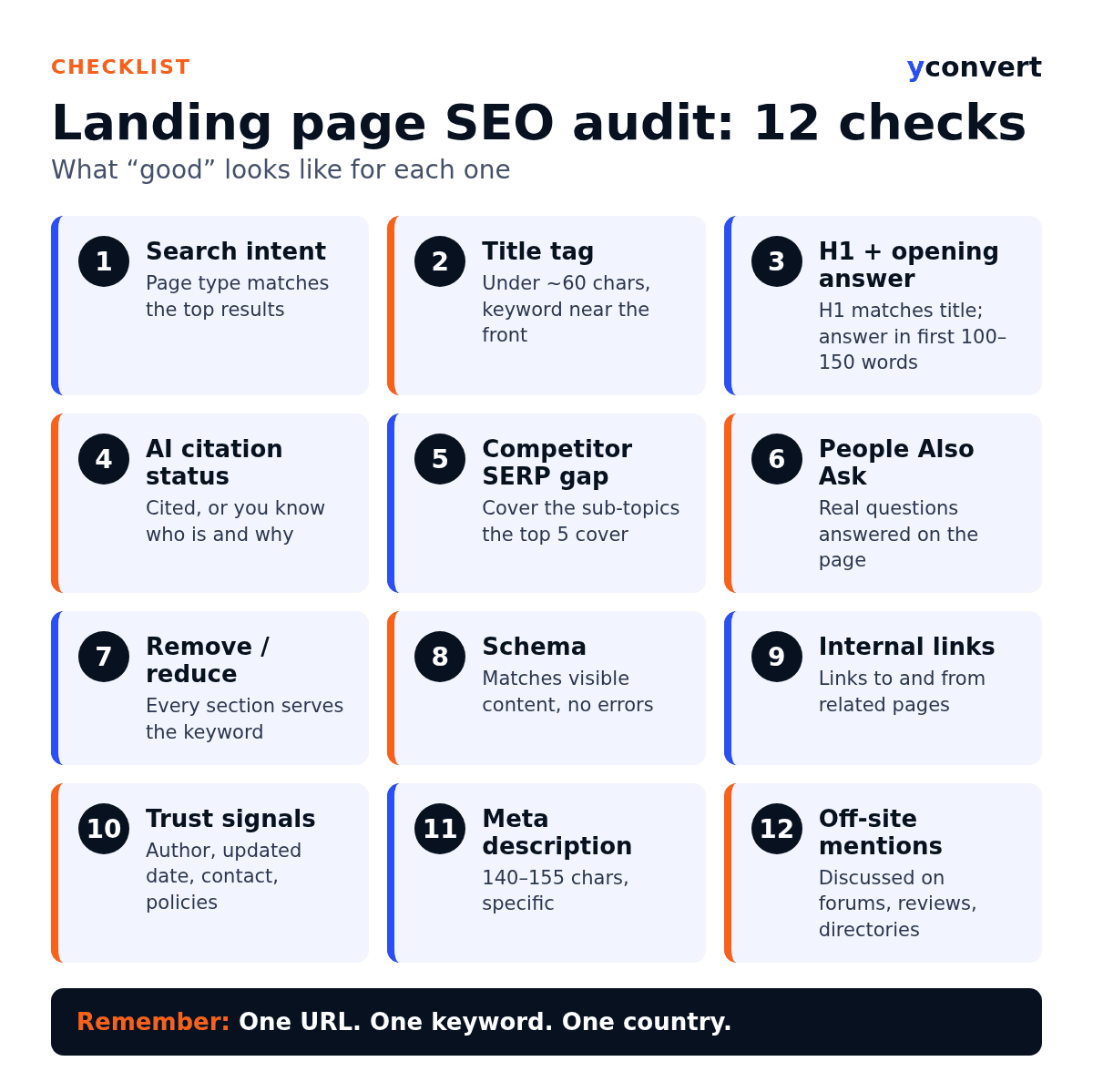
Now the detail on the ones that matter most.
1. Intent first, always
Search the keyword. Look at what kind of pages hold the top five. If they’re all comparison guides and yours is a “Book Now” page, no amount of on-page polish will fix it. You either change the page type or build a supporting guide that links to it.
One thing I’ve changed my mind on this year. I used to treat every keyword the same. Now I sort them first. “What is a root canal” gets answered right in the AI summary, and fewer people click through. “Emergency plumber near me” or “mortgage calculator” is different. The person wants to do something, and a summary can’t do it for them. So landing pages built around an action still pull clicks, and they’re where I spend audit time first.
2 and 3. Title, H1 and the first paragraph
This is where I find the most fixable problems. Take a common pattern: a law firm’s “divorce lawyer” page with a title over 80 characters that opens with the firm’s full name. It can rank fine while AI Mode cites a forum thread for the same question, because the thread opens with the exact question and the firm’s page opens with a paragraph about its history.
My fix pattern is simple. Shorten the title. Make the H1 say the same thing in natural words. Put a two to four sentence answer right under it.
Also count the H1s. Page builders love to turn the hero tagline into a second H1, and I keep finding pages with four or five. An online store category page that says “Running Shoes” and then “Run Your Best Life” as two H1s is sending a mixed signal for no reason. Keep one. Make the tagline a paragraph.
4. Check AI Overview and AI Mode separately
Search the keyword and look at both. Google has said the two can use different models, so a page cited in one may be missing from the other. Note who gets cited. Then ask the useful question: what does their passage do that mine doesn’t? Usually it’s shorter, more direct, or covers a sub-question you skipped.
Citations rotate, so check more than once.
5 and 6. Competitor gaps and PAA
Open the top five results. List their H2s. Mark what they cover that you don’t. Then add the People Also Ask questions for the keyword. This gives you the sub-questions Google is likely to fan out to.
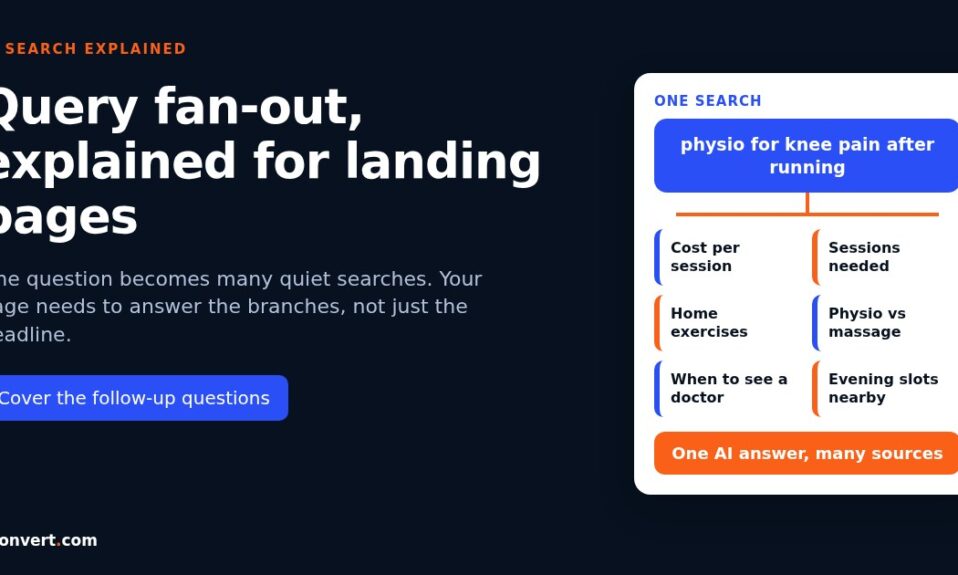
One more habit. When an AI system answers a query, it quietly breaks it into smaller questions (“best X for Y”, “X vs Z”, “X price”) and pulls from pages ranking for each. So I write down the obvious comparison and “best” variants of the keyword too. If a real estate agent’s page for “buy flat in Pune” never mentions how buying compares to renting, or which areas suit families, that’s a fan-out question someone else gets to answer.
I don’t copy competitor structure. I look for the gaps everyone shares, because that’s where a clear answer stands out.
7. What to remove
I’ve come to like this step the most. Cutting is underrated. Typical things I remove:
- FAQs unrelated to what the page sells
- A second intro that repeats the first
- Generic paragraphs that could sit on any website
- Internal links to pages with nothing to do with the topic
A tighter page is easier to read and easier to quote.
8. Schema that tells the truth
Validate the JSON-LD and then compare it to the visible page line by line. The failure I see most on SaaS pricing pages is a price mismatch. Say the plans were raised last quarter: the pricing table shows the new monthly price, but the Offer schema still carries the old one. That’s a trust problem as much as a technical one. Fix the source of truth, then the markup.
9. Internal links: the cheapest win
If I could fix only one technical thing on most sites, it’d be this. Check two directions. What links to the landing page from your other pages, and with what anchor text? And where does the page send people next? I often see a high-traffic blog post sitting two clicks away from the money page without a single link to it. Adding one, in a sentence that makes sense, costs nothing.
While you’re here, open Search Console for that URL. Look at the queries it already gets impressions for. Sometimes the page ranks for a better keyword than the one you picked, and that changes the whole audit.
10. Trust signals
For commercial pages I check: a named author or reviewer, a “last updated” date, a contact page, privacy and terms, and payment or refund notes. And testimonials. If the testimonials are placeholders (“Replace with real name”), take them down until you have real ones. Fake-looking proof is worse than none.
11 and 12. Meta description and off-site mentions
The meta description won’t move rankings, but it’s your pitch on the results page. I write it the way a hotel writes a booking line: what you get, for whom, one specific detail. Keep it 140 to 155 characters and unique per page.
Off-site is the part most audits skip. Search your brand name plus the topic. Is anyone talking about you on forums, review sites or local directories? AI answers lean on what other people say, not only what you say about yourself. A coaching centre with zero mentions outside its own site will struggle to get recommended, however good the landing page is. I don’t fix this in a day. I just flag it so nobody expects on-page work to cover it.
How I write up the result
The output of an audit shouldn’t be a 40-page PDF nobody reads. Mine has:
- A one-line diagnosis (“Ranks, not cited; answer is buried and title truncates”).
- Five fixes, ranked, each with who does it: writer, developer, or SEO.
- What to recheck and when.
That’s it. If a client wants the full data, it goes in an appendix.
Related on Yconvert: why ranking pages get skipped by AI Overviews; whether FAQ schema still helps; and if your copy feels bloated, run it through the word counter before and after you cut.
Frequently asked questions
How do I do an SEO audit of a single landing page? Pick one URL, one primary keyword and one target country. Check the title and H1, the opening answer, AI Overview and AI Mode citation status, the top competitors, schema, internal links and trust signals, then list fixes in priority order.
How is a landing page audit different from a site audit? A site audit looks for technical issues across many URLs. A landing page audit asks why one page isn’t winning one query, so it focuses on content, intent match, competitors and citations.
How long should a landing page audit take? A manual pass on one page usually takes an hour or two. A tool can produce the raw checks faster, but someone still needs to decide which fixes matter first.
What should I fix first after an audit? Start with intent and the opening answer, then the title, then missing sub-questions. Technical extras like schema come after the page clearly answers the query.
How often should I audit a landing page? Recheck important pages every few months, and after any big content change, price change, or drop in rankings or AI citations.
Run this checklist automatically
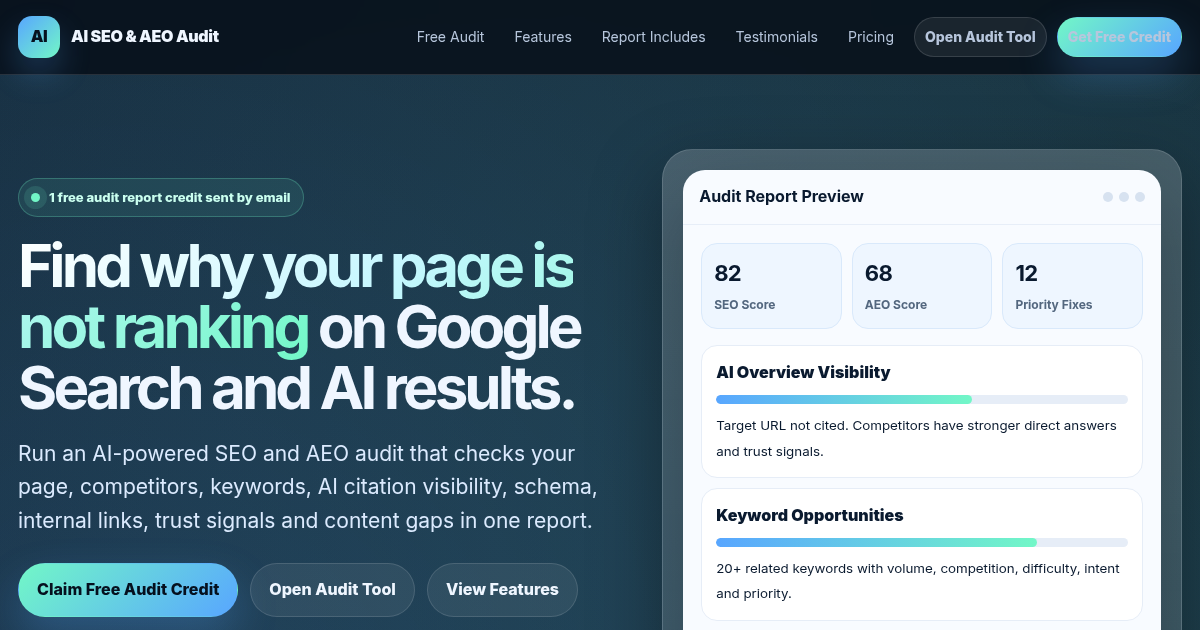
Our AI SEO & AEO audit tool follows the same frame: one URL, one keyword, one country. It returns SEO and AEO scores, AI citation status, competitor gaps, keyword opportunities, schema and internal link checks, a remove/reduce list and a PDF you can share. Your first report credit is free. After that it’s $2 per report, or 10 reports for $15 and 20 for $20.