Last updated: October 2026
Short answer: to convert feet to centimeters, multiply the feet by 30.48. So 12 ft × 30.48 = 365.76 cm. If your number is in feet and inches, turn it all into inches first, multiply by 2.54, and you have centimeters: 7 ft 6 in is 90 inches, and 90 × 2.54 = 228.6 cm.
That’s the whole formula. One multiplication. And yet I still see quotes, product listings and floor plans where the metric number is off by a few centimeters, sometimes by a lot more, because somebody rounded too early or read “6.5 ft” as six feet five.
Most of the feet to cm work that crosses my desk isn’t about people. It’s rooms, furniture, containers, tanks, tents. Things that get built or shipped in one system and sold or fitted in the other. (Going the other way, from a metric reading back to feet and inches, is a different job, and I covered it in my centimeters to feet guide.) This post sticks to feet going in and centimeters coming out.
Why 30.48, and why it never changes
One foot is 12 inches. One inch is exactly 2.54 cm. Multiply them and you get 30.48 cm per foot, exactly. Not roughly. It’s a defined value, so there’s no hidden decimal tail to worry about.
So the rule is:
- centimeters = feet × 30.48
- centimeters = inches × 2.54 (when you’ve converted feet and inches to total inches)
I keep both in my head because real measurements rarely come as clean feet. A tape reads 9 ft 4 in, not 9.33 ft.
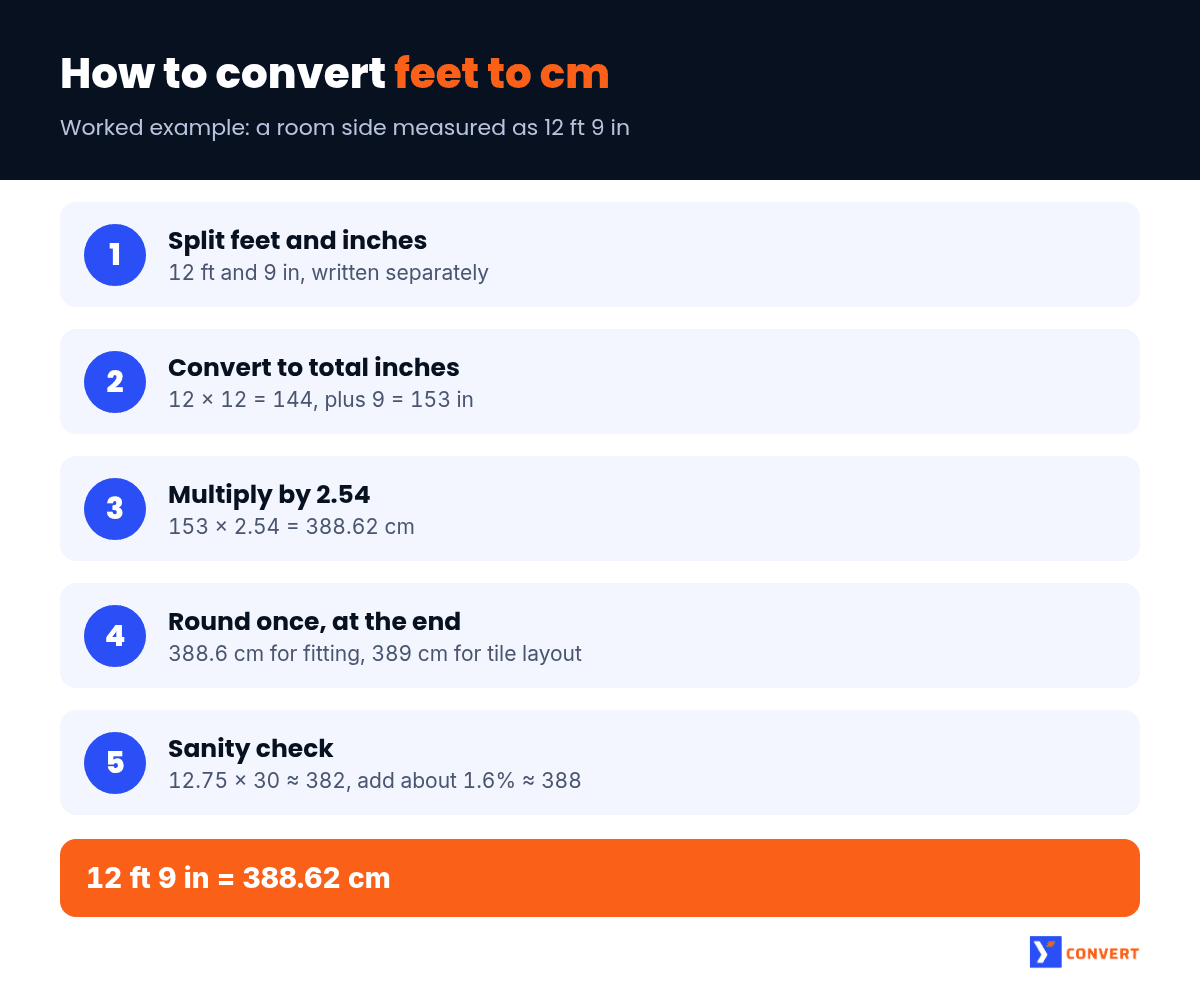
How to convert feet to centimeters, step by step
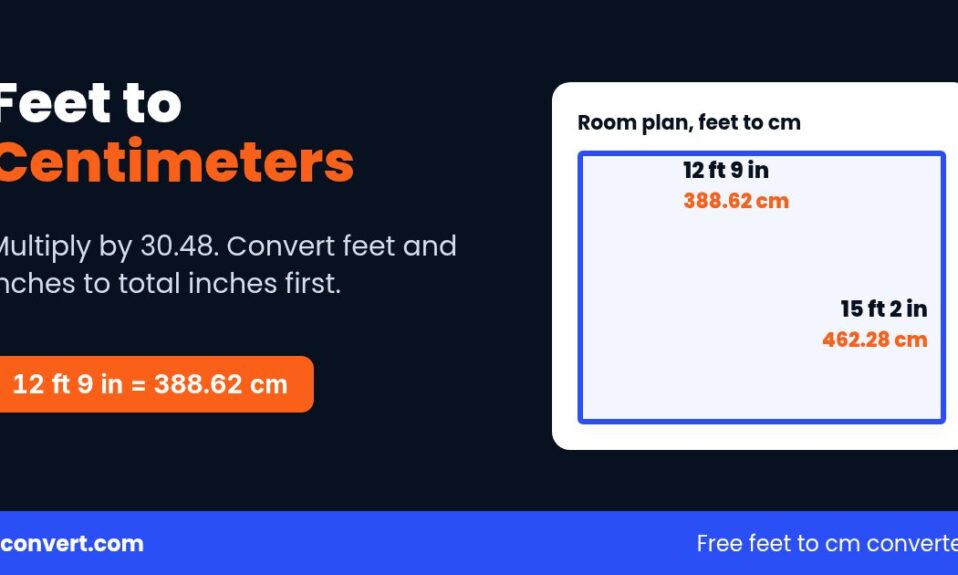
Take a job I’d consider typical. A flooring contractor gets a room drawn as 12 ft 9 in by 15 ft 2 in, and the tiles are sold in centimeter sizes. Here’s how I’d do the first side.
Step 1: Split feet and inches
12 ft 9 in. Feet part is 12, inch part is 9. Write them down separately. Don’t try to turn 9 inches into “.9 ft” in your head (that mistake comes up again below).
Step 2: Turn everything into inches
12 × 12 = 144 inches. Add the 9: 153 inches total.
Step 3: Multiply by 2.54
153 × 2.54 = 388.62 cm.
Step 4: Round once, at the end
For tile layout, 388.6 cm or even 389 cm is fine. For a cabinet that has to slide between two walls, I’d keep the millimeters and call it 388.6 cm, then take off a fitting gap. The point is to round once, on the final number, not at every step.
Step 5: Sanity check with the shortcut
12.75 ft × 30 is about 382. Add a bit (roughly 1.6%) and you land near 388. Close enough to tell me I didn’t slip a decimal.
The other side, 15 ft 2 in, is 182 inches, which is 462.28 cm. So the room is about 388.6 × 462.3 cm.
The 6.5 ft trap (decimal feet are not feet and inches)
This one catches more people than anything else on this page.
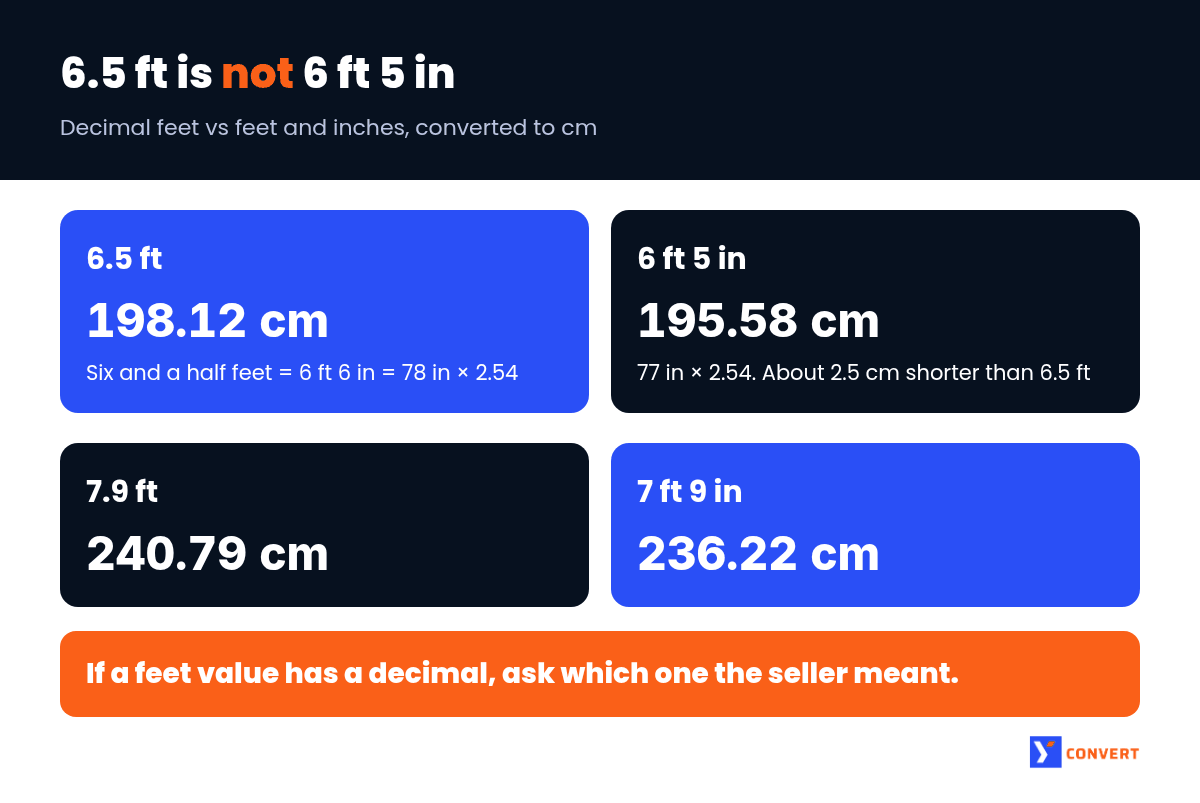
6.5 ft means six and a half feet. That’s 6 ft 6 in, which is 198.12 cm. But plenty of listings write “6.5” when the seller meant 6 ft 5 in, which is 195.58 cm. The gap is about 2.5 cm. Small on paper. Big when a sofa doesn’t go through a door frame.
I’ve seen this go wrong with an online furniture store that imports from a supplier working in feet. The supplier sheet says “sofa length 7.3”. Is that 7.3 ft (222.5 cm) or 7 ft 3 in (221 cm)? Here the gap is only 1.5 cm, so nobody notices. With “7.9” the difference is a lot larger: 7.9 ft is 240.8 cm, while 7 ft 9 in is 236.2 cm. Nearly 5 cm.
My rule: if a number in feet has a decimal, ask. Every time. It’s a 30-second message and it saves a return.
A quicker way to do it in your head
When I just need a rough feel for size, I multiply by 30 and add a little.
- Feet × 30, then add about half a centimeter for each foot.
- 10 ft: 300 + 4.8 = 304.8 cm.
- 4 ft: 120 + 1.92 = about 122 cm.
The “× 30” part gets you within 2% on its own. That’s fine for “will this tank fit on the stand” but not for anything you’re cutting.
Feet to cm values I get asked about most
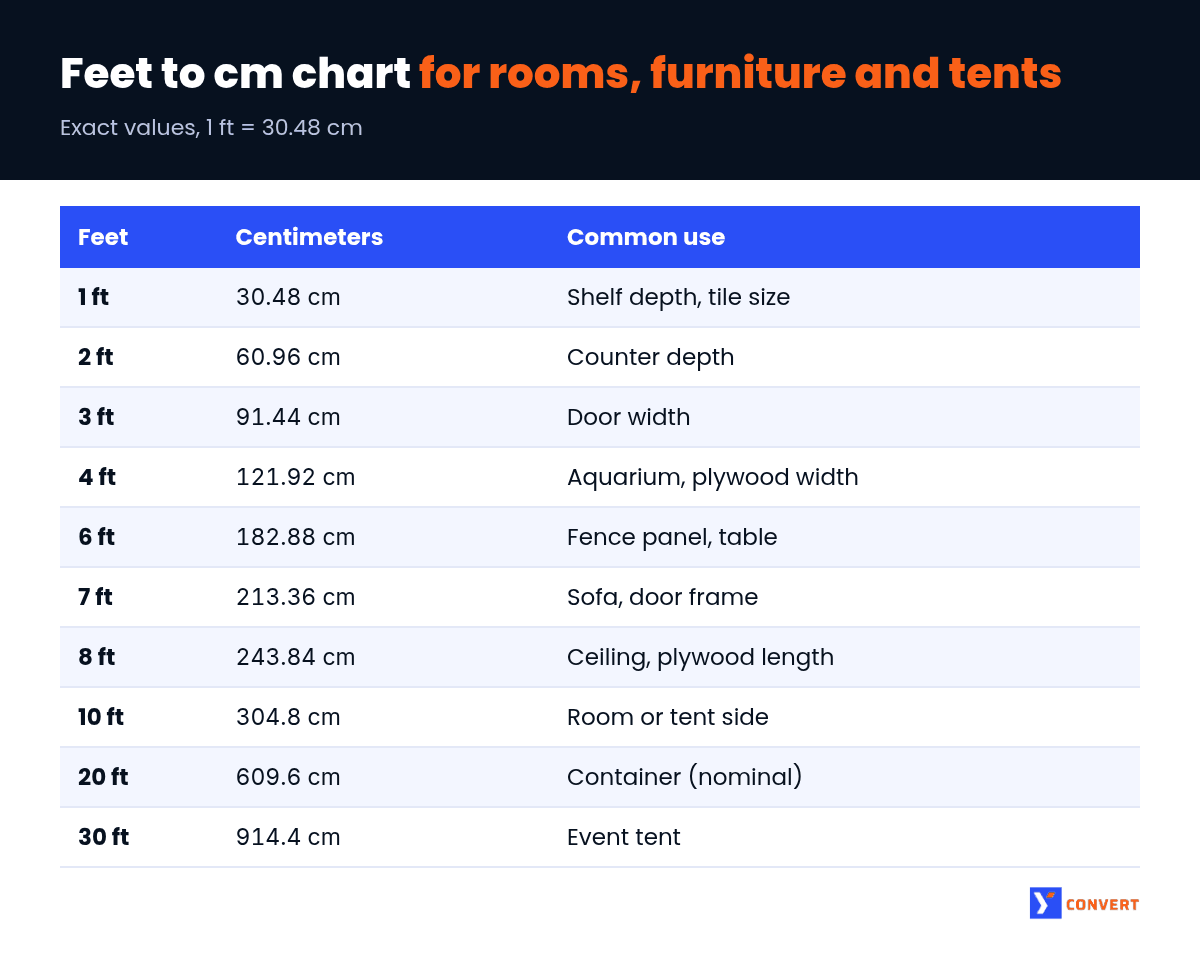
These are the ones that come up in shop, warehouse and event work. All are exact, then rounded to two decimals where needed.
| Feet | Centimeters | Where I usually see it |
|---|---|---|
| 1 ft | 30.48 cm | Shelf depth, tile size |
| 2 ft | 60.96 cm | Kitchen counter depth |
| 3 ft | 91.44 cm | Door width, desk length |
| 4 ft | 121.92 cm | Aquarium length, plywood width |
| 5 ft | 152.4 cm | Bed width, fence panel |
| 6 ft | 182.88 cm | Dining table, fence panel |
| 7 ft | 213.36 cm | Sofa length, door frame |
| 8 ft | 243.84 cm | Ceiling, plywood length |
| 10 ft | 304.8 cm | Room side, tent side |
| 20 ft | 609.6 cm | Shipping container (nominal), marquee |
| 30 ft | 914.4 cm | Event tent, garage run |
Square feet are a different conversion
People search “feet to cm” when they actually have an area. A 10 × 10 ft room is 100 square feet, and you can’t multiply 100 by 30.48 to get anything useful.
For area you square the factor: 1 sq ft = 30.48 × 30.48 = 929.03 cm². Most people want square meters anyway, so 1 sq ft is about 0.0929 m².
The cleaner way, and the one I’d use for a flooring quote, is to convert each side first and multiply after. 388.62 cm × 462.28 cm = about 17.97 m². Do the sides, then the area. Less room to go wrong.
Where feet to cm goes wrong in real work
A few patterns I keep running into:
- Event tent rental. A 20 × 30 ft tent becomes 609.6 × 914.4 cm. Fine. But the venue’s lawn is measured in meters, and someone rounds the tent to “6 × 9 m”. That is almost 10 cm short on one side and over 14 cm short on the other, which matters when pegs and guy ropes sit outside the frame.
- Shipping and moving. Container sizes are quoted in feet, but the cargo list is in centimeters. Nominal length is not internal length, so I convert the nominal figure only to sanity check, and use the real internal spec from the carrier for planning.
- Aquarium and pet shops. A “4 ft tank” is 121.92 cm. Stands sold in Europe come as 120 cm. That 2 cm overhang is a real problem for glass.
- Garden and fencing suppliers. A 6 ft panel is 182.88 cm. Posts add width. Converting panels without posts is how a fence run comes up short.
Feet to cm in Excel or Google Sheets
If you have a column of measurements, don’t do them one by one.
- Decimal feet in A2:
=A2*30.48 - Feet in A2 and inches in B2:
=(A2*12+B2)*2.54 - Built-in function:
=CONVERT(A2,"ft","cm")
Then round in a separate column with =ROUND(C2,1) so the raw value stays exact. I like keeping the unrounded number around for when someone asks “why does the total look off by 2 cm”.
Use the converter for the quick ones
For a single number, the feet to centimeters converter does the multiplication and shows the formula next to the answer. Free, no sign-up.
If you’re working with longer runs, the feet to meters converter skips a step. For small parts, the inches to cm converter is the one I’d use, and my centimeters to inches guide explains how to turn a metric number back into tape-measure fractions.
FAQ
How many centimeters are in a foot?
Exactly 30.48. A foot is 12 inches and each inch is 2.54 cm, so 12 × 2.54 = 30.48 cm.
What is the formula to convert feet to cm?
Multiply the feet by 30.48. For example, 8 ft × 30.48 = 243.84 cm. If you have feet and inches, convert to total inches and multiply by 2.54 instead.
How do I convert feet and inches to centimeters?
Multiply the feet by 12, add the inches, then multiply the total by 2.54. 5 ft 3 in is 63 inches, and 63 × 2.54 = 160.02 cm.
Is 6.5 feet the same as 6 feet 5 inches?
No. 6.5 ft is six and a half feet, which is 6 ft 6 in or 198.12 cm. 6 ft 5 in is 195.58 cm. Always check which one a listing means.
How do I convert square feet to square centimeters?
Multiply square feet by 929.03, because 30.48 × 30.48 = 929.03. For flooring and rooms it’s usually easier to convert each side to centimeters first and then multiply.