To convert minutes to hours, divide the minutes by 60. So 90 minutes is 1.5 hours, 45 minutes is 0.75 hours, and 135 minutes is 2.25 hours. If you need hours and minutes instead of a decimal, take the whole hours from the division and keep the remainder as minutes: 135 minutes is 2 hours 15 minutes.
Simple, right? It is, until someone writes 2 hours 15 minutes as 2.15 on a timesheet. That one habit causes more billing and payroll errors than anything else I see with time math. This post covers the formula, a table of values worth knowing, the decimal versus hours-and-minutes trap, and a handful of real situations where it matters.
The minutes to hours formula
Here it is:
hours = minutes ÷ 60
And the reverse:
minutes = hours × 60
A few to check on your own calculator:
- 30 minutes ÷ 60 = 0.5 hours
- 100 minutes ÷ 60 = 1.6667 hours
- 480 minutes ÷ 60 = 8 hours
The minutes to hours converter does the division in one box. Type the minutes, press convert, read the hours. One minute shows as 0.01667 hours, which is 1/60 rounded to five decimal places. That’s fine for almost everything. If a figure is going into a contract or a payroll export, I’d still divide by 60 directly and round once, at the very end.
Why 60 and not 100? Hours and minutes come from a counting system based on 60, which is far older than decimals. It’s annoying for arithmetic. It’s also why a converter is worth bookmarking.
Minutes to hours: a table worth keeping
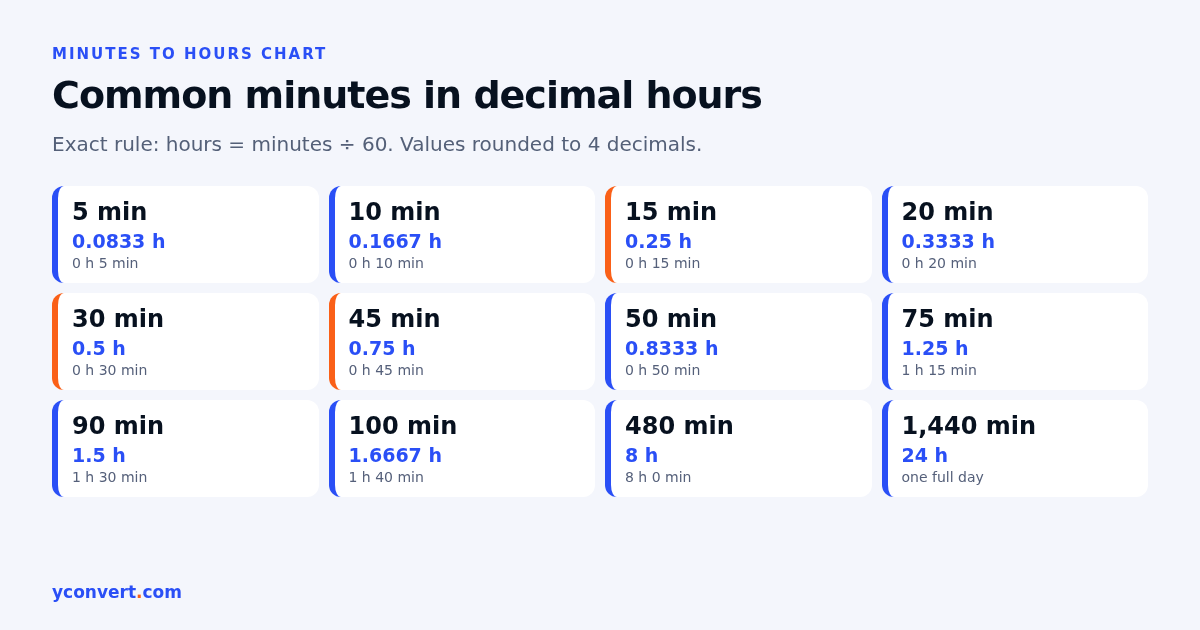
These are the conversions that come up again and again. Where the answer doesn’t end cleanly, I’ve rounded to four decimals.
| Minutes | Decimal hours | Hours and minutes |
|---|---|---|
| 5 min | 0.0833 h | 0 h 5 min |
| 10 min | 0.1667 h | 0 h 10 min |
| 15 min | 0.25 h | 0 h 15 min |
| 20 min | 0.3333 h | 0 h 20 min |
| 30 min | 0.5 h | 0 h 30 min |
| 40 min | 0.6667 h | 0 h 40 min |
| 45 min | 0.75 h | 0 h 45 min |
| 50 min | 0.8333 h | 0 h 50 min |
| 75 min | 1.25 h | 1 h 15 min |
| 90 min | 1.5 h | 1 h 30 min |
| 100 min | 1.6667 h | 1 h 40 min |
| 150 min | 2.5 h | 2 h 30 min |
| 480 min | 8 h | 8 h 0 min |
| 1,440 min | 24 h | one full day |
If you memorise only four, make them the quarters: 15 is 0.25, 30 is 0.5, 45 is 0.75, 60 is 1. Most timesheet entries land near one of those, so they double as a quick sanity check.
Decimal hours vs hours and minutes
This is the part worth slowing down for.
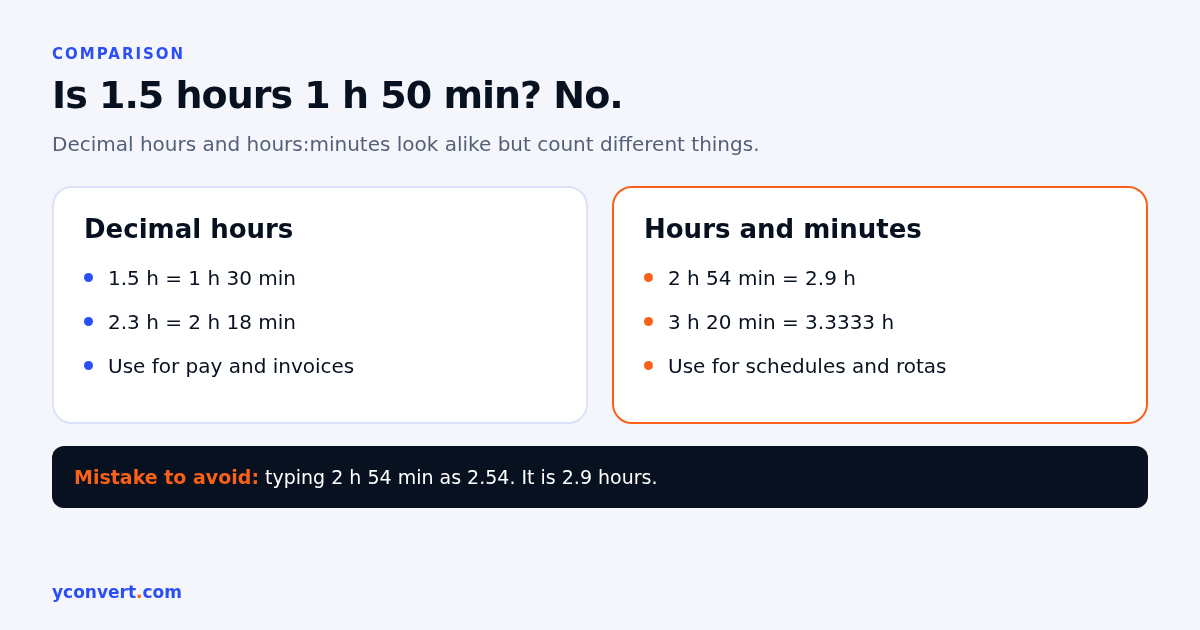
1.5 hours is not 1 hour 50 minutes. It’s 1 hour 30 minutes, because half an hour is 30 minutes. In the same way, 2.3 hours is 2 hours 18 minutes, not 2 hours 30. The digits after the point are a fraction of an hour, not a count of minutes.
To go from decimal hours back to hours and minutes, multiply only the part after the point by 60:
- 2.3 hours: 0.3 × 60 = 18, so 2 h 18 min
- 1.75 hours: 0.75 × 60 = 45, so 1 h 45 min
- 7.8 hours: 0.8 × 60 = 48, so 7 h 48 min
My rule: pick one format per document and say which one it is in the column header. “Hours (decimal)” or “Time (h:mm)”. It sounds fussy. It saves arguments later.
Where minutes to hours actually comes up
Formulas are easy to agree with and easy to get wrong in practice. Here’s how the same division plays out in a few different lines of work.
A freelance video editor billing by the hour
Say an editor logs three sessions on a client project: 37 minutes, 52 minutes and 85 minutes. That’s 174 minutes in total. Divided by 60, it’s 2.9 hours. At ₹1,500 an hour, the fee is ₹4,350.
Now the common slip. 174 minutes is 2 hours 54 minutes, and it’s tempting to type that as 2.54. At the same rate, 2.54 hours comes to ₹3,810. The editor quietly loses ₹540 on one small invoice. If GST applies at 18% on top, the correct bill is ₹4,350 plus ₹783, or ₹5,133. I covered the GST side of that, including how to add or remove it, in the post on using a GST calculator the right way.
A contact centre adding up talk time
A team lead wants to know how many agent hours went into yesterday’s queue. There were 220 calls, averaging 6 minutes 30 seconds each. First turn the seconds into a fraction of a minute: 30 seconds is 0.5 minutes, so the average is 6.5 minutes. Then 220 × 6.5 = 1,430 minutes. Divide by 60 and you get 23.8333 hours, or 23 hours 50 minutes.
Two conversions, done in order. Skipping the first step and calling it 6.30 minutes is the same trap as above, just one level down.
An office cleaning company running payroll
A cleaner clocks in at 7:50 and out at 15:35, with a 30-minute unpaid break. From 7:50 to 15:35 is 7 hours 45 minutes, which is 465 minutes. Take off the break and it’s 435 minutes. Divide by 60: 7.25 paid hours.
Payroll software usually wants that 7.25, not 7:15. Some employers also round clock times to the nearest quarter hour. If you do, check the rules where you operate, since rounding has to be fair to staff over time.
A bakery planning oven time
A bakery runs three batches of bread at 35 minutes each and two trays of something heavier at 50 minutes each. That’s 105 plus 100, so 205 minutes of oven time. In hours it’s 3.4167, which is 3 hours 25 minutes. For a shift plan, the hours-and-minutes version is easier to read. For working out gas or power cost per hour, the decimal is the one you need.
A coaching centre scheduling classes
A tutor teaches five sessions a week, each 75 minutes long. That’s 375 minutes, or 6.25 hours, which is 6 hours 15 minutes. Handy when a parent asks how many hours of teaching the fee actually covers, or when you’re comparing two timetables that use different session lengths.
A runner turning a finish time into speed
Speed needs hours, but race times arrive in minutes. Run 5 km in 27 minutes and the hours figure is 27 ÷ 60 = 0.45. Then 5 ÷ 0.45 = about 11.1 km per hour. If your watch shows miles, my notes on converting miles to kilometers with a mental shortcut handle the distance side.
Convert minutes to hours in 4 steps
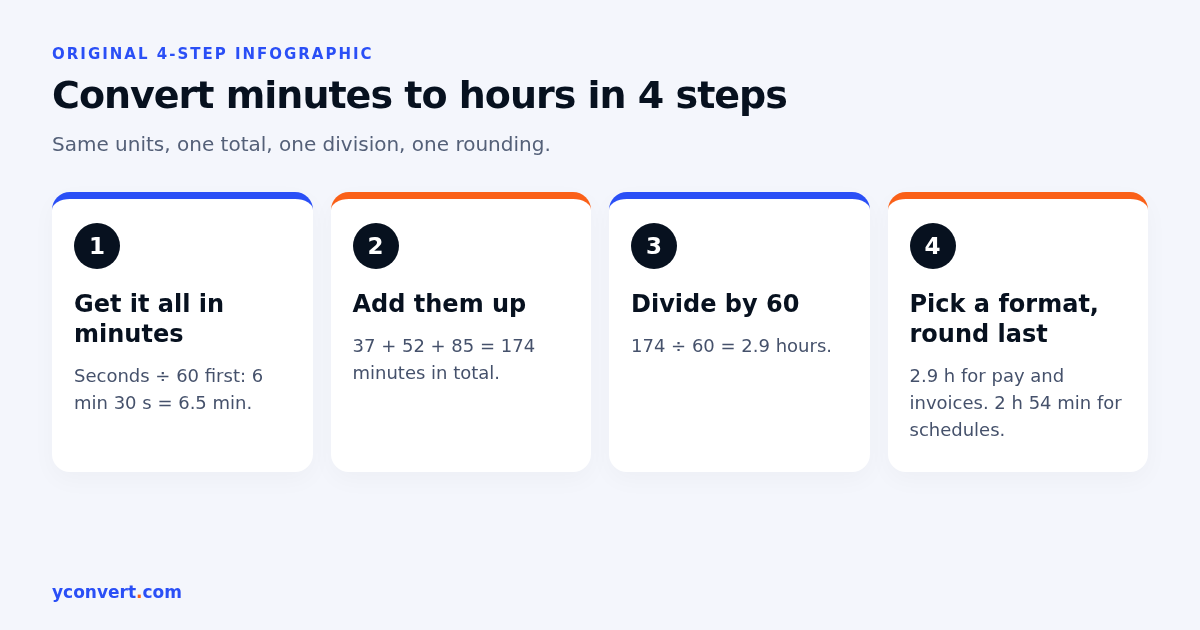
The routine I use so a long column of minutes doesn’t trip me up:
- Get everything into minutes. Turn seconds into minutes first (seconds ÷ 60) and turn any hours into minutes (hours × 60). Mixed units are where errors hide.
- Add them up. Total the minutes before converting. Converting each line and adding rounded decimals drifts.
- Divide by 60. Or paste the total into the converter.
- Pick the format, then round. Decimal hours for pay and invoices. Hours and minutes for schedules. Round once, at the end.
A quick check: the hours figure should always be much smaller than the minutes figure. If 300 minutes turns into 18,000 of anything, you multiplied.
The mistakes I see most often
Writing minutes after the decimal point
Covered above, but it deserves the top spot. 3 hours 20 minutes is 3.3333 hours, not 3.20. Every time you see a decimal hour figure ending in a number above 59, like 4.75, you know it’s decimal. When it ends in something like .20 or .40, ask.
Rounding every line instead of the total
If you convert 20 minutes to 0.33 on ten separate lines and add them, you get 3.3 hours. The real total is 200 minutes, which is 3.3333 hours. Small, sure. Across a month of entries for a whole team, it isn’t.
Spreadsheets showing time as a fraction of a day
Most spreadsheet apps store a time like 6:00 as 0.25, because six hours is a quarter of a day. So when you subtract two clock times and get a strange small number, it isn’t broken. Multiply it by 24 to get decimal hours. Going the other way, a plain number of minutes divided by 1,440 can be formatted as a time.
Forgetting the day boundary
A night shift from 22:00 to 06:00 is 8 hours, or 480 minutes. Simple subtraction says minus 16. Add 24 hours when the end time is earlier than the start, then convert.
For bigger totals, it can help to think in days. There are 1,440 minutes in a day, and the minutes to days converter is quicker than dividing twice.
FAQ
How do I convert minutes to hours?
Divide the minutes by 60. For example, 150 minutes ÷ 60 = 2.5 hours, which is 2 hours 30 minutes.
What is 45 minutes in hours?
45 minutes is 0.75 hours, or three quarters of an hour.
How many hours is 100 minutes?
100 minutes is about 1.67 hours (1.6667), which is 1 hour 40 minutes.
Is 1.5 hours the same as 1 hour 50 minutes?
No. 1.5 hours is 1 hour 30 minutes. The .5 means half an hour, not 50 minutes.
How do I turn decimal hours back into minutes?
Multiply the decimal part by 60. For 2.3 hours, 0.3 × 60 = 18, so it’s 2 hours 18 minutes. To get total minutes, multiply the whole figure by 60: 2.3 × 60 = 138 minutes.
How many minutes are in a day?
There are 1,440 minutes in a day, which is 24 hours × 60 minutes.
Before you send the timesheet
For a quick answer, the minutes to hours tool is the fastest way through. And if your time estimates are about content, like reading time for an article, the post on using a word counter to check writing length pairs well with it.
If you also run a site full of practical pages like this, our AEO and SEO audit starts with 1 free credit, then $2 per report, or 10 reports for $15 and 20 for $20. It shows whether search and answer engines are actually picking your pages up.
Last updated: November 2026