Last updated: October 2026
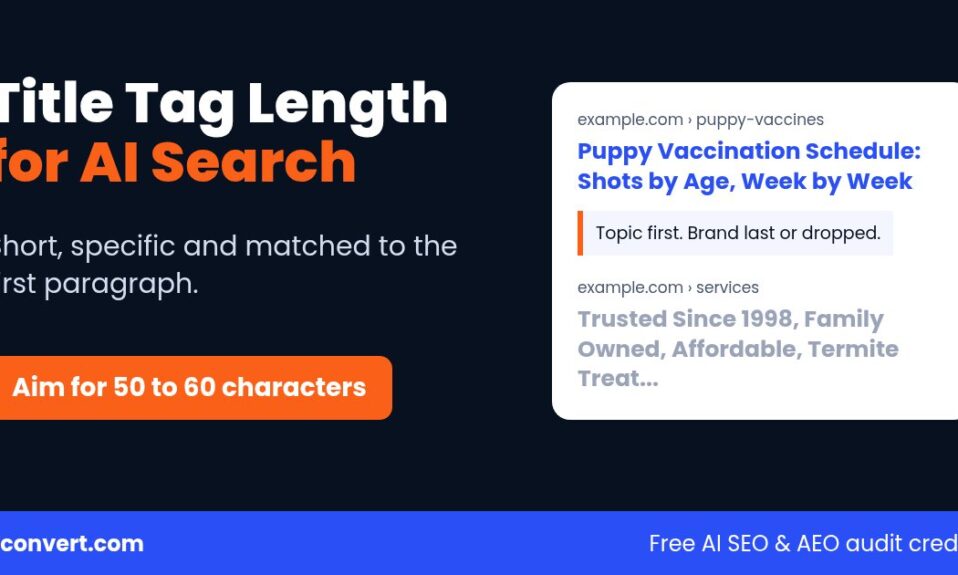
Short answer: keep the title tag around 50 to 60 characters, with the main topic in the first half. AI search doesn’t have a stricter limit than classic search. What changed is how the title gets used. Google still cuts long titles in the results page, and AI answers mostly read your title as a label that tells them what the page is about. So a title that is short, specific and matches the page’s first paragraph does better than a long one stuffed with keywords.
I get asked this a lot now, usually phrased as “do I need to rewrite all my titles for AI?” Almost never. But in most audits I run, a handful of titles are doing the page real harm, and length is only part of why.
What length actually means for a title tag
There are two limits people mix up.
The display limit. Google shows titles up to a certain pixel width on desktop and a bit less on mobile. Past that, it cuts the title with an ellipsis. In practice that lands somewhere around 50 to 60 characters, depending on how wide the letters are. A title full of capital Ws runs out sooner than one full of i’s and l’s.
The rewrite risk. If a title is long, vague, or doesn’t match the page, Google often replaces it with something else, usually pulled from your H1 or a heading. You can have a 45-character title and still get it rewritten if it says “Home | Services | Best Company”.
AI answers sit on top of both. An AI overview or chat answer rarely shows your title in full. It reads it, along with the heading and the opening lines, to decide if your page answers the question. Length matters less there. Clarity matters a lot.
Does AI search need shorter titles?
Not shorter. Plainer.
My own view, after looking at a lot of pages that get cited and a lot that don’t, is that the title is mostly a matching signal for AI systems. When the title, the H1 and the first two sentences all say the same thing in slightly different words, the page is easy to place. When the title promises one thing (“Ultimate Guide to Pet Care 2026”) and the page is really about vaccination schedules for puppies, it’s a weaker match, however good the content is.
So I don’t chase a new character count for AI. I chase alignment.
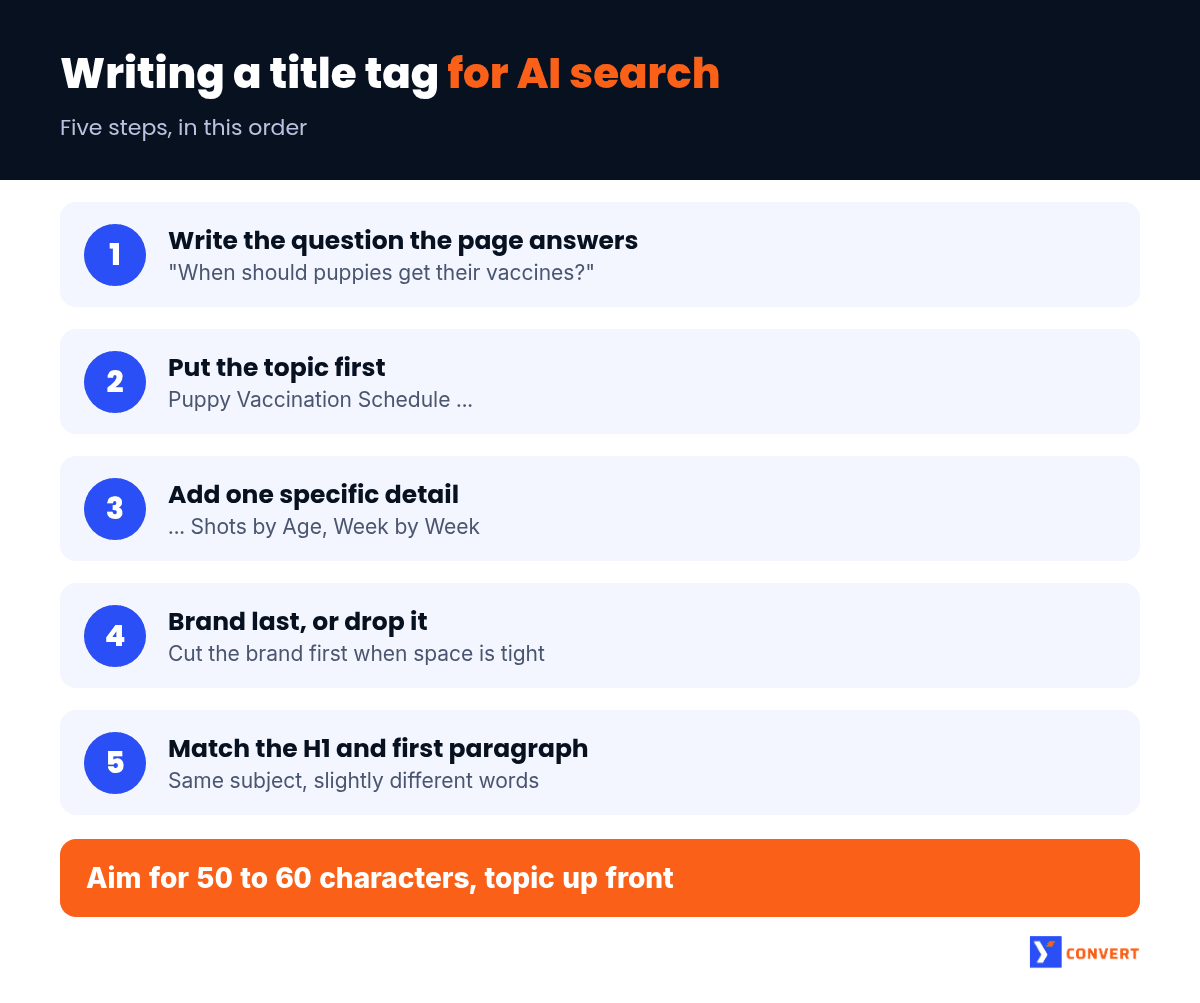
How I write a title tag for AI search, step by step
Here’s the order I follow. I’ll use a veterinary clinic’s vaccination page as the example.
Step 1: Write the question the page answers
“When should puppies get their vaccines?” That’s the page. Not “pet care”, not “our vet services”.
Step 2: Put the topic first
“Puppy Vaccination Schedule” goes at the front. Front-loading means that even if Google trims the end, the part that matters is visible, and an AI system parsing it sees the subject straight away.
Step 3: Add one detail that makes it specific
A location, a qualifier, a year if the content truly changes yearly. “Puppy Vaccination Schedule: Shots by Age, Week by Week”. About 55 characters. Clear.
Step 4: Put the brand last, or drop it
On a long title, the brand is the first thing I cut. Google often shows the site name separately anyway. For a local business with a strong name, I’ll keep it at the end after a pipe or dash.
Step 5: Check it against the H1 and the first paragraph
If the title says “schedule” and the H1 says “Everything About Puppy Health”, I fix the H1. They don’t have to match word for word, but they should describe the same thing.
Title tag length examples (bad, okay, good)
These are made-up but they reflect patterns I see in audits all the time.
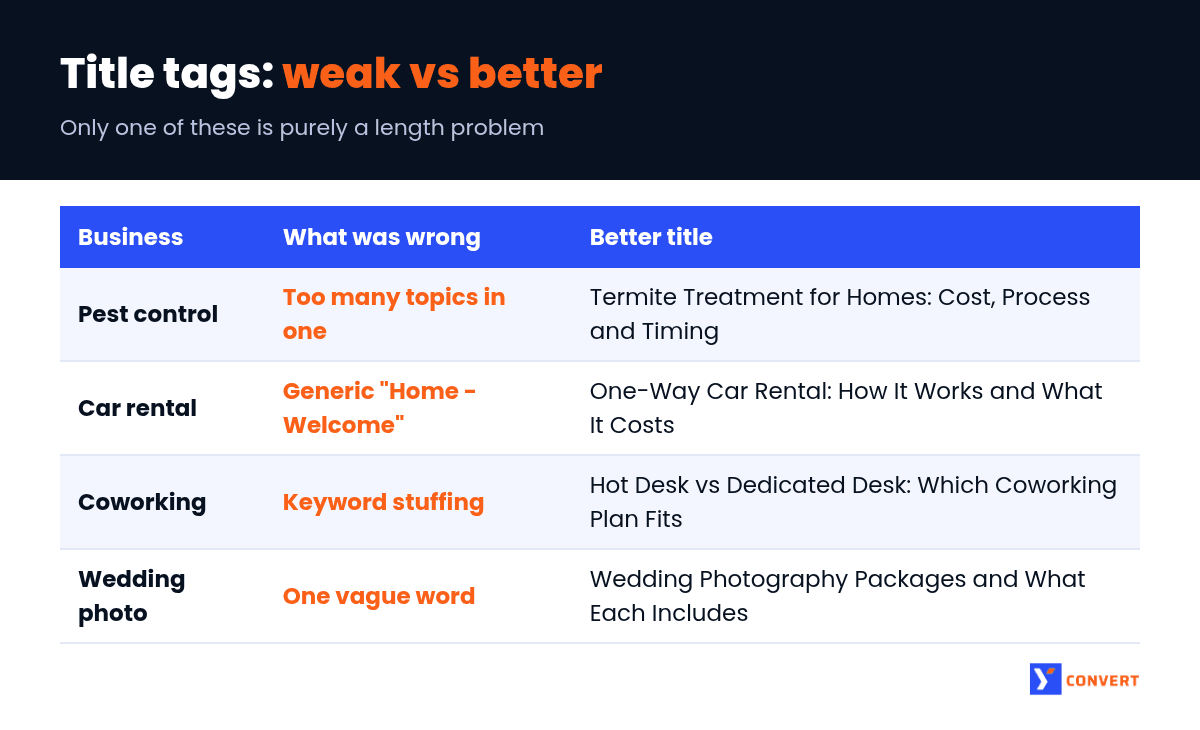
| Business | Weak title | Better title | Why |
|---|---|---|---|
| Pest control | Pest Control Services, Termite, Rodent, Bed Bug, Cockroach Removal Near Me | Termite Treatment for Homes: Cost, Process and Timing | One topic per page, topic first |
| Car rental | Home – Welcome to Our Car Rental Company | One-Way Car Rental: How It Works and What It Costs | Says what the page is |
| Coworking space | Best Coworking Space 2026 Top Rated Flexible Office Hot Desk | Hot Desk vs Dedicated Desk: Which Coworking Plan Fits | Answers a real comparison |
| Wedding photographer | Photography | Wedding Photography Packages and What Each Includes | Specific, matches the page |
The weak ones fail in different ways. Too long, too generic, or too many topics in one. Only one of them is a pure length problem.
When a longer title is fine
I don’t treat 60 characters as a wall. A title of 65 or 70 that front-loads the topic often works fine. The end gets cut, the reader still knows what the page is, and AI systems still read the full text in the source.
Where long titles hurt is when the useful part is at the end. “Trusted Since 1998, Family Owned, Affordable, Termite Treatment” puts the only thing a searcher cares about where it’s most likely to be cut.
Signs your title is hurting you in AI answers
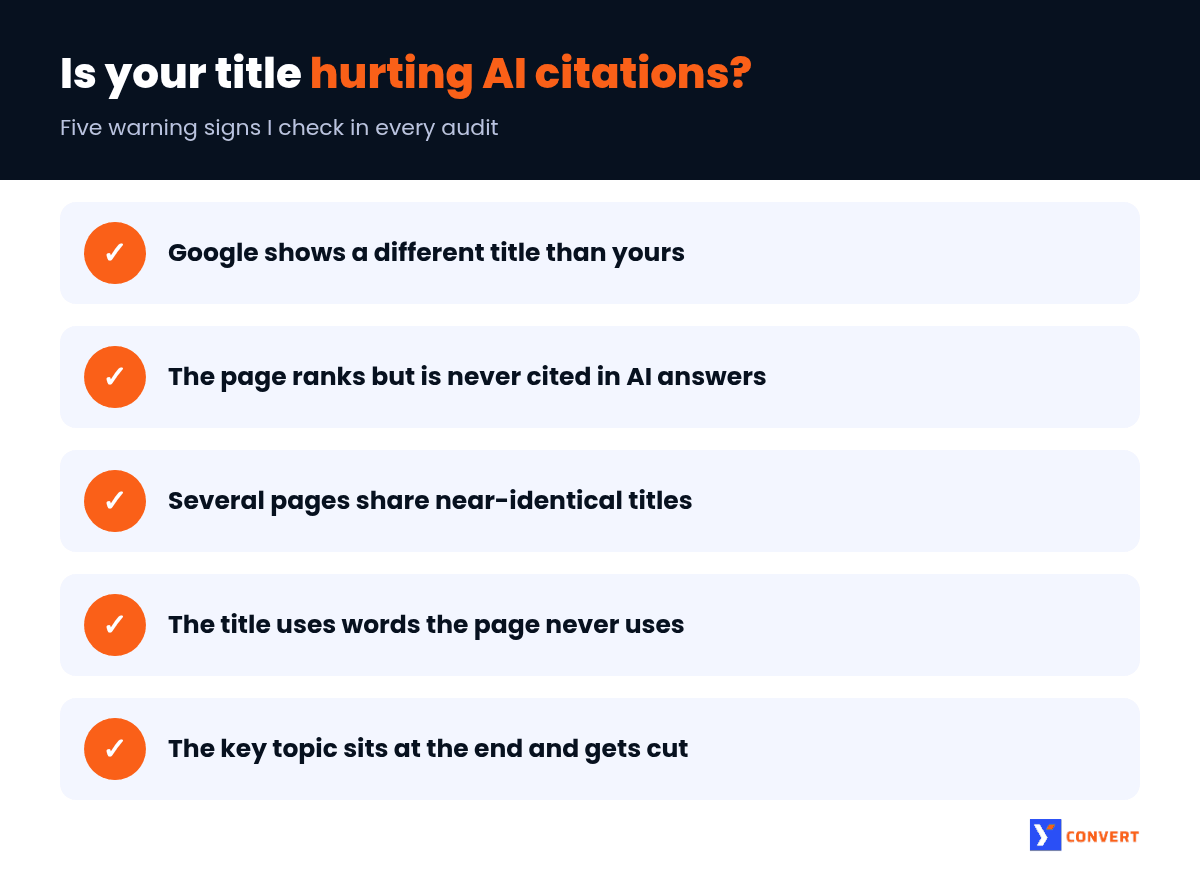
A few things I check in an audit:
- Google rewrites it in the results. Search for the page and compare. If the shown title differs from yours, Google didn’t trust it.
- The page ranks but never gets cited. Often the title is broad while the content is narrow, or the reverse. I go through this in more detail in ranking but not cited in AI Overviews.
- Several pages share near-identical titles. Five location pages titled “Pest Control | Brand” give an AI system nothing to tell them apart.
- The title uses words the page never uses. If the title says “cost” and there’s no price or cost range anywhere on the page, that’s a promise the page doesn’t keep.
Title tag vs H1 vs meta description
Quick way I explain it to clients:
- Title tag: the label. What the page is, in the fewest clear words.
- H1: the heading the reader sees. Can be a bit warmer or longer.
- Meta description: the pitch. Google often rewrites it, and AI answers rarely use it directly, but it still helps clicks when it’s shown.
If you only have time to fix one, fix the title and the first paragraph together. That pair does most of the work for both search and AI answers. My landing page SEO audit checklist covers the rest of the on-page checks, and how to get cited in Google AI Mode goes further into what makes a page quotable.
Check your titles in one go
If you’d rather not go page by page, the AI SEO and AEO audit flags titles that are too long, generic or out of line with the page content, along with the other on-page issues. Your first report is free. After that it’s $2 per report, or 10 for $15 and 20 for $20.
FAQ
How long should a title tag be in 2026?
Aim for about 50 to 60 characters, with the main topic in the first half. Google cuts titles by pixel width, so the exact cut-off varies, but this range shows in full on most screens.
Do AI search engines use the title tag?
Yes, as one of the signals for what a page is about. AI answers rarely display your title in full, but they read it alongside the heading and opening text to decide whether the page answers the question.
Is a 70-character title tag bad?
Not automatically. If the topic is at the front and the title matches the page, a longer title can work. It becomes a problem when the important words sit at the end and get cut off.
Why does Google change my title tag?
Usually because the title is vague, stuffed with keywords, duplicated across pages, or doesn’t match the content. Google then builds a title from your H1 or another heading instead.
Should I put my brand name in the title tag?
Put it at the end if you include it. On long titles it’s the first thing to cut, because the topic matters more to searchers and to AI systems than the brand does.