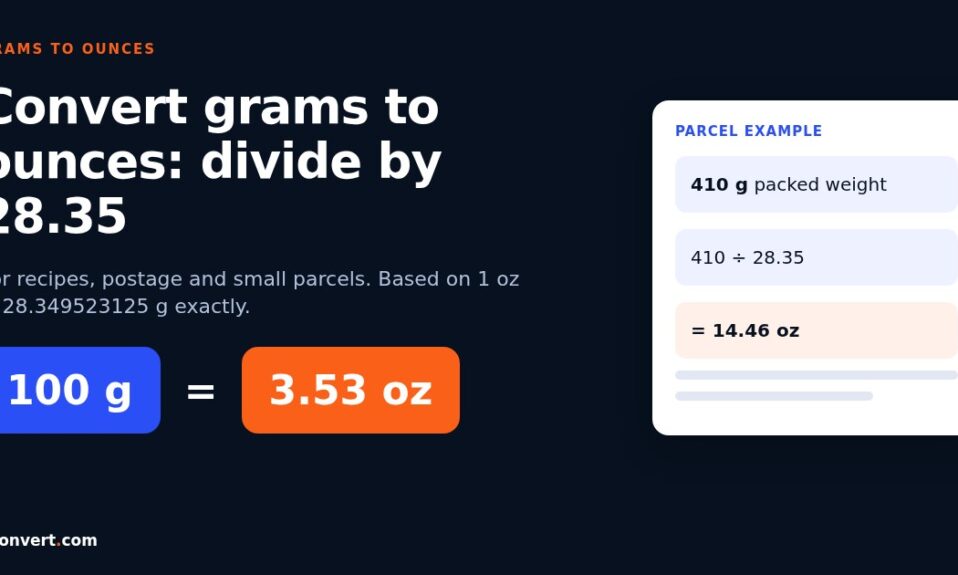
To convert grams to ounces, divide the grams by 28.35 (or multiply by 0.035274). So 100 g is about 3.53 oz, 250 g is about 8.82 oz and 500 g is about 17.64 oz. The factor isn’t a guess. An ounce is defined as exactly 28.349523125 grams, which means one gram is 0.03527396 of an ounce, and every figure below comes from that.
Simple enough on paper. In practice the trouble starts somewhere else. A recipe card written in grams lands in front of someone with an ounce scale. A shipping label wants ounces while the scale on the packing table shows grams. A jeweller quotes a weight in “ounces” and means a different ounce altogether. This guide covers the formula, a chart, a way to do it in your head, the three ounces people mix up and a handful of jobs where getting it right actually saves money.
The grams to ounces formula
ounces = grams ÷ 28.349523125
Most of the time you can shorten that:
ounces = grams × 0.035274
And going the other way:
grams = ounces × 28.3495
A few to check by hand:
- 50 g ÷ 28.3495 = 1.76 oz
- 150 g ÷ 28.3495 = 5.29 oz
- 1,000 g ÷ 28.3495 = 35.27 oz
The grams to ounces converter does it in one step. Type the grams, read the ounces. Decimals like 7.8 or 0.5 are fine.
Where does 28.349523125 come from? The pound was fixed at exactly 0.45359237 kg by international agreement in 1959. An ounce is a sixteenth of that pound. Divide 453.59237 g by 16 and you land on 28.349523125 g, with nothing left over. So the factor is settled. The only decision you make is how many decimals to keep.
Grams to ounces chart
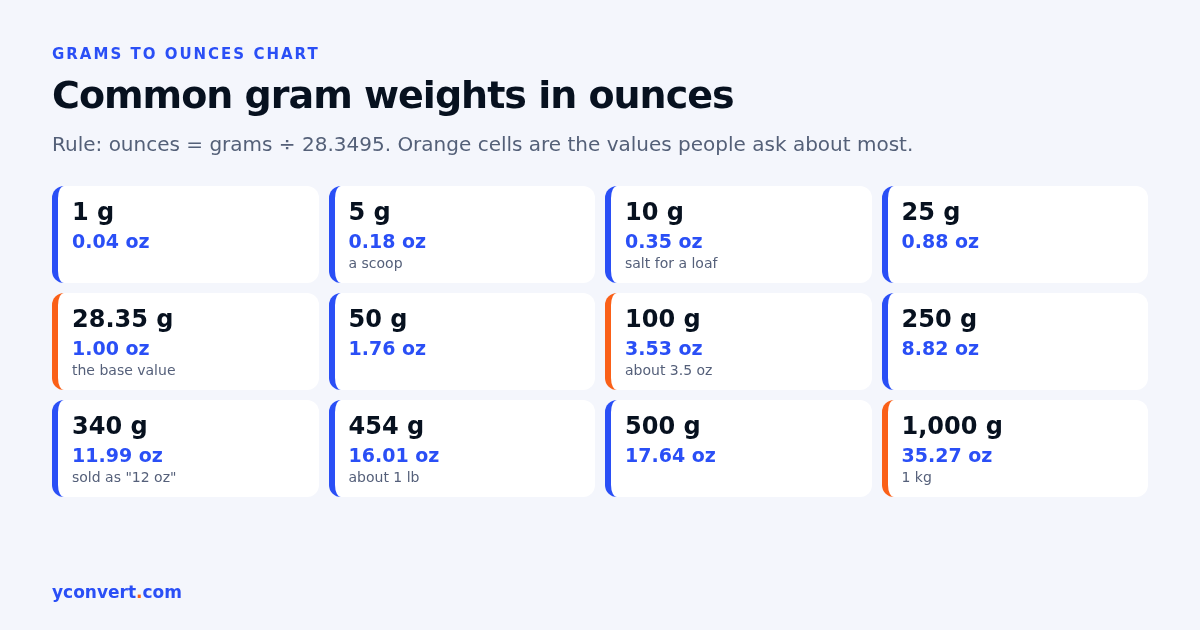
These are the weights I look up most. Ounces are rounded to two decimals.
| Grams | Ounces | Where it tends to come up |
|---|---|---|
| 1 g | 0.04 oz | A pinch of yeast or a small charm |
| 5 g | 0.18 oz | A scoop of powder |
| 10 g | 0.35 oz | Salt for a loaf |
| 25 g | 0.88 oz | A sachet or a sample pack |
| 28.35 g | 1 oz | The base value |
| 50 g | 1.76 oz | A chocolate bar |
| 100 g | 3.53 oz | A tea tin or a greeting card set |
| 250 g | 8.82 oz | A standard coffee bag in many countries |
| 340 g | 11.99 oz | The bag usually sold as “12 oz” |
| 454 g | 16.01 oz | Roughly one pound |
| 500 g | 17.64 oz | A bag of flour or rice |
| 1,000 g | 35.27 oz | One kilogram |
Look at the 454 g row. People treat 454 g as a pound, and it’s close, but it’s actually a hair over. The exact pound is 453.59 g. For a kitchen that difference vanishes. On a label, it doesn’t. Once you get past a pound or so, most people switch to pounds and ounces anyway, and the kilograms to pounds converter is the better tool for that range.
Doing it in your head
My shortcut is this: every 100 g is about 3.5 oz.
So count the hundreds, multiply by 3.5, and you’re nearly there. 300 g becomes 10.5 oz. 700 g becomes 24.5 oz. The true answer is always a little higher, because the real figure per 100 g is 3.527 oz, not 3.5.
If that small gap matters, add about a quarter of an ounce per kilogram. Take 500 g. Five hundreds times 3.5 is 17.5, plus an eighth of an ounce for the half kilogram, gives 17.625 oz. The exact answer is 17.637. Close enough for anything short of a lab.
The other shortcut I hear a lot is “divide by 28”. It works, but it runs slightly high, by a bit over 1%. On 250 g it gives 8.93 oz when the truth is 8.82. Fine for soup. Not fine for a label.
And for tiny amounts? Just remember that 1 oz is a bit over 28 g. A 5 g scoop is clearly a small fraction of an ounce, which is why I keep small quantities in grams and don’t bother converting at all.
Avoirdupois, troy and fluid ounces
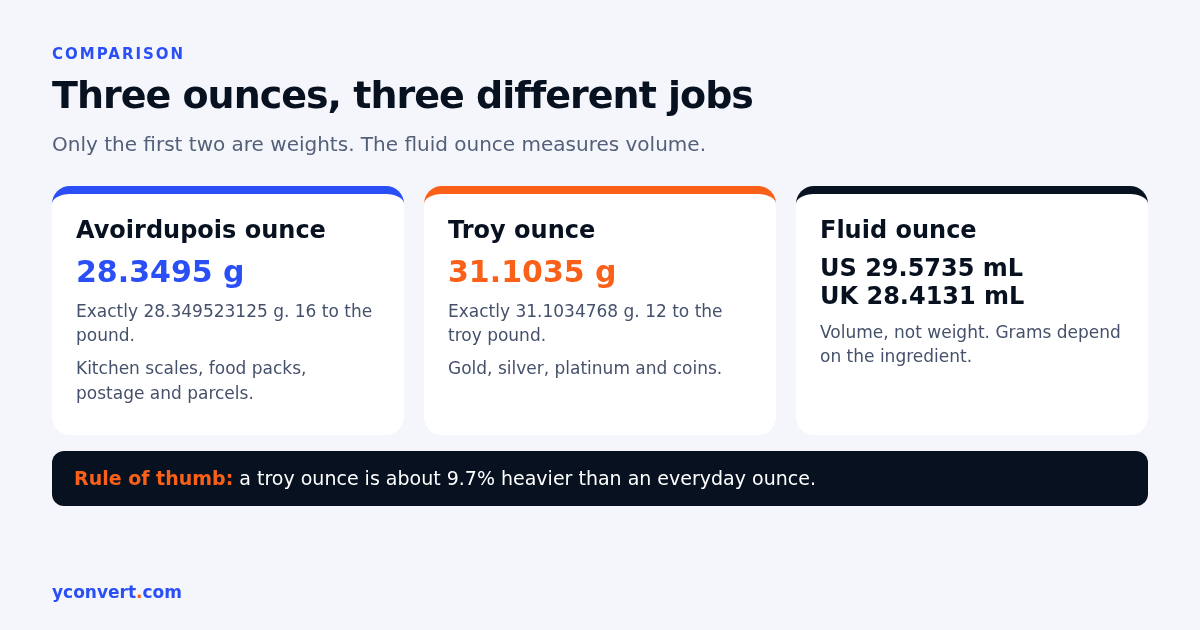
This is the part that catches people out. “Ounce” means three different things depending on who’s talking.
The avoirdupois ounce (the everyday one)
This is the ounce on kitchen scales, food packs, postage scales and parcel labels. It’s the 28.349523125 g ounce, sixteen to the pound. When anyone says “grams to ounces” without qualification, this is the one they mean, and it’s the one the converter uses.
The troy ounce (precious metals)
Gold, silver and platinum are priced per troy ounce, which is exactly 31.1034768 g. That’s about 9.7% heavier than the everyday ounce. So if you weigh a silver piece in grams and divide by 28.35, you’ll overstate its troy weight. For metals, divide by 31.1035 instead. There are twelve troy ounces in a troy pound, not sixteen, which is another reason the two systems don’t mix.
The fluid ounce (volume, not weight)
A fluid ounce measures space, not mass. A US fluid ounce is 29.5735 mL and a UK fluid ounce is 28.4131 mL. There is no single grams figure for a fluid ounce, because it depends on what’s in the cup. A fluid ounce of water weighs roughly 29.5 g, a little over one weight ounce. A fluid ounce of flour weighs much less, and of honey much more. If a recipe says “8 oz” next to a liquid, check whether it means volume before you put it on the scale.
Where grams to ounces actually matters
Here are a few jobs where I’ve seen this conversion decide something. Each one is an illustrative pattern, not a real client.
A bakery writing recipe cards for overseas customers
Say a small bakery shares its sourdough formula: 500 g flour, 350 g water, 10 g salt. Converted, that’s 17.64 oz flour, 12.35 oz water and 0.35 oz salt. The dough weighs 860 g in total, or 30.34 oz, which is about 1 lb 14.3 oz. My advice is to print both units side by side and to keep salt and yeast in grams too, since 0.35 oz is hard to read on most home scales. Also label the water as weight. Someone will otherwise pour 12 fluid ounces and wonder why the dough feels different.
A coffee roaster sizing bags
A roaster packing 340 g bags often prints “12 oz” on the front. But 12 oz is 340.19 g, so a bag filled to exactly 340 g is a touch under. Tiny, yes. Still, I’d fill to 341 g so the ounce claim is true, or print “11.99 oz (340 g)” and accept that it looks fussy. The roaster’s 250 g bag converts to 8.82 oz, and “8.8 oz” is the honest way to round it.
A jeweller quoting a silver ring
A silver ring weighs 7.8 g on the bench scale. In troy ounces that’s 7.8 ÷ 31.1035 = 0.2508 ozt. If someone divides by the everyday ounce instead, they get 0.2751 oz, which would overstate the metal content by almost a tenth. When metal value is part of the price, I always write “ozt” or “troy oz” so nobody has to guess. For older family pieces weighed in traditional units, the tola to gram guide helps get everything into grams first.
An online stationery seller shipping a printed planner
Picture a seller mailing a printed planner. The planner weighs 380 g, the padded mailer adds 30 g, so the package is 410 g, or 14.46 oz. Carriers that price by the ounce usually round any fraction up to the next whole ounce, so this goes out at 15 oz. Add a thank-you card and a sticker sheet and it may tip into the next band. The habit I’d build: weigh the packed parcel, not the product, and convert once from the final gram figure.
A supplement brand writing a label
A powder tub holds 300 g with a 5 g serving scoop. On the front, 300 g becomes 10.58 oz, usually printed as 10.6 oz. The per-serving figure is a different story: 5 g is 0.18 oz, which tells a shopper almost nothing. I’d keep servings in grams and use ounces only for the net weight on the pack.
Convert grams to ounces in 4 steps
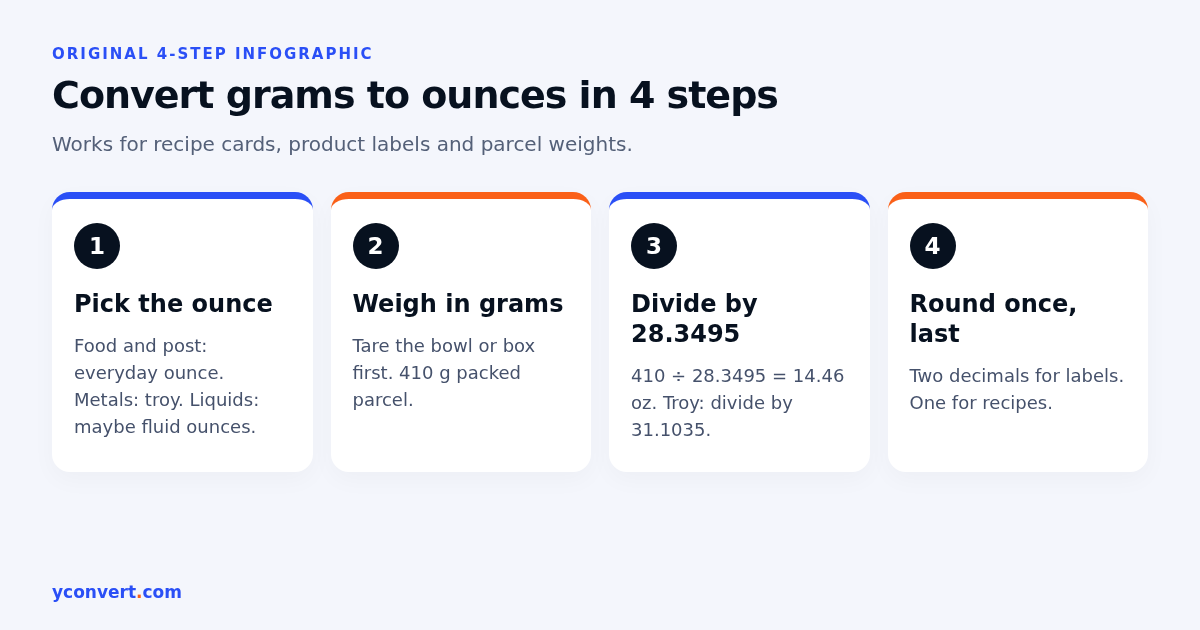
- Check which ounce you need. Food, postage and parcels use the everyday ounce. Metals use troy. Liquids in a recipe may be fluid ounces, which is volume.
- Weigh in grams and tare the container. Grams are finer, so start there. Zero the scale with the bowl, box or mailer on it if you only want the contents.
- Divide by 28.3495. Or multiply by 0.035274. For troy ounces, divide by 31.1035.
- Round once, at the end. Two decimals for labels and shipping. One for recipes. Never round a middle step and then convert again.
Common mistakes with grams and ounces
Treating fluid ounces as weight
The biggest one. A cup of oil, flour and sugar each weigh different amounts. Only weight ounces convert cleanly to grams.
Using the everyday ounce for gold or silver
It understates the gram weight of a troy ounce by about 2.75 g. On one coin that’s small. On a shipment of bullion it isn’t.
Converting, rounding, then converting back
If you turn 250 g into 9 oz and later back into grams, you get 255 g. Five grams have appeared from nowhere. Keep the original gram figure as your source of truth.
Forgetting the packaging
A product weight and a shipping weight are two different numbers. For postage, the mailer, tape and inserts all count.
FAQ
How do I convert grams to ounces?
Divide the grams by 28.3495, or multiply them by 0.035274. For example, 200 g ÷ 28.3495 = 7.05 oz.
How many ounces are in 100 grams?
100 grams is about 3.53 ounces, because 100 × 0.035274 = 3.527.
How many grams are in one ounce?
One avoirdupois ounce is exactly 28.349523125 grams, usually rounded to 28.35 g. One troy ounce, used for precious metals, is exactly 31.1034768 grams.
Is a fluid ounce the same as an ounce of weight?
No. A fluid ounce measures volume. A US fluid ounce is about 29.57 mL and a UK fluid ounce is about 28.41 mL. How many grams it weighs depends on the liquid or ingredient.
How many ounces is 1 kilogram?
1 kilogram is about 35.27 ounces, or 2 pounds 3.27 ounces.
How do I convert ounces back to grams?
Multiply the ounces by 28.3495. For example, 8 oz × 28.3495 = 226.8 g.
Before you weigh the next batch
For a quick answer without the long division, the grams to ounces converter gives it in one step. If your numbers are in kilograms and pounds instead, the pound to kg converter and this list of everyday pound to kilo questions cover the bigger weights.
And if you run a site full of practical pages like this one, our AEO and SEO audit starts with 1 free credit, then $2 per report, or 10 reports for $15 and 20 for $20. It shows whether search and answer engines are picking up your pages.
Last updated: November 2026