Last updated: November 2026
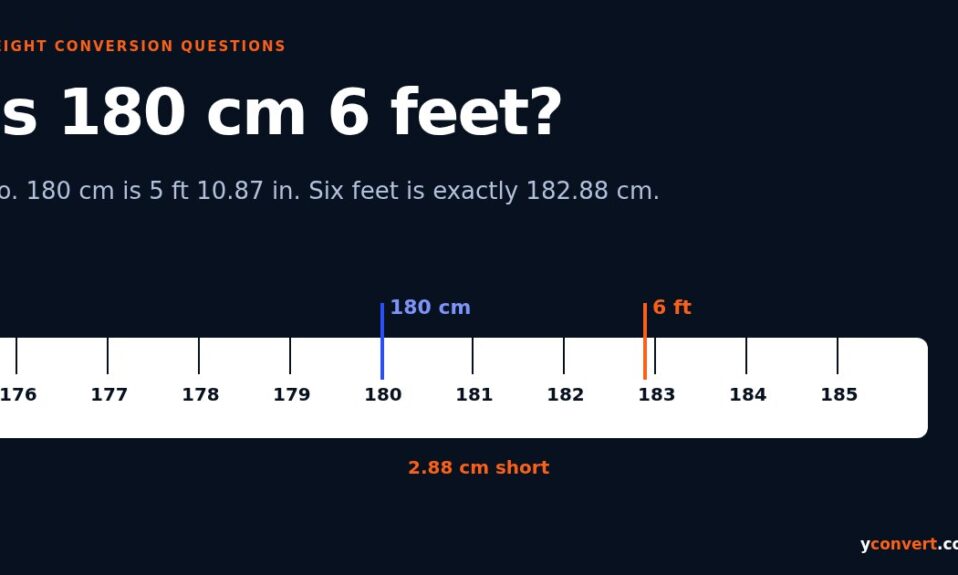
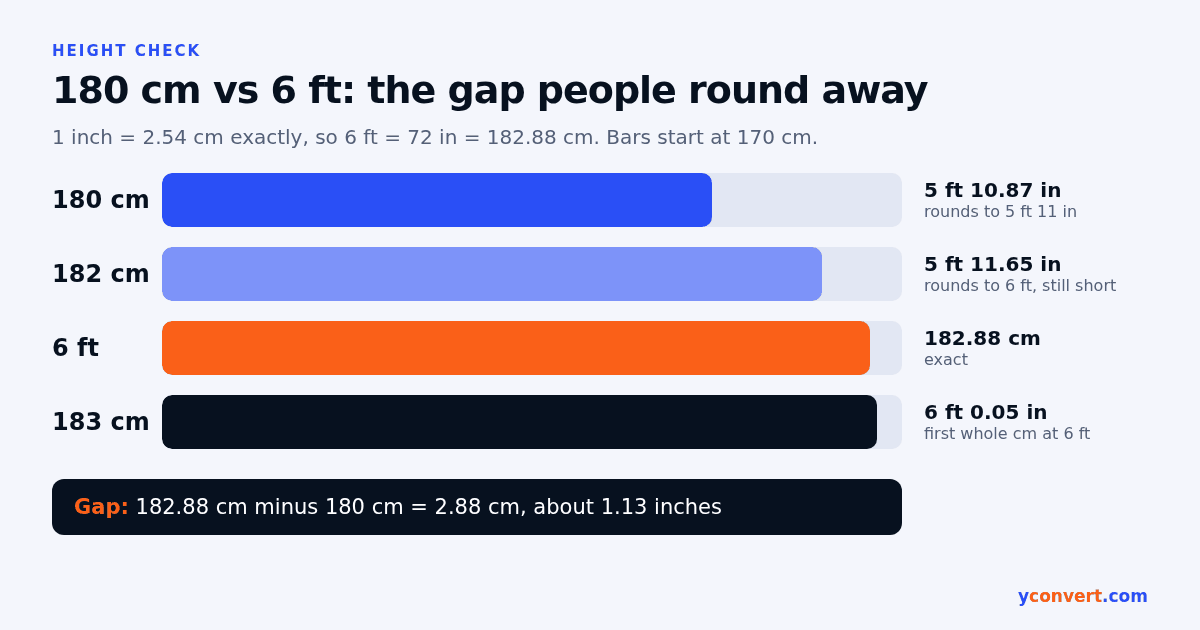
No, 180 cm is not 6 feet. It’s 5 ft 10.87 in, which most people round to 5 ft 11 in. Six feet is exactly 182.88 cm, so 180 cm falls 2.88 cm short, a little over an inch. If you want a whole number of centimeters that actually reaches 6 ft, the answer is 183 cm.
That one question comes up more than any other height conversion I deal with. I get why. In countries that measure in centimeters, 180 is the big round number. In countries that measure in feet, 6 ft is. People assume the two milestones are the same. They’re close. Not the same.
Below are the height questions I actually get asked, answered the way I’d answer a colleague. If you want the full step-by-step method instead, I’ve covered that in my guide on how to convert centimeters to feet. This one is about the awkward edge cases.
Is 180 cm 6 feet tall?
Short answer, again: no. Here’s the working so you can check it yourself.
One inch is exactly 2.54 cm. That’s a defined value, not a measured one, so there’s no rounding hiding in it. Six feet is 72 inches, and 72 × 2.54 = 182.88 cm.
Now go the other way. 180 ÷ 2.54 = 70.87 inches. Take out 60 inches for the first 5 feet and you have 10.87 inches left. So 180 cm is 5 ft 10.87 in.
Round that to the nearest inch and you get 5 ft 11 in. Not 6 ft. You’d need another 1.13 inches for that.
Honestly, the gap sounds tiny until you put it next to a requirement. An airline recruiting cabin crew might publish a height or reach rule in one unit while applicants measure themselves in the other. Someone who writes “about 6 ft” on the form because they’re “180” has overstated by more than an inch. That’s the sort of thing that shows up the moment a tape measure comes out.
Does 182 cm count as 6 feet?
This is where it gets interesting, and slightly unfair.
182 cm is 5 ft 11.65 in. If you round to the nearest inch, that becomes 6 ft 0 in. So on a dating profile, a team roster or a size guide that asks for feet and inches, 182 cm will usually show up as 6 ft.
But it isn’t 6 ft. It’s 0.88 cm under. If the rule is “at least 6 ft”, 182 cm doesn’t meet it, however the app chooses to display it.
So my answer depends on what you’re doing:
- Describing yourself: 182 cm rounds to 6 ft, and that’s a fair description.
- Meeting a minimum: 182 cm is below 6 ft. 183 cm is the first whole centimeter that clears it.
Why do 180 and 181 cm both show as 5 ft 11 in?
Because an inch is 2.54 cm wide, and centimeters only come in steps of 1. Every inch on the feet scale swallows either two or three whole centimeter values.
Here’s how it falls out when you round to the nearest inch. I built this from the exact factor, one band at a time:
| Shown as | Exact cm | Whole cm values that round to it |
|---|---|---|
| 5 ft 8 in | 172.72 | 172, 173 |
| 5 ft 9 in | 175.26 | 174, 175, 176 |
| 5 ft 10 in | 177.8 | 177, 178, 179 |
| 5 ft 11 in | 180.34 | 180, 181 |
| 6 ft 0 in | 182.88 | 182, 183, 184 |
| 6 ft 1 in | 185.42 | 185, 186 |
Notice 5 ft 11 in only gets two values. 5 ft 10 in and 6 ft both get three. That’s not a conspiracy. It’s just where the 2.54 cm bands happen to land against whole numbers.
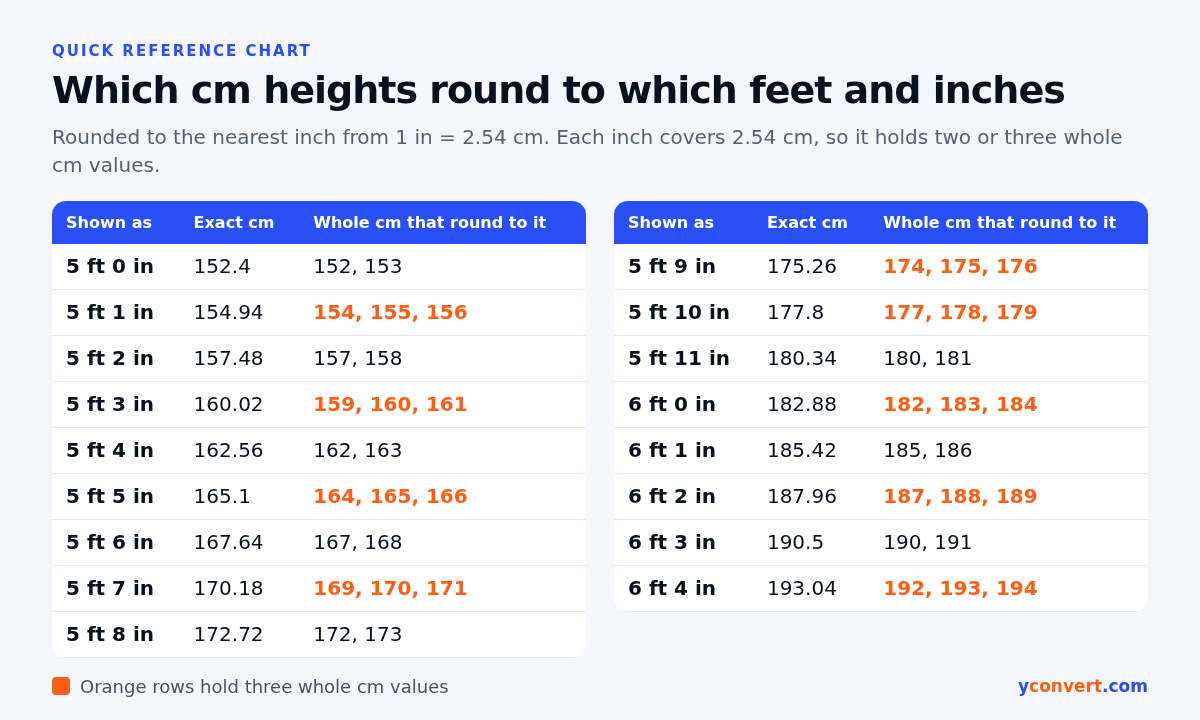
I find this table useful in a very practical way. A sportswear store selling online might build its size guide in centimeters and then add a feet-and-inches column for overseas shoppers. If they convert each centimeter value separately and round, two neighbouring rows end up with identical labels. Shoppers then wonder why 180 and 181 are listed as different sizes but the same height. Grouping by inch, the way the table does, avoids that confusion entirely.
Should I round my height up or down?
Nearest inch is the usual convention. Under half an inch, drop it. Half an inch or more, round up.
That said, not every system does this. Some software truncates, which means it just chops off the decimal. Under truncation, 182 cm becomes 5 ft 11 in instead of 6 ft. Same person, same measurement, a different number on screen.
This causes real head-scratching. Say a fitness app developer ships an update and users start complaining that their height “changed”. Nothing in their data moved. The new version simply switched from truncating to rounding, so everyone in the upper half of an inch band jumped up an inch overnight.
My own rule is simple:
- If there’s a minimum or maximum height involved, don’t round in your favour. Use the exact figure, or round toward the safe side.
- If you’re just describing yourself, round to the nearest inch.
- If a form asks for centimeters, give it centimeters. Don’t convert at all.
That third point gets ignored a lot. Converting twice (cm to feet, then the form converts back) adds a rounding step for no reason.
Which number should I write on a form?
The one the form asks for, measured in that unit if you can. That’s it really. But the decision has a few branches, so here’s how I think through it.
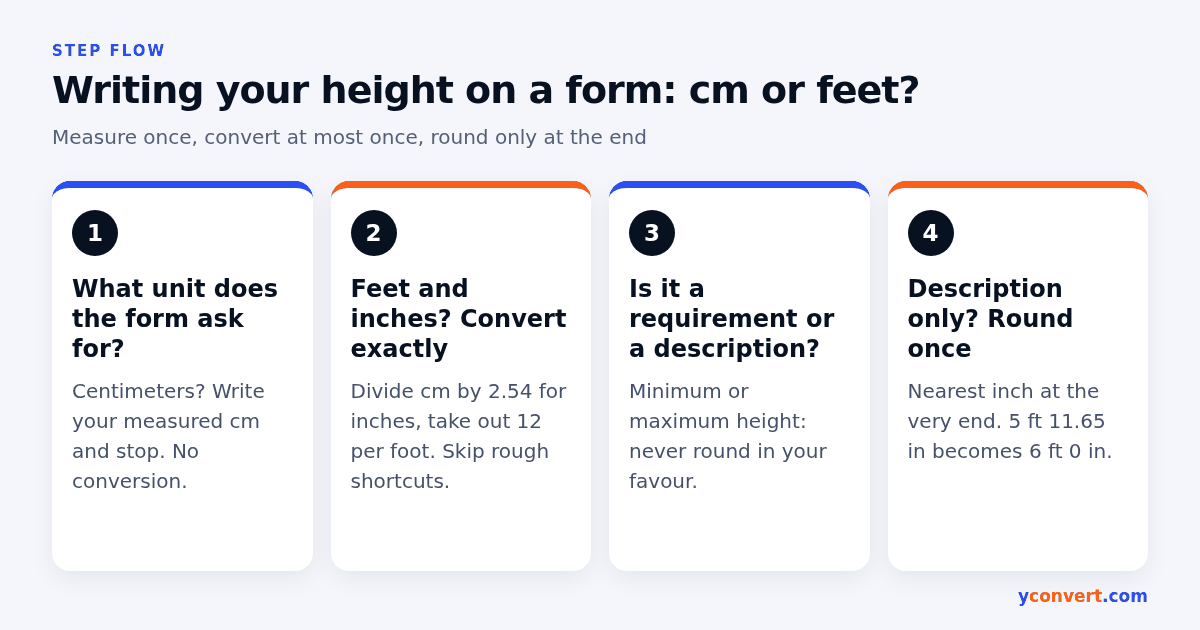
First, look at the unit the field wants. If it’s centimeters, write your measured centimeters and stop. If it’s feet and inches, convert from your centimeter measurement using 2.54, not a rough shortcut. Then check whether the height is a requirement or just a description. Requirements get the honest, unrounded-in-your-favour value. Descriptions can be rounded to the nearest inch.
An amusement park is a good example of why this matters. Ride height limits are checked against a measuring post at the entrance, not against what a parent typed into a ticket booking. If a child is right on the edge, the conversion on paper doesn’t help. The post decides.
Is 5.9 feet the same as 5 ft 9 in?
No, and this catches people out when an app shows decimal feet. 5.9 ft means 5 feet plus nine tenths of a foot. Nine tenths of 12 inches is 10.8 inches. So 5.9 ft is 5 ft 10.8 in, almost 5 ft 11 in.
180 cm in decimal feet is 5.906 ft, which is why some converters print “5.9 ft” for it. Read that as feet and inches and you’d think it was 5 ft 9 in. You’d be nearly two inches out.
How can I convert my height without a calculator?
I use an anchor and a step. The anchor is 6 ft = 182.88 cm, which I round to 183 in my head. The step is 2.54 cm per inch, which I treat as “two and a half”.
So:
- 6 ft 1 in is about 183 + 2.5 = 185.5 cm (exact: 185.42)
- 5 ft 11 in is about 183 minus 2.5 = 180.5 cm (exact: 180.34)
- 5 ft 10 in is about 183 minus 5 = 178 cm (exact: 177.8)
Going from centimeters, I do it backwards. 175 cm? That’s 8 cm under 183, roughly three steps of 2.5, so about 5 ft 9 in. The exact answer is 5 ft 8.9 in. Close enough for conversation.
A rowing club sorting new members into boats by height could do this on the dock with no phone in hand. For anything written down, though, I’d still use the exact factor.
A few heights people ask about by name
These are worked from 2.54 cm per inch and rounded only at the end:
- 5 ft: exactly 152.4 cm
- 5 ft 10 in: exactly 177.8 cm
- 179 cm: 5 ft 10.47 in, so 5 ft 10 in
- 183 cm: 6 ft 0.05 in, so 6 ft
- 7 ft: exactly 213.36 cm
A modelling agency that lists talent in both units is a nice place to see all this play out. A comp card that says “180 cm / 6 ft” is wrong on its face, and anyone booking from it on the feet number will get someone shorter than they planned for. “180 cm / 5 ft 11 in” is the honest pairing.
Quick tools for checking
If you’d rather not do any of this by hand, our cm to feet converter gives you the decimal feet instantly, and the feet to cm converter is handy for checking a feet-and-inches figure in reverse. For the leftover inches part, the cm to inches converter is the one I keep open. All free, nothing to sign up for.
FAQ
Is 180 cm 6 feet?
No. 180 cm is 5 ft 10.87 in, which rounds to 5 ft 11 in. Six feet is exactly 182.88 cm, so 180 cm is 2.88 cm (about 1.13 in) short of 6 ft.
How many cm is exactly 6 feet?
6 feet is exactly 182.88 cm. Six feet is 72 inches and one inch is defined as exactly 2.54 cm, so 72 × 2.54 = 182.88.
Is 182 cm considered 6 feet?
182 cm is 5 ft 11.65 in. It rounds to 6 ft when you round to the nearest inch, but it is still 0.88 cm under 6 ft. For a minimum of 6 ft, 183 cm is the first whole centimeter that qualifies.
Why does my height show differently in two apps?
One app is probably rounding to the nearest inch and the other is truncating, or one shows decimal feet. 182 cm rounds to 6 ft 0 in but truncates to 5 ft 11 in, and 5.9 ft means 5 ft 10.8 in, not 5 ft 9 in.
Should I round my height up on a form?
Use the unit the form asks for. If it asks for centimeters, give centimeters with no conversion. For a minimum height requirement, do not round in your favour. For a simple description, rounding to the nearest inch is the usual convention.