Last updated: November 2026
For most small businesses, local SEO comes first and AEO comes straight after, because the second depends on the first. If your Google Business Profile is half finished, your address differs between directories and your service pages never say what you actually do, no answer engine has much to work with. Fix the facts, then shape the answers. I use the SEO and AEO page audit to see which side of that list a page is failing on before I touch anything.
That order surprises some owners. They hear that people now ask chatbots for recommendations and assume the old work is finished. It isn’t. The way people reach the information has changed a lot. The information they need has barely changed at all.
What each one actually covers
Local SEO is the work that helps a business show up when someone searches with local intent: the map results, the business profile, the local organic links. It leans on your profile, your reviews, consistent listings and pages that clearly describe services and areas.
AEO, answer engine optimisation, is about being the clear, quotable source when someone asks a question and expects an answer rather than a list of links. That could be an AI Overview, AI Mode, a chatbot with search, or a voice assistant reading out a reply.
They overlap more than the acronyms suggest. I wrote a longer take on that in AEO vs SEO: is it worth treating them separately, but the short version for a local business is this: AEO is mostly local SEO with better answers written on top.
Why local SEO still goes first
Think about how someone hires a pest control company. They search, glance at the map results, read a few recent reviews, maybe check photos, and then tap the call button. Often they never visit the website at all. That journey still runs heavily through Google’s local results, and a chatbot can’t shortcut it if it doesn’t trust the basic facts.
Here’s the part people miss. An AI system can’t make up a local business. When it recommends one, it has to pull the name, location, services and reputation from somewhere: your site, your profile, directories, reviews, local coverage. If those sources disagree, or say very little, you’re a weak candidate however clever your content is.
So the foundation does double duty. A complete profile and consistent listings help you in the map pack, and they give answer engines facts they can verify across more than one source.
| Area | Local SEO job | What it gives AEO |
|---|---|---|
| Business profile | Ranking in map results | Confirmed hours, category, services |
| Name, address, phone | Trust between listings | Proof the business is real and where it is |
| Reviews | Click and call decisions | Real language about what you do well |
| Service pages | Relevance for local searches | Specific facts to quote in an answer |
| Crawl access | Pages get indexed | Pages can be fetched for AI answers |
The local SEO fixes I’d make this month
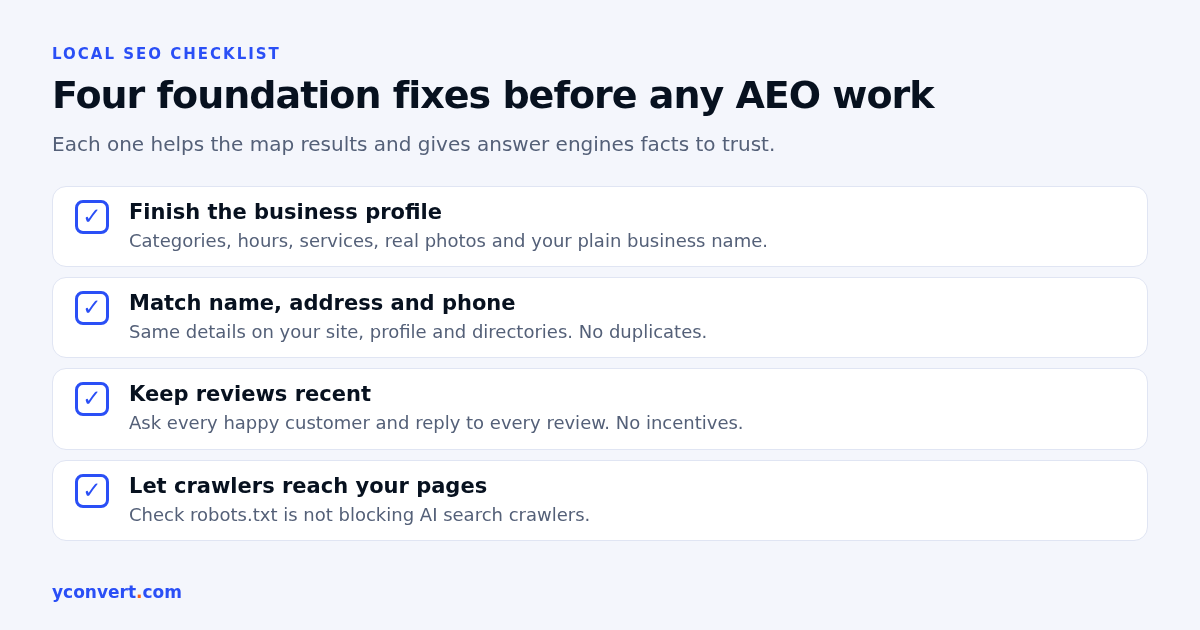
Finish the business profile properly
Fill in every section that applies: primary and secondary categories, hours, service areas, services, products and the Q&A. Use your real business name with no keywords stuffed into it. Google’s guidelines don’t allow that, and I’ve seen profiles get suspended for it, which wipes out far more visibility than the extra words ever brought in.
Add real photos. A car detailing business should show its own van, its own team and actual finished jobs, not stock images. Post updates now and then so the profile looks cared for.
Make your listings agree with each other
Check your name, address and phone number on your website, your profile, the big directories and any industry listings. Old addresses, a second phone number someone added years ago, missing hours on one site. Each mismatch is a small reason for a system to hesitate. Remove duplicates while you’re there.
Keep reviews coming, and reply to them
Recent reviews carry more weight with real customers than a pile of five stars from years ago. Ask every happy customer, send a direct link, and make asking part of your routine after a job rather than something you remember once a quarter. Reply to every review, including the one-star ones, calmly and briefly.
One caution. Don’t pay for reviews or offer discounts and prize draws in exchange for them. Google’s policies prohibit incentivised reviews, and the risk isn’t worth it.
Check that crawlers can reach you
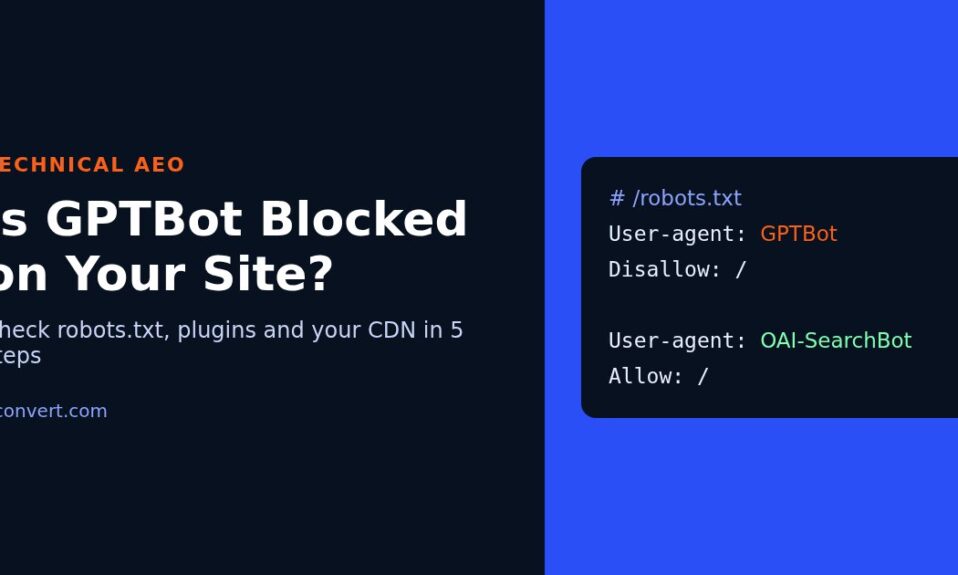
This one takes two minutes. If your robots.txt blocks the crawlers that AI search tools use, you can be excluded from their answers entirely. OpenAI, for example, states that sites blocking its search crawler won’t appear in ChatGPT search answers. My guide on checking whether GPTBot is blocked in robots.txt walks through what to look for.
Then the AEO layer: answers people can actually use
Once the facts are solid, I move to the questions. Not keywords. The questions customers ask on the phone, at the counter, in emails.
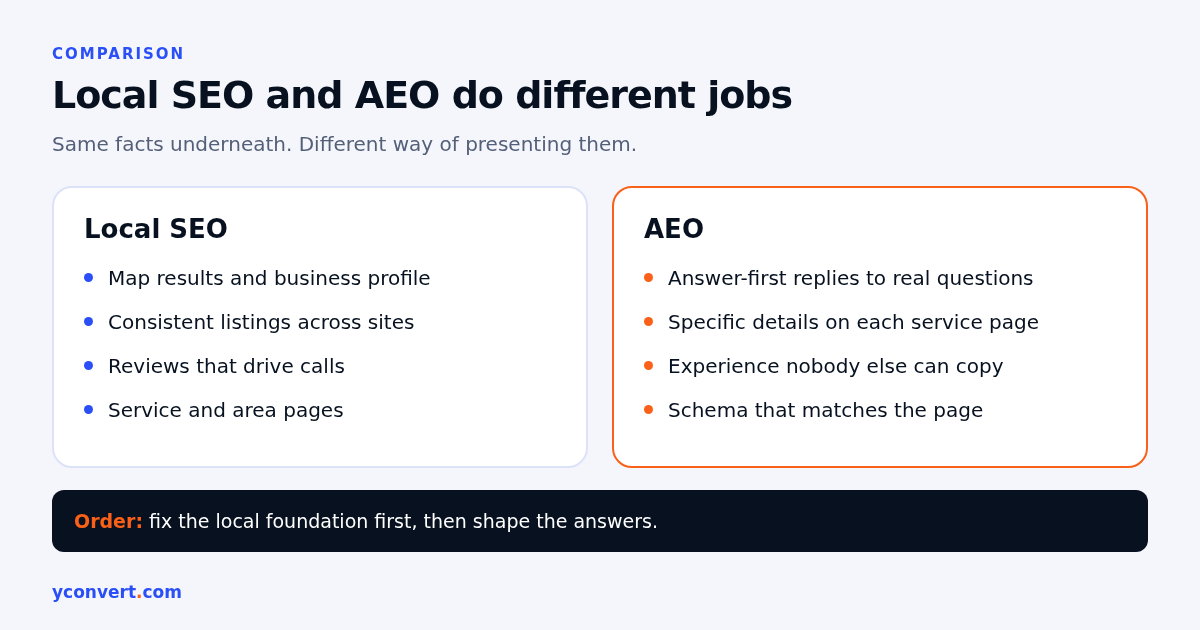
A physiotherapy clinic hears the same ones every week. Do I need a referral? How many sessions will a sore shoulder take? Can I come in during my lunch break? Every one of those deserves a plain answer somewhere on the site, ideally on the relevant service page rather than buried in a single general FAQ page.
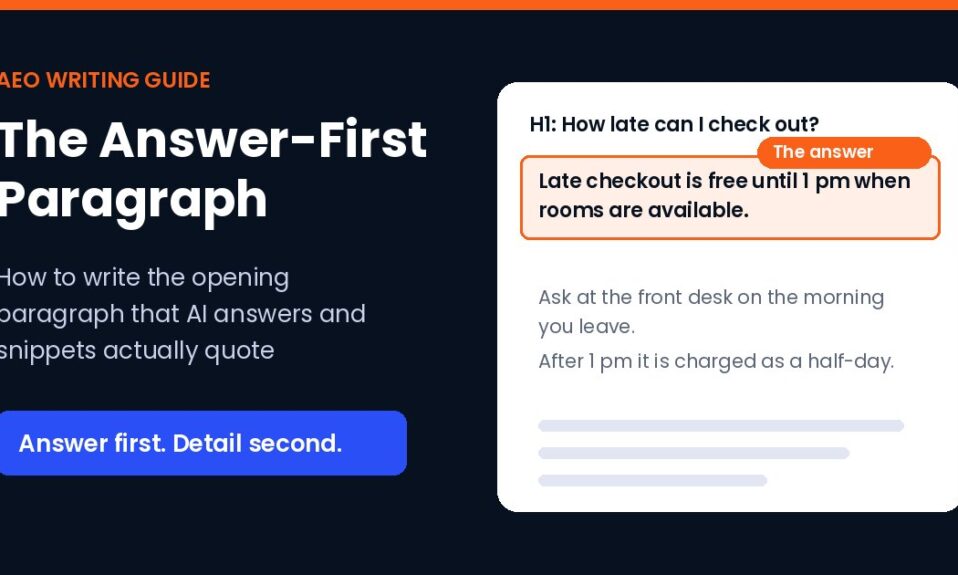
Answer first, then explain. If the question is whether a referral is needed, the first sentence should say yes or no and when. The background can follow. I go into the structure of that opening in how to write an answer-first paragraph.
Be specific about what you do
AI search tends to break a long question into smaller pieces and look for each one. Someone might ask for a bakery nearby that makes eggless birthday cakes and can deliver the same day. If your site never mentions eggless cakes or same-day delivery, you can’t match that request, even if you do both every week.
You don’t need a page for every phrasing. You do need the important facts written down somewhere a crawler can read them. Services, exceptions, areas, timings, what you don’t do. That last one matters more than people think, because it makes your page more trustworthy as a source.
Write things only you know
Generic copy like “quality service, customer first” tells a reader nothing and tells an answer engine even less. What helps is experience. A tutoring centre explaining the mistakes it sees most often in a particular exam, or how it groups students who join halfway through a term. That’s content nobody else can copy from a thousand other sites, and it’s exactly the kind of detail that gets picked up in a generated answer.
Add schema, but don’t chase tricks
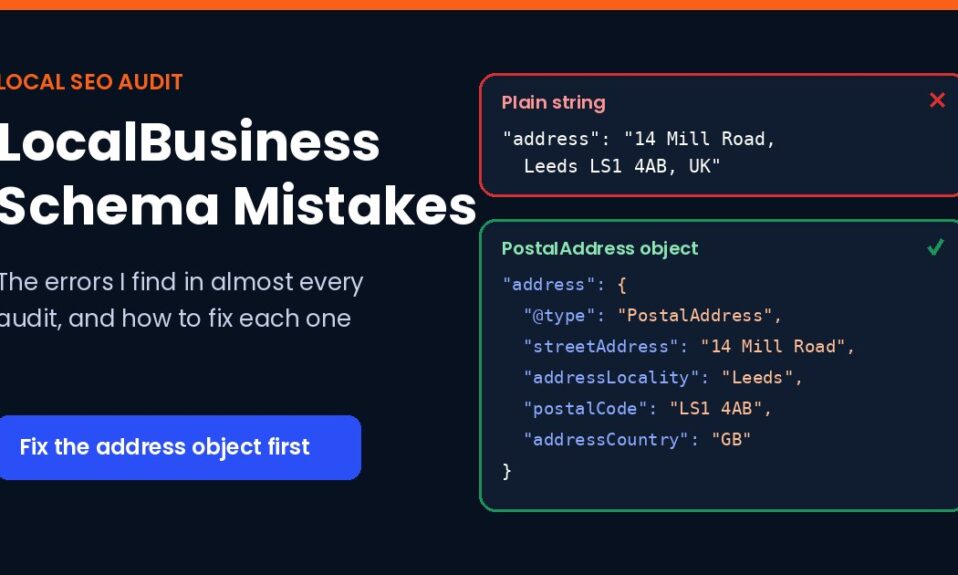
Structured data such as LocalBusiness markup helps confirm your details, as long as it matches what’s on the page. I’ve listed the errors I see most in LocalBusiness schema mistakes. Beyond that, be wary of anyone selling a special file or special markup as essential for AI visibility. Google’s guidance for its AI features says there are no extra technical requirements beyond being eligible for normal Search. Do the useful work first.
A simple order of work
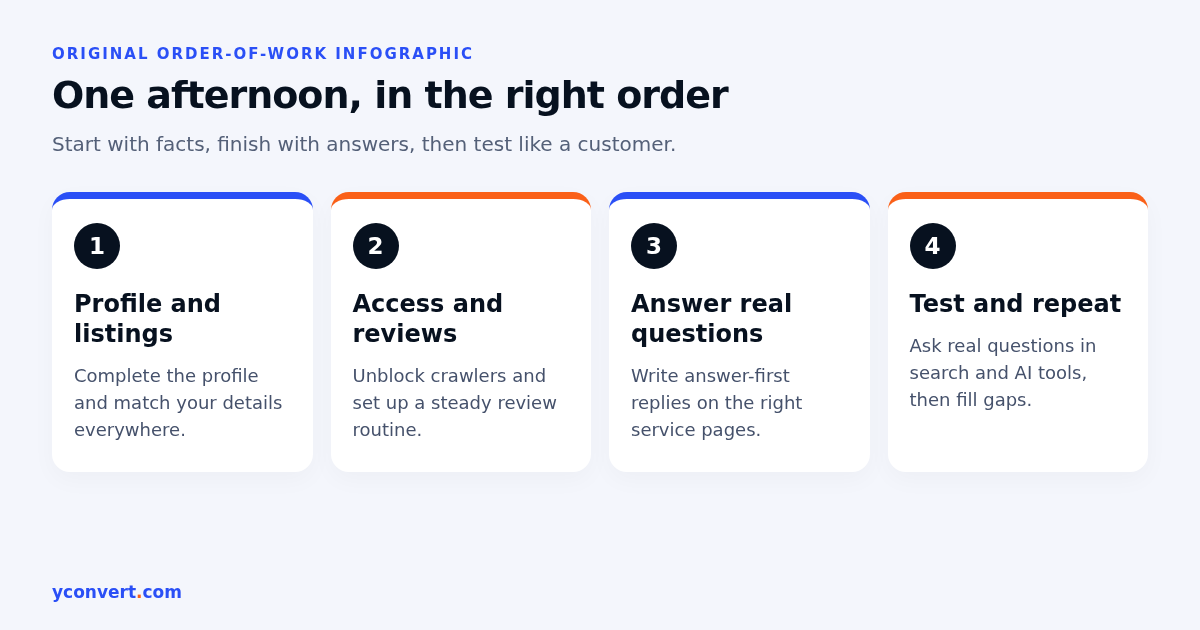
If I had one afternoon with a small business site, I’d go in this order:
- Fix the profile and the business name.
- Match name, address and phone everywhere and remove duplicates.
- Confirm crawlers aren’t blocked.
- Set up a steady way to ask for reviews and reply to them.
- Write answer-first replies to the ten questions customers ask most.
- Add specific service details and one piece of genuine experience per key service.
- Add or correct LocalBusiness schema.
Then test it the way a customer would. Type three or four real questions into Google and two or three AI tools, save what comes back, and note what’s missing from your own pages. Results move around, so don’t obsess over a single check. Look for gaps you can actually fill.
How I know it’s working
I track the local side through the business profile’s own insights: calls, direction requests, website clicks. For the answer side, I keep a small list of questions and re-run them every few weeks, noting the date and which sources get cited. It’s rough, and I treat it as observation rather than proof. Still, when the fundamentals are fixed, I usually see local visibility improve first and answer citations follow later.
If you want a quick read on where a page stands, the audit gives you 1 free credit, then reports are $2 each, 10 for $15 or 20 for $20.
FAQ
Should a small business focus on local SEO or AEO first?
Local SEO first. A complete business profile, consistent listings, reviews and clear service pages give answer engines the verified facts they need. AEO then improves how clearly those pages answer real customer questions.
Does AEO replace local SEO?
No. Answer engines draw on the same sources that local SEO improves, such as your website, business profile, listings and reviews. AEO builds on that foundation rather than replacing it.
Do I need a special file or schema for AI search?
Google says its AI features have no extra technical requirements beyond normal Search eligibility. Accurate LocalBusiness schema is still useful, but it should match the visible page.
Can I offer customers a discount for leaving a review?
Google’s policies prohibit incentivised reviews. Ask every satisfied customer, make it easy with a direct link, and reply to the reviews you receive.
How can I check if AI tools mention my business?
Ask the same real customer questions in Google and a few AI tools, record the date and cited sources, and repeat every few weeks. Treat the results as trends, not exact rankings.